History of the East - Part 1
Continuing the history of Thiusland series, this week is part 1 of the History of the East, where we'll explore the origins of the bogs of the East, the land of the lizardfolks.
The bogs of the east form an area of livable land between the plains and the rocky ridges that denote the easternmost edge of Thiusland. Surrounded by mountainous and rocky ridges on all sides, it’s a moist area of wet and foggy winters, hot and humid summers and otherwise rainy weather covered by large areas of dotted thin forests and many placid bogs. Such a place is favorable to insects, birds and reptiles of many kinds, so much so that it became a hub of power to the first government of Thiusland.
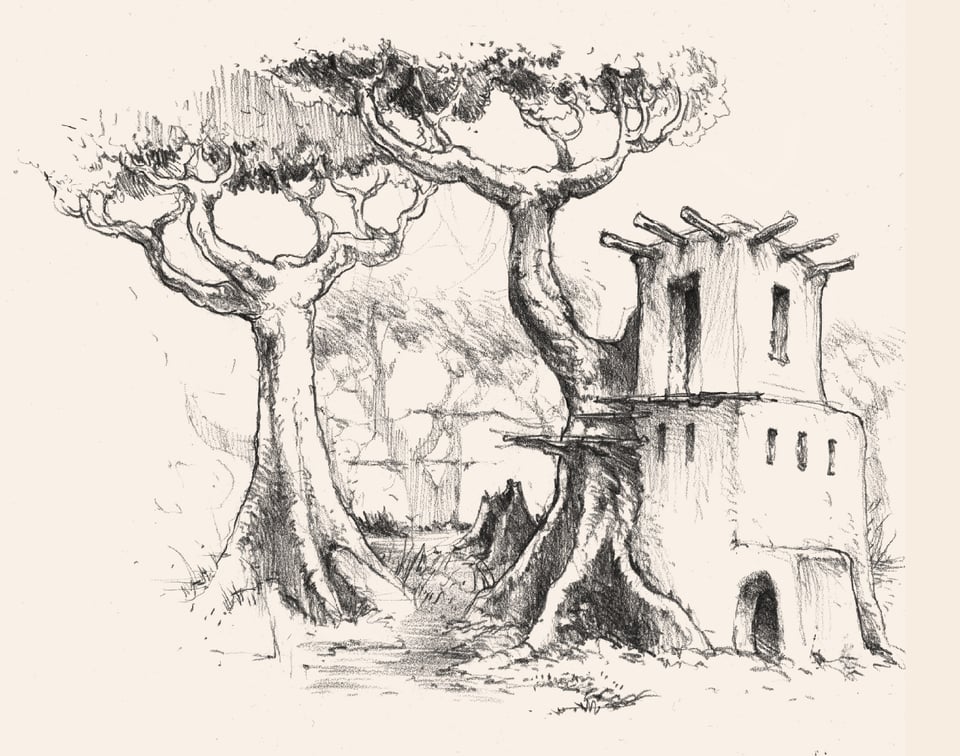
History of the bogs community
History Long Past
Long long ago, as was all of Thiusland, the east was the domain of gigantic elemental beings. The area was then mostly covered by a large lake inhabited by earth and water giants who slowly shaped the land closer to what it is now. But when a great fire threatened the great Urboral tree, the giants rallied against it, and fought fiercely in an attempt to save the primeval tree, sadly to no avail. Most of the water elementals perished in the battle and the remaining earth giants, overrun by sorrow, laid down in defeat on the eastern edge of what is now called the plains and the north, forming the great mountain chain that now borders the bogs. Although most of the earth elementals fell into a deep slumber, not all of them rested. Slirabh, the giant serpent of rock and stone whose body makes up a jagged mountain range rising a hundred meters high into the sky, was still awake. Its sorrow gave it a purpose, and inhabited by that purpose, it stands as a guardian of the nature of Thiusland against all forces who might threaten it.
Some time passed, and some tenacious and magic-welding lizards, escaping from the clutches of the dragons ravaging their homeland, made the journey across the shifting stones on the back of Slirabh to end up at the bogs of the east.Thirty or so lizardfolk, members of two families, who joined together for the journey traveled in relative harmony. Their voyage was well chronicled by Zliphia, who made great mention of the cooperation between the two families, freely sharing their spells in a way wizards of their homeland never did. This uncommon collaboration was instrumental to their survival. While only ten of the original travelers made it, the ones who did found welcoming wetlands filled with insects, open land, and tree cover that was like paradise to them.
The ten original survivors of the journey were split between two families; the Viparas and the Skinks. Those who considered themselves a part of the Skink family settled down early on and built a small village in a protected glade away from the rocky ridges. The Vipara on the other hand, after some debate, gathered some supplies and grew their numbers over eight years in preparation for an expedition far into the bogs.
During their journey, the Vipara first went west, using the stars as a guide. At this time, Thiusland was ruled by beasts, giants were in their early years and elves still roamed freely. As they would rest at night around a campfire, the lizardfolk were reading the stars and interpreting their celestial secrets which they used to deepen their folk magic practice.
Unbeknownst to them, the elves were watching and following the lizardfolk along their journey, marveling at their ingenuity in star-reading and spell craft that seemed to come as second nature to them.They were also pleased with the diplomacy they demonstrated when meeting the snakes of the eastern hills, which we now know as slitherskins, and how quickly the two found an understanding.
Back at the foot of the mountains, the Skinks had built wooden walls and fences around their shelters, taking the wood from a forest they found north. From that fort they would venture out and hunt large insectoids to sustain themselves and gather materials and plants from the woods. They quickly became skilled hunters in the treacherous bogs and saw martial prowess as a paragon of value. Storytelling and the gathering of knowledge grew in importance in their culture, for hunting routes and fighting techniques could be shared through stories, as well as preserved in intricate sculptures that would illustrate the best hunting routes. In three decades, they had built a system of marks inscribed on bark that would be the basis of the written Repitilenoid language and the first form of writing in Thiusland.
Around the third decade, the Vipara were now on the southern shore and were met by an elven spirit accompanied by strange pink skinned and hairy creatures they called gnomes. The elves insisted that the lizardfolk bring the gnomes with them back to their main city in the east, as they could teach them lots. The Vipara gladly accepted as their curiosity towards these people was unmatched, and together they started the long walk back home. Along the journey the gnomes spoke of their inventions and ways of farming, techniques and concepts the likes of which the Vipara had never heard of, and the gnomes observed as the magical acuity of their hosts never ceased to amaze them. The Vipara returned thirty six years from the day they left to the glade and introduced the gnomes to the few Vipara who stayed behind and now lived on the outskirts of the grand fortress of the Skinks: Xedoc.
To be continued...

