
Monthly Musical Miscellany – June 2026

Hey folks,
Summer's all over us, I’m mostly made of sweat and the piano lid is getting too heavy to lift.
Time to sit a dark corner and read this month’s musical miscellany.
To quote my dear friend, Super Mario… HERE WE GO!
Studio Notice: Summer Holiday Booking Times
As many of you know, I'll be away for a much-needed lie-down over the summer. But, as is tradition, I'll be cracking the studio open for one week for anyone wanting a quick catch-up lesson before September.
Booking runs from Saturday 1 August to Friday 7 August 2026 — Sunday included.
Contact me privately to book, or sort yourself out on the online portal. Slots will be available from Monday.
Policy Update: Autumn Lesson Rates Rise
A quick note. From 1 September, adult lessons go up — by a pound for most, fifty pence for concessions. Partly inflation, partly my ongoing war with petty cash and the small mountain of shrapnel it generates.
So: adult lessons will be £30, or £25 concessions. Children's rates stay exactly where they are.
For The Record – An Incomplete History of Music
The sort of project in another life that I would have loved to have made.
Nothing less than a sprawling multi-part documentary about the entire history of music in the vein of something like ‘Civilisation’ by Kenneth Clark. The fact it’s all being released for free is even more astonishing.
This should be required watching in all schools and couldn’t come at a better moment.
The New 2027 ABRSM Syllabus, Taken Apart
A long, detailed and rather pointed review of the new ABRSM piano syllabus (2027–28), from the Heart of the Piano channel.
The argument, briefly. Pop, jazz and film arrangements have been creeping out of List C and into Lists A and B, to the point where in some grades a candidate can now pass an ABRSM exam without playing a single classical piece. This is set against the wider "decolonising the curriculum" push that's reshaped every exam board since 2019 — broader representation of women and non-white composers, which he's for (as am I), but a sound point is made that ABRSM is not where people go for a diverse, cutting-edge curriculum. They go there for a traditional classical education. It exists as part of a wider ecosystem, alongside Trinity, LCM, ABRSM jazz and the popular new Rockshool grades, each offering different perspectives and strengths.
The video argues that the content shake-up here is problematic, as it is offering many badly abstract arrangements of non-classical music that are simply not enjoyable to play, don’t make sense, and are not meant to be presented in a classical format.
The deeper worry: ABRSM functions as a de facto national curriculum for some teachers (it shouldn’t, but that’s the way it is), so teachers will simply march students from grade to grade using the material in these books, which are now trying to do everything, but in doing so, don’t do any of it particularly well. Meeting students where they actually are, and a wider repertoire, are not the same thing as lowering the bar.
Jacques Loussier Plays Bach
I love a weird discovery like this. Jacques Loussier (1934–2019) was a French pianist who, in 1959, hit on the idea of using Bach as a scaffold for jazz improvisation. With Pierre Michelot on bass — a Django Reinhardt alumnus — and Christian Garros on drums, the Play Bach Trio sold something north of six million records and clocked up thousands of concerts. Purists sniffed. Everyone else bought tickets.
The origin story is the lovely bit. As a student at the Paris Conservatoire, his memory failed him mid-prelude, so he improvised his way out — and reasoned afterwards that he wasn't desecrating anything, since the eighteenth-century players, Bach very much included, were formidable improvisers themselves. He was following tradition, not vandalising it.
(And if you're British and of a certain age, you already know his ‘Air on the G String’ sold Hamlet cigars on the telly for the better part of thirty years.)
On Music and Bodies
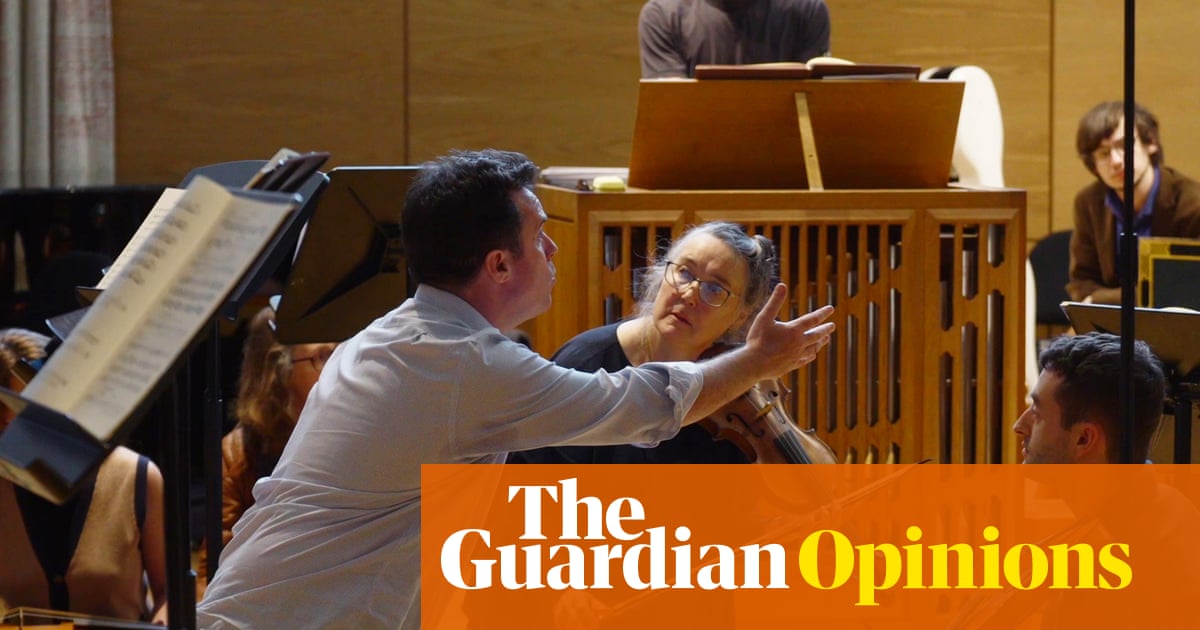
Making earwax melt and teeth rattle: the project returning music to our bodies | Classical music | The Guardian
Listeners in the 17th and 18th centuries experienced music in a startlingly vivid – and physical way. A fascinating academic project is wondering if we should let ourselves be much more moved, and get moving. Plus: a prime minister’s musical legacy?
Great piece here on the work of Bettina Varwig, professor of music history at Cambridge, and her book Music in the Flesh.
Varwig’s argument is that we've inherited a mind-body split that early music-makers simply didn't have. In the seventeenth century, music was understood as a full-body event, something that moved the humours, stirred the blood, worked on you physically as much as mentally. Body and soul, tangled together.
What I find genuinely exciting is what she does with it. Rather than leaving this as a footnote in a monograph, she's been staging it: performances of Bach's St John Passion in which the singers work off-book, share parts, and move when the music moves them — the static, reverent, sit-still-and-clap-at-the-end concert format quietly dismantled. The idea of handing players and listeners back a more embodied role in the music, instead of pinning them to chairs, is exactly the sort of thing I wish more of our institutions had the nerve to try.
OK Computer 64
A few things dominated my formative years in the 90s, and two of them are combined ingeniously here: a complete recreation of Radiohead's OK Computer, built entirely from the sound-font packs of classic Nintendo 64 games.
It's probably the nostalgia talking. But there's something strangely engaging about this in our erstwhile AI-assisted end times — and it should be said that pulling something like this off, as deftly as it's been done, takes considerable musical skill.
It's passionate, pointless, beautifully-made projects like this that give me brief respite from otherwise hating the internet entirely.
Sárán Mulligan & Muirine Nic Róibín
Some exceptional folk music to finished with.
Sárán Mulligan and Muirine Nic Róibín are a folk duo based in Dublin who blend concertina with fiddle and clarinet, sprinkling traditional-feeling tunes with often surprising harmonic and melodic choices.
Beautifully shot and presented, to boot.
Have a great weekend one and all!
Will