PGB California June 2021 Newsletter
Salam Perguruan,
It’s time for another community update. Not too much going on at the moment, but we have a community Town Hall coming up this month!
Announcements
Community Town Hall June 26th
Please join us for our next all community meeting on June 26th from 10:00-11:30AM PDT. Staff will present updates on formalizations of our organizational structure for community comment. Look out for another notice with Zoom details and an agenda the week before.
Class Schedule
Visit the website for an up-to-date class schedule for Tao Kung and Silat.
Science Corner
Guru on the essence of movement
On May 2, 2000, Jaida asked Guru: How does a student know when they have learned what you want them to learn?
Kim: “How does a student know when they have learned what you want them to learn, in the long movement, for example?…Is there some > conscious knowledge, something that can be understood in words, when you understand the movement?”
Guru: “No. You get the essence after you do it a long time.”
Kim: "How do you know you have the essence?”
Guru: "It is achieved when there is no heavy breathing, no emotion comes up, when you can do it slow, smooth.”
Kim: "Even though doing it full?”
Guru: "Yes. This happens when you are able to do it with your internal rhythm. Each person is different, has a different rhythm: > rough or soft, romantic…. But you can't talk about it until you have the essence. People talk too much about the long movements. It's like a glass. One > person is talking about the glass it's made of, another the shape of the glass, the colors on it, or someone is talking about what's > inside the glass, or is it empty or full. They all think they are talking about the same thing, but they aren't. Just making > confusion. Only after you know the movement, the essence, can you talk about the whole, like knowing all about the glass, inside > and out, shape and character. After you have the essence, then you can discuss the long movement with others who also know the > essence of the movement. Only then do you know."
Kim: "Like the blind men and the elephant?"
Guru: “Yes. Silat is like a house. You can stand on the outside of a beautiful house and discuss what you imagine is inside. But > you must enter the house to know what is inside.
Entering the house: that is the essence of long movement. Long movements allow you to enter the house.
But you can talk about short movements. Short movements are the blueprint for the house. With short movements, you learn balance, > position, strength, and technique. Technique very important.
And ambilan is like being a civil engineer. That's where you learn to build the house, choosing what is effective. You can talk about short movements and ambilan, but not about long movements."Kim: “What about liong bun?"
Guru: “You can't talk about liong bun. If long movement is entering the house, liong bun is deciding where to put the sofa. You > have a beautiful sofa, but where should it go so the house is even more beautiful?
And tui ciu is what kind of sofa: what color, what size, what shape, and so on, that best fits the house.
You can't talk about long movement, liong bun, or tui ciu. But you can talk about short movement and ambilan.”Kim: “Where does keterampilan fit in?”
Guru: “Stimulation. Keterampilan is the garden. Without a garden the house is lifeless. Only brick. Before you build the house, you > have to look at the garden."
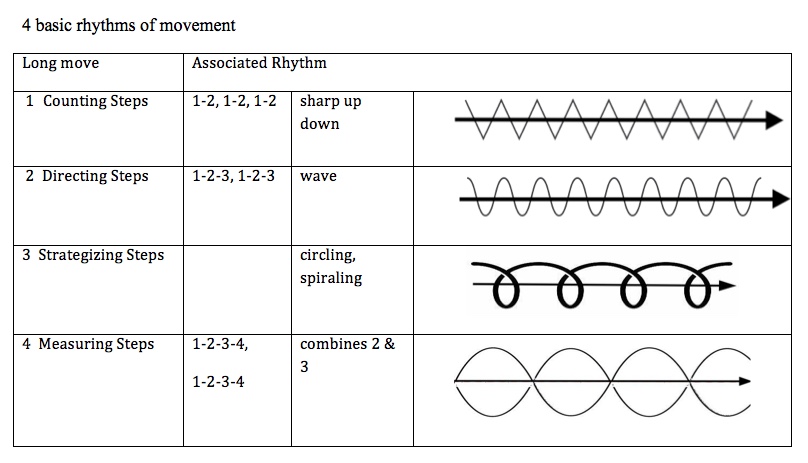
For more to contemplate on rhythm, Jaida has compiled a chart for the types of rhythm found in the first 4 long movements of the standardization:
Get Involved
If you're interested in getting more involved to help PGB California grow and thrive, we'd love to have you! Currently we are looking for a volunteer to help manage the monthly newsletter. Get in touch at org@bayareawhitecranesilat.com and we'll tell you more.
That’s a wrap for this month. See you soon on the Zooooom. And watch out for snakes!
Organization Staff
Ross, Jeanette, Eric, Alison, Jennifer