#### article
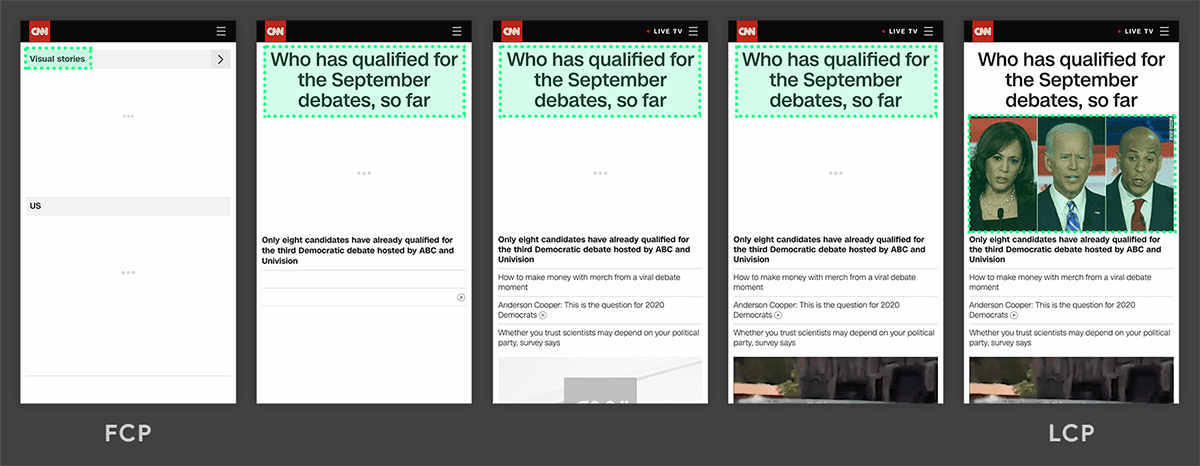
## Measure when crucial content has been loaded
First Contentful Paint or First Meaningful Paint can help establish when text is visible. So far, there hasn’t been a metric focusing on pinpointing when media, which often *is* also primary content, becomes available. In his article, [Phil Walton](https://twitter.com/philwalton) explains a new performance metric—**Largest Contentful Paint**.
[Largest Contentful Paint →](https://web.dev/largest-contentful-paint/)
#### article
## Understand why TTFB matters
Time to First Byte is an often overlooked metric. Touching on the back-end but also ops territory, understanding what affects it and how to debug slowdowns can require a thorough understanding across the whole stack. Here, [Harry Roberts](https://twitter.com/csswizardry) demystifies TTFB and how to work with it.
[Time to First Byte: What It Is and Why It Matters →](https://csswizardry.com/2019/08/time-to-first-byte-what-it-is-and-why-it-matters/)
#### article

## Load CSS without delaying page rendering
CSS can easily have a huge impact on performance. Inlining critical CSS is a well-established technique that aids with mitigating this problem. But how do we go further and serve the remainder of our styles asynchronously? [Scott Jehl](https://twitter.com/scottjehl) has a simple solution.
[The Simplest Way to Load CSS Asynchronously →](https://www.filamentgroup.com/lab/load-css-simpler/)
#### media

## Learn how to test your sites for mobile experience
Performance advice on Instagram? Sign me up! [Addy Osmani](https://twitter.com/addyosmani) started sharing short and actionable articles—the first one describes how to effectively understand the experience of your customers using mobile devices.
[How fast is your site on mobile? →](https://www.instagram.com/p/B0zvl54BfrD/)
#### tools
## Find out how annoying typing delay can be
[Monica Dinculescu](https://twitter.com/notwaldorf) is known for her ridiculously fun, awesome and educational projects. This time, her demo portrays how frustrating user interaction can become once delayed even a few milliseconds.
[delay experiment →](https://input-delay.glitch.me)