Spade shape with cobalt blue background

Performance Newsletter

Archives
Calibre Monitoring
Free Speed Tools
Log in
Subscribe
24 April 2024

⚡ 150: How web bloat affects slow devices

͏ ͏ ͏ ͏ ͏ ͏ ͏ ͏ ͏ ͏ ͏ ͏ ͏ ͏ ͏ ͏ ͏ ͏ ͏ ͏ ͏ ͏ ͏ ͏ ͏ ͏ ͏ ͏ ͏ ͏ ͏ ͏ ͏ ͏ ͏ ͏ ͏ ͏ ͏ ͏ ͏ ͏ ͏ ͏ ͏ ͏ ͏ ͏ ͏ ͏ ͏ ͏ ͏ ͏ ͏ ͏ ͏ ͏ ͏ ͏ ͏ ͏ ͏ ͏ ͏ ͏ ͏ ͏ ͏ ͏ ͏ ͏ ͏ ͏ ͏ ͏ ͏ ͏ ͏ ͏ ͏ ͏ ͏ ͏ ͏ ͏ ͏ ͏ ͏ ͏ ͏ ͏ ͏ ͏ ͏ ͏ ͏ ͏ ͏ ͏ ͏ ͏ ͏ ͏ ͏ ͏ ͏ ͏ ͏ ͏ ͏ ͏ ͏ ͏ ͏ ͏ ͏ ͏ ͏ ͏
 
Performance Newsletter
[issue ]()150
 
#### Editor’s note
 
The first article in today’s issue covers a web performance angle I’ve been thinking and sharing about for a while. Speed is far from being single dimensional. Just because 4G, 5G, and fibre speeds exist, it doesn’t mean web performance has been solved (not mentioning that the definitions of those speeds themselves can be vastly different).
 
Slow devices are incredibly common, and while a good network can help download assets faster, it doesn’t address processing ever-growing JavaScript bundles. Quickly, the web becomes unusable if you don’t own a $2000+ device released within the last year. Are we going to accept gatekeeping essential services on the web, as well as the wealth of information it has to offer, based on socioeconomic factors and disposable income?
 
Karolina


#### What’s Performance newsletter?
 

Performance Newsletter is a fortnightly mailing by [Calibre](https://calibreapp.com), featuring web performance tools, talks and resources.

Don’t worry—we don’t spam. If you’d like to leave, [unsubscribe]() at any time. Suggest content [here. ](mailto:[email protected])


# Articles  
 
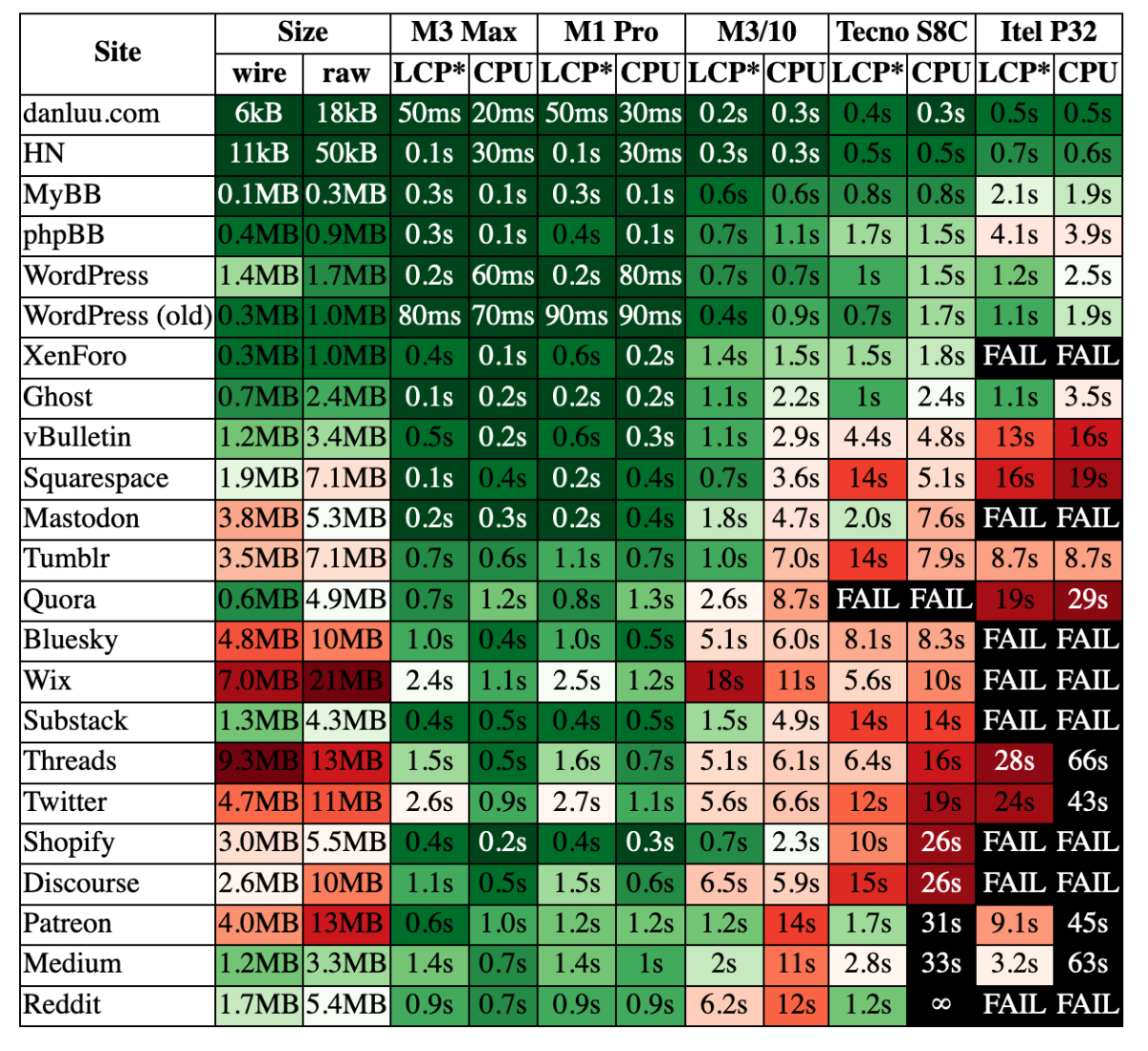
Table showing a list of popular websites, their size, and then load times across different CPUs
 
### [How web bloat impacts users with slow devices](https://danluu.com/slow-device/)
 
[Dan Luu](https://danluu.com/)
While the internet speeds are scaling up, the market share of high-end devices isn’t following at the same ratio. Here’s why faster connectivity often doesn’t mean a faster user experience.
 
The same headline and text snippet rendered in two, side-by-side boxes for Windows & Apple and then Android systems. While the body text is similar, the heading is rather different.
 
### [Are web-safe fonts still relevant in 2024?](https://pimpmytype.com/web-safe-fonts/)
 
[Oliver Schöndorfer](https://pimpmytype.com/)
Remember using web-safe fonts to ensure consistency across different operating systems? Let’s check if this is still a beneficial approach, even more so for performance reasons.
 
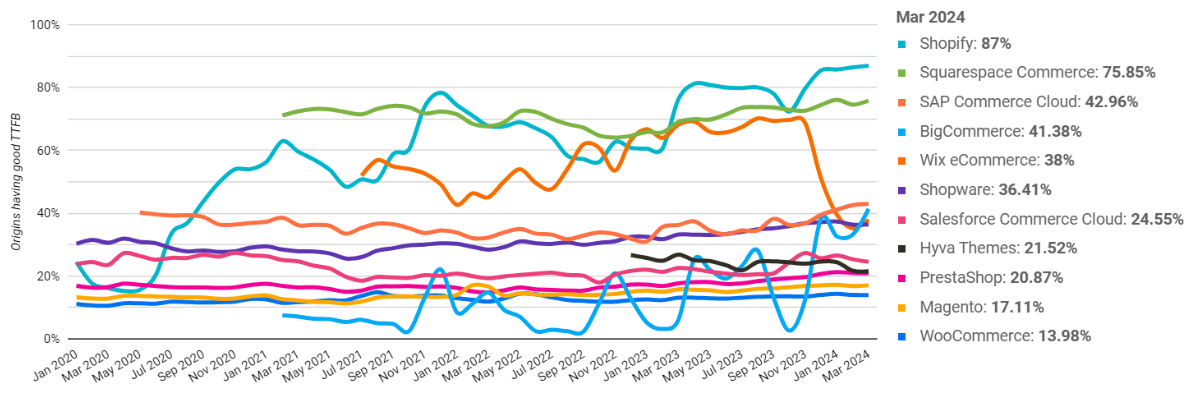
Chart showing percentage of origins having good TTFB over time for ecommerce platforms. The most current data shows Shopify being the fastest, and WooCommerce the slowest
 
### [What is a good TTFB for ecommerce?](https://www.erwinhofman.com/blog/what-is-a-good-ttfb-for-ecommerce/)
 
[Erwin Hofman](https://www.erwinhofman.com/)
The choice of ecommerce platform for your store will inevitably have an effect on web performance. Learn how to determine what’s good TTFB when choosing between providers.
 
Chart explaining the three parts of an interaction: Input Delay, Processing Time, and Presentation Delay.   A long task blocks input delay, then there is processing time (longest bar) and presentation delay, then the Next Paint happens.
 
### [Understanding Interaction to Next Paint (INP)](https://frontendmasters.com/blog/understanding-inp/)
 
[Mat Marquis](https://hire.wil.to/)
There are never too many articles about INP. This time, focus goes to understanding what happens on the main thread and how Interaction to Next Paint differs from First Input Delay.


# Tools  
 
Screenshot saying 'According to this WebPageTest run, https://www.javascript.com/ requires 2,609,038 bytes of JavaScript to show 2,003 characters of text on the page. That's 1,302.6 JavaScript bytes per character.'
 
### [Uncompressed JavaScript bytes per character](https://javascript-bytes-per-character.glitch.me/)
 
[Leon Brocard](https://www.astray.com/)
Find out how the ratio of bytes of JavaScript per each text character, based on a WebPageTest result.


# Courses, Talks & Podcasts  
 
### [Cache ruins everything around me](https://syntax.fm/show/753/cache-ruins-everything-around-me)
 
[Wes Bos](https://wesbos.com/) & [Scott Tolinski](https://tolin.ski/)
Managing caching is a popular web performance strategy. Tune in for a discussion about invalidation issues, partial caching, flash of unstyled content headaches, and more.
 
 
Calibre
 
This email is brought to you by the team at [Calibre](https://calibreapp.com). We automate web performance testing, reporting and alerting, so you don’t have to.


Performance Newsletter is sent from the traditional lands of the Wurundjeri people of the Kulin nation. We acknowledge that sovereignty was never ceded and pay respects to the Elders past and present.

Send your suggestions, links and feedback to [[email protected]](mailto:[email protected]).

[View or share this email →]()
[Quickly unsubscribe →]()
[Browse older issues →]()

**Sent by**
Calibre Analytics

V119 / 425 Smith Street
Ngár-go
Fitzroy VIC 3065
Australia

 
Don't miss what's next. Subscribe to Performance Newsletter:
← Newer ⚡ 151: Why don’t we talk about minifying CSS? Older → ⚡ 149: Don’t get scammed on web performance
perf.email
Bluesky
LinkedIn