Spade shape with cobalt blue background

Performance Newsletter

Archives
Calibre Monitoring
Free Speed Tools
Log in
Subscribe
15 November 2023

⚡ 139: Unbearable weight of JavaScript

͏ ͏ ͏ ͏ ͏ ͏ ͏ ͏ ͏ ͏ ͏ ͏ ͏ ͏ ͏ ͏ ͏ ͏ ͏ ͏ ͏ ͏ ͏ ͏ ͏ ͏ ͏ ͏ ͏ ͏ ͏ ͏ ͏ ͏ ͏ ͏ ͏ ͏ ͏ ͏ ͏ ͏ ͏ ͏ ͏ ͏ ͏ ͏ ͏ ͏ ͏ ͏ ͏ ͏ ͏ ͏ ͏ ͏ ͏ ͏ ͏ ͏ ͏ ͏ ͏ ͏ ͏ ͏ ͏ ͏ ͏ ͏ ͏ ͏ ͏ ͏ ͏ ͏ ͏ ͏ ͏ ͏ ͏ ͏ ͏ ͏ ͏ ͏ ͏ ͏ ͏ ͏ ͏ ͏ ͏ ͏ ͏ ͏ ͏ ͏ ͏ ͏ ͏ ͏ ͏ ͏ ͏ ͏ ͏ ͏ ͏ ͏ ͏ ͏ ͏ ͏ ͏ ͏ ͏ ͏
 
Performance Newsletter
[issue 139 ]()
 
#### Editor’s note
 
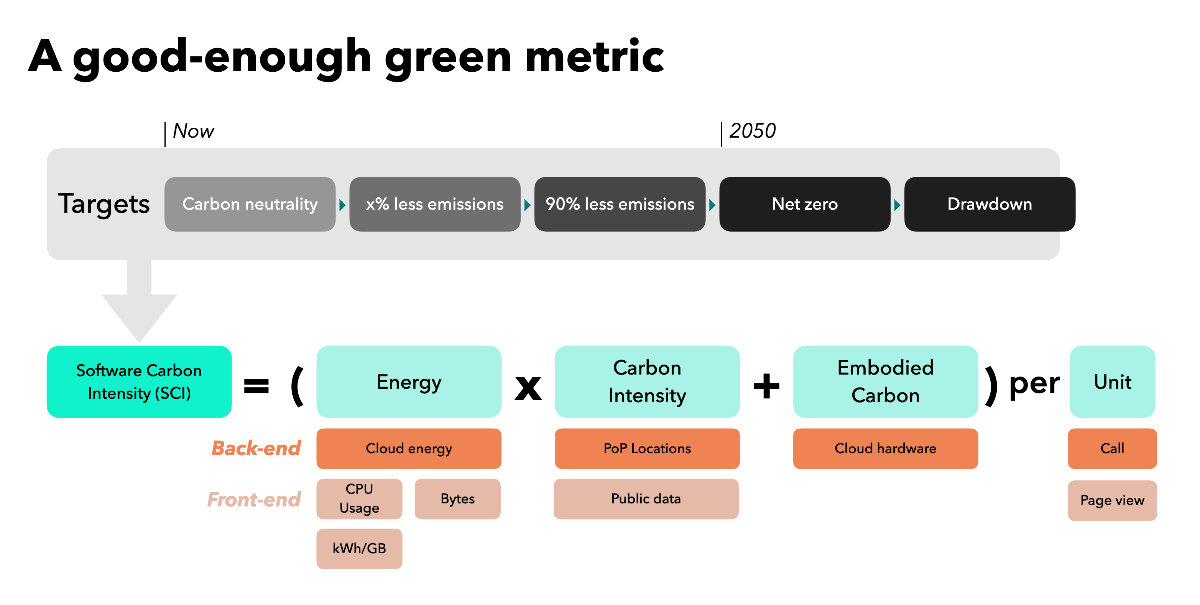
There are plenty of conversations about measuring carbon emissions, especially in the context of web performance and sustainability. Some sentiment being that the current measurements are partial and don’t show a full picture, which Brian Ramirez covers in their talk featured in this issue.
 
While clear, actionable and reliable data is critical, I’d argue that these carbon measurements are still useful. We know that web performance metrics have evolved during the years—some have been phased out, new ones were created, and sometimes, definitions of measurements changed entirely. Change is not new.
 
We should be thorough while executing on new metrics, but raising awareness about quantifying carbon impact is critical **now**. Perfection can wait.
 
Karolina


#### What’s Performance newsletter?
 

Performance Newsletter is a fortnightly mailing by [Calibre](https://calibreapp.com), featuring web performance tools, talks and resources.

Don’t worry—we don’t spam. If you’d like to leave, [unsubscribe]() at any time. Suggest content [here. ](mailto:[email protected])


# Articles  
 
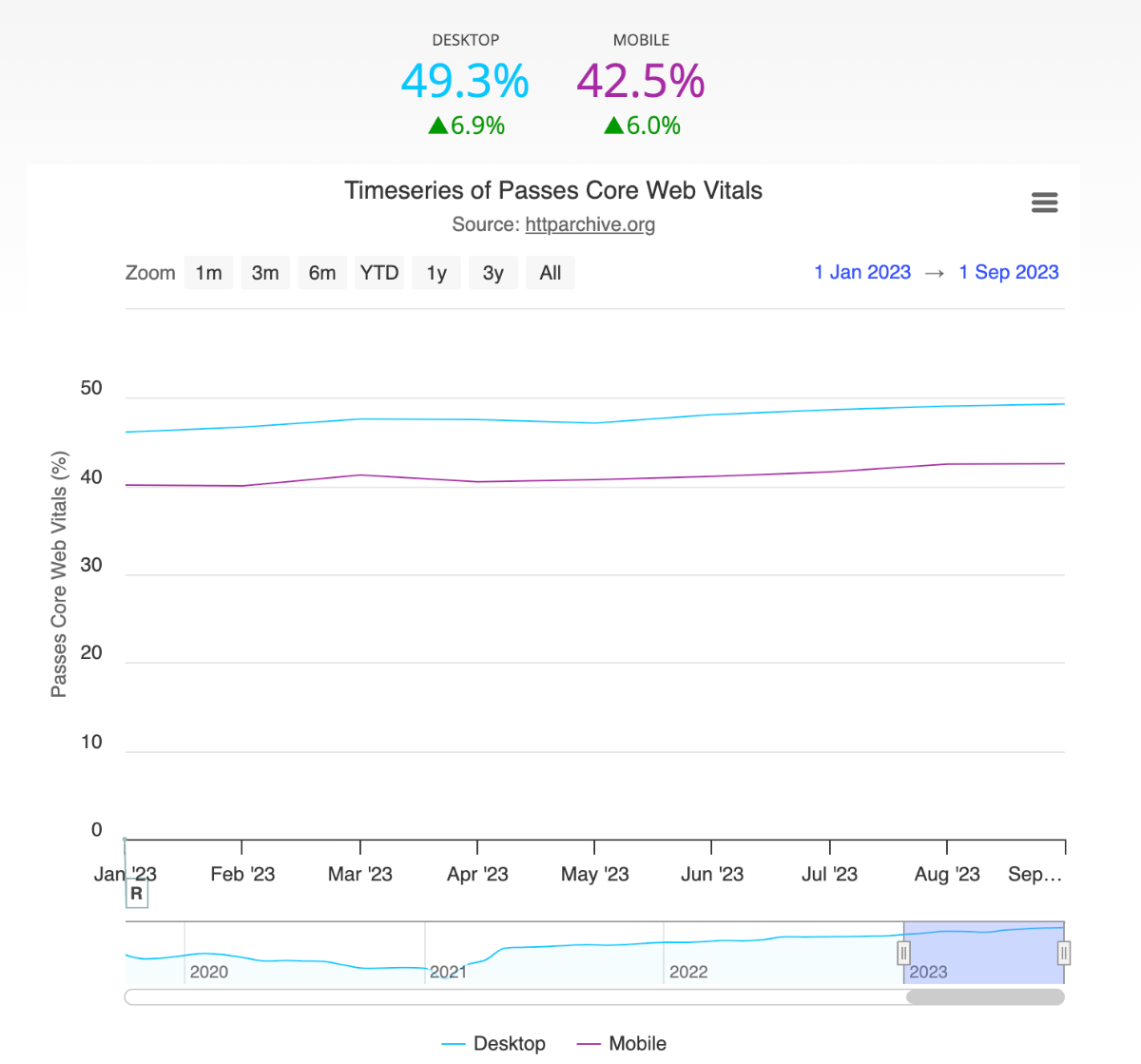
Chart showing timeseries of passes Core Web Vitals, which rose by 6.9% on desktop, and 6% on mobile in the last year
 
### [A faster web in 2024](https://rviscomi.dev/2023/11/a-faster-web-in-2024/)
 
[Rick Viscomi](https://rviscomi.dev/)
How well are we doing on web performance, and what’s our next optimisation challenge for the coming year? Hint: it’s not Interaction to Next Paint!
 
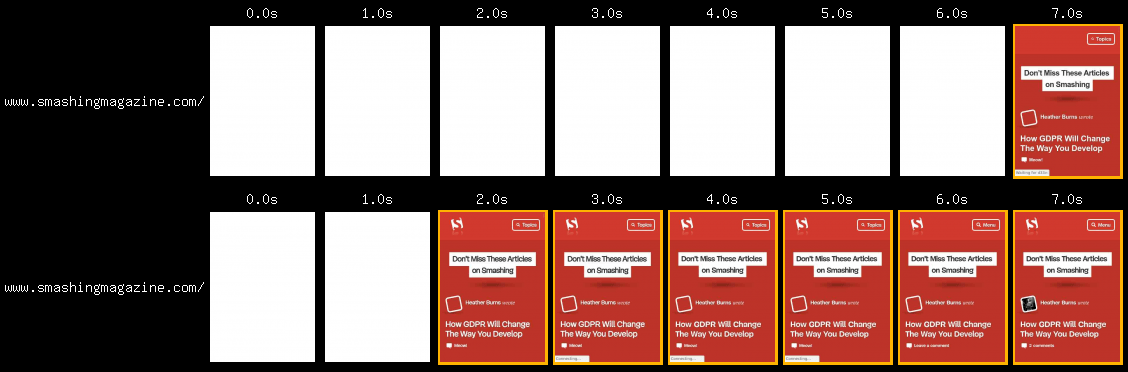
A comparison of page load on a very slow connection (top) versus a faster connection (bottom).
 
### [Learn web performance course](https://web.dev/learn/performance)
 
Web.dev now has a new course on web performance, covering why speed matters, optimising specific assets, resource loading and more.
 
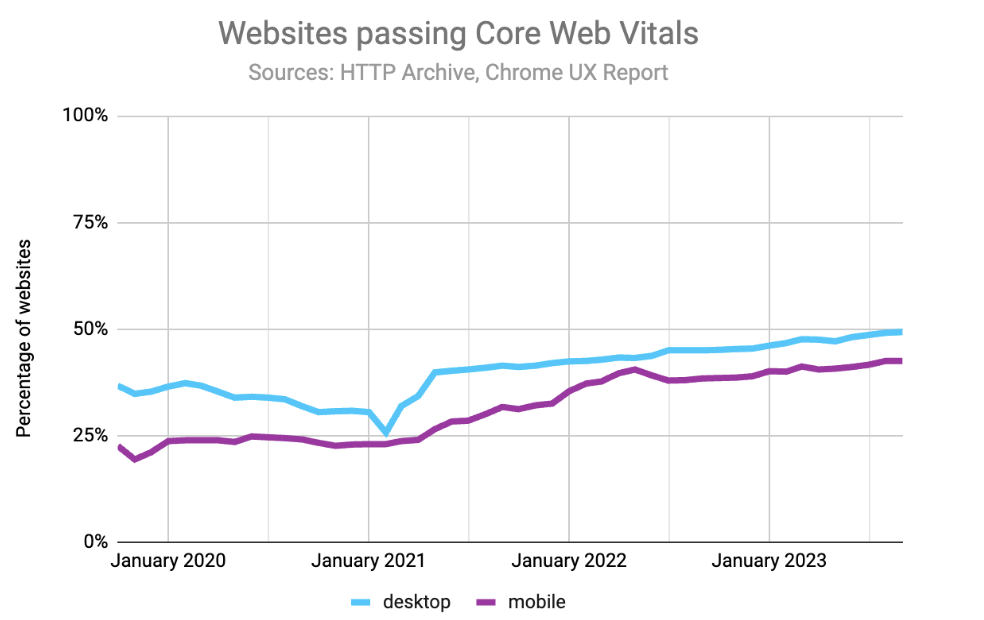
Websites passing Core Web Vitals chart showing dsktop and mobile % of websites rising
 
### [How Core Web Vitals saved users 10,000 years of waiting for web pages to load](https://blog.chromium.org/2023/11/how-core-web-vitals-saved-users-10000.html)
 
[Addy Osmani](https://addyosmani.com/), [Annie Sullivan](https://www.linkedin.com/in/anniesullie/) & [Kouhei Ueno](https://www.linkedin.com/in/kouheiueno/)
Check how the Core Web Vitals initiative has progressed in 2023 and what improvements were brought to Google Chrome to foster better web performance.


# Case Studies  
 
### [Optimize along the way: An industrial case study on web performance](https://www.sciencedirect.com/science/article/pii/S0164121222002692#sec4)
 
[Jasper van Riet](https://jaspervanriet.nl/), [Ivano Malavolta](https://www.ivanomalavolta.com/) & [Taher A. Ghaleb](https://taher-ghaleb.github.io/)

This paper showcases improving the performance of a Web dashboard at 30 MHz, a technology company in the agricultural sector that provides growers insight into their data.


# Courses, Talks & Podcasts  
 
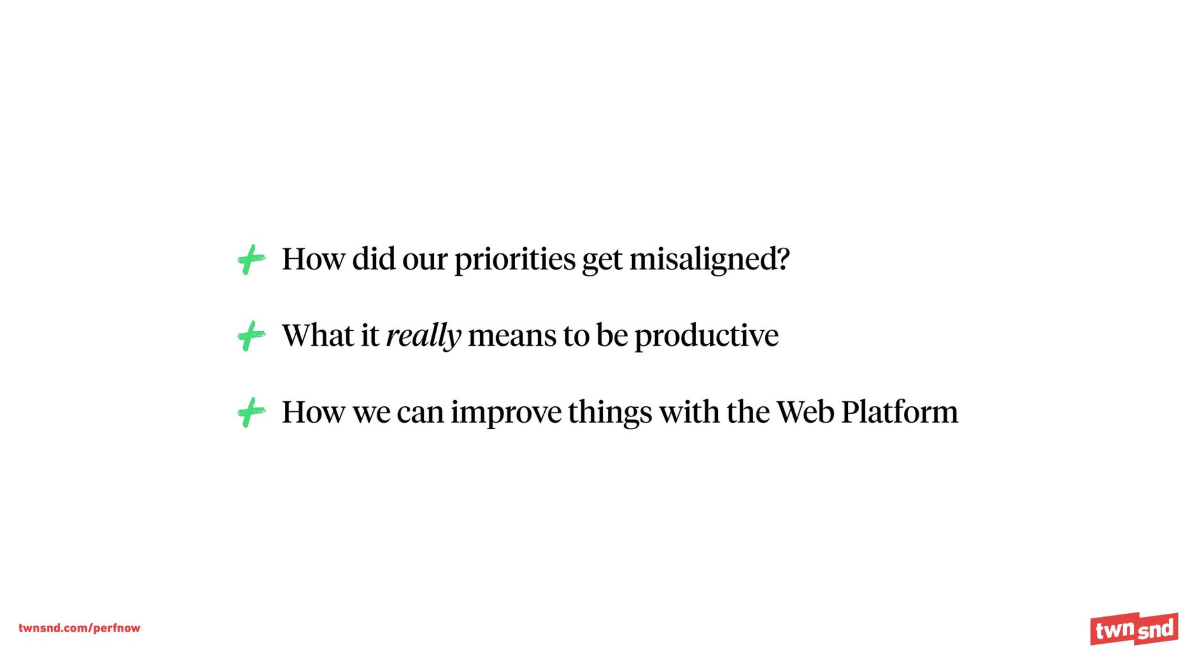
Talk screenshot saying "How did our priorities get misaligned? What it really menas to be productive and Howe we can improve things with the web platform"
 
### [The unbearable weight of massive JavaScript](https://speakerdeck.com/ryantownsend/the-unbearable-weight-of-massive-javascript-performance-dot-now)
 
[Ryan Townsend](https://twnsnd.com/)
JavaScript frameworks and SPAs have been marketed as the solution to all our performance issues, yet here we are mostly dealing with speed (and more!) issues caused by JavaScript. How did this happen and how do we go forward?
 
A good enough metric chart defining Software Carbon Intensity metric
 
### [Why we need a green perf metric](https://screenspan.net/talks/green-perf-metric/)
 
[Brian Louis Ramirez](https://screenspan.net/)
The carbon impact of the internet is huge, yet we’re somewhat lacking in tools to measure it with confidence. What would it take to measure carbon emissions, focusing on device use and embodied carbon?
 
 
Calibre
 
This email is brought to you by the team at [Calibre](https://calibreapp.com). We automate web performance testing, reporting and alerting, so you don’t have to.


Performance Newsletter is sent from the traditional lands of the Wurundjeri people of the Kulin nation. We acknowledge that sovereignty was never ceded and pay respects to the Elders past and present.

Send your suggestions, links and feedback to [[email protected]](mailto:[email protected]).

[View or share this email →]()
[Quickly unsubscribe →]()
[Browse older issues →]()

**Sent by**
Calibre Analytics

V119 / 425 Smith Street
Ngár-go
Fitzroy VIC 3065
Australia

 
Don't miss what's next. Subscribe to Performance Newsletter:
← Newer ⚡ 140: How people perceive speed Older → ⚡ 138: Who to trust with online business?
perf.email
Bluesky
LinkedIn