Frequently Asked Questions
Thank you for subscribing to the daily summary of Prince Edward Island electricity load and generation. What follows are notes and answers to questions I’ve been asked by subscribers.
Data Source
I download and archive data from the Renewable Energy Indicators page maintained by the Province of PEI which, in turn, uses data provided by Maritime Electric.
What The Numbers Mean
Here’s a summary that was sent out recently:
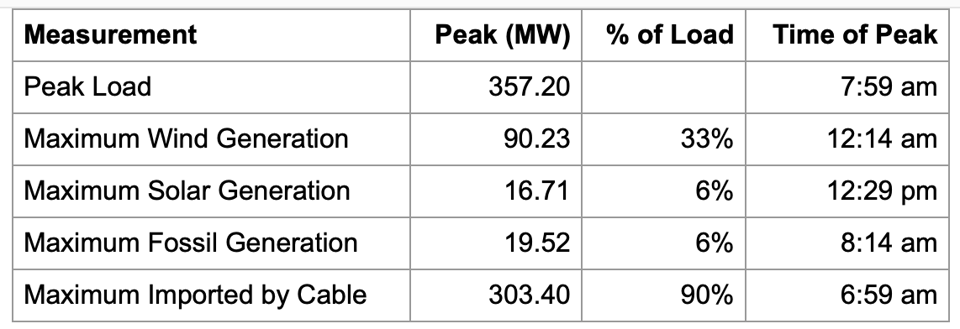
This table reports on the peak for each metric: in other words, in the “Peak (MW)” column you will see the maximum value reached for each measure, and beside it you will see the percentage load at that time met by that type of generation, and the time of the peak.
In the example here, 12:29 p.m. was the time that we reached the peak solar generation of 16.71 MW. At the time, it was responsible for 6% of the Island’s load.
In other words, these aren’t totals for the day, they are just peaks. They don’t tell you anything about how much energy each generation type provided over the course of the entire day, just the maximum reached.
What’s “Wind Generation”?
This is electricity generated “from all wind facilities in the province.” It includes wind turbines at North Cape, Norway, Elmira, Hermanville, West Cape, Eastern Kings, and Summerside.
As of 2025, Maritime Electric counts the total wind generation capacity at 233 MW.
What’s “Solar Generation”?
This is electricity generated by “utility-scale solar facilities in the province.” Currently this includes the Slemon Park solar farm (10 MW) and the Summerside solar farm (21 MW) for a total of 31 MW of capacity.
Summerside’s solar farm includes a 10 MW battery, so potential peak could be 41 MW from solar.
There is additional “net-metered” solar capacity—things like residential rooftop solar panels—that is NOT included in this figure. It’s currently estimated to be above 55 MW.
What’s “Fossil Generation”?
This is electricity generated on Prince Edward Island from fossil fuel sources. Maritime Electric has 3 combustion turbines, 2 in Borden-Carleton (15 MW and 25 MW), and 1 in Charlottetown (49 MW). The City of Summerside has one diesel generation plant (12.5 MW).
Total fossil capacity is 101.5 MW.
According to Maritime Electric, these are used in the following situations:
when there are transmission system outages on PEI or elsewhere in the region that disrupts the Company’s ability to import sufficient energy through the Interconnection [submarine cables to NB];
when the Interconnection is at its transfer capacity limit and additional energy is needed, which is known as curtailment by NB Power events;
to hold the import of energy across the Interconnection to the scheduled amount, which is known as a Hold-to-Schedule directive from NB Power;
for providing emergency energy to third parties when there are supply shortages in the region, which may be due to planned or unplanned generator outages, or due to higher-than-expected customer load; and
for monthly test runs to ensure each unit remains in good working order.
Fossil generation does not include electricity generated by the “energy from waste” plant in Charlottetown, which is primarily used internally, with a small amount fed to the grid.
What is “Imported by Cable?”
This is electricity imported from NB Power via submarine cables.
The “rated” capacity of the cables is 560 MW, but there are limits on the New Brunswick side that reduce that to 300 MW maximum.
Generation Summary
So, to summarize the above, here’s our current generation capacity:
Source | Capacity |
|---|---|
Wind | 233 MW |
Solar | 41 MW |
Fossil | 101.5 MW |
Imported | 300 MW |
So the theoretical maximum generation—perfect wind, perfect sun, all the fossil turned on, maximum imports—is 675.5 MW. The peak load ever reached on PEI was this year 403 MW.
What are the maximum peaks ever?
These are peaks measured from archived data from November 2012 to the present.
Wind: 210 MW on January 2, 2026.
Solar: 36 MW on June 9, 2025.
Fossil: 96 MW on February 6, 2013.
Imported: 309 MW on December 23 2025.