Fast is better than slow
Hey there friends! Hope your spring1 has been splendid. Here in Bavaria we're nearing the end of that period where there's a public holiday every other week. Honestly, it's a bit much for me, but at least it gave me time to write a new blog post.
New blog post
About 10 years ago, I realized all the best programmers I had worked with had something in common: they were fast. By that I mean that they moved quickly: we’d discuss a problem and an hour or two later they’d already have a patch ready or a prototype to show off.
It took me a while, but eventually I realized: they weren’t fast because they were great programmers, they were great programmers because they were fast.
Think about it — if you’re fast, you get data more quickly. That helps you make better decisions, sooner. It also means you learn faster, and over longer periods it means you learn more. Being fast also means you can try out multiple approaches to a problem and pick the best one.
A lot of people push back on this because it sounds like hustle culture. But there are lots of ways to move faster that don’t involve working long hours. Jamie Brandon has written a pair of excellent posts on this: Speed matters and Moving faster. You should go and read those if you haven’t already.
I have a few suggestions of my own — things that are a bit more about the messy reality of working as a software engineer than they are about coding per se. And I’m slightly embarrassed to admit that, unlike Jamie, they took me more than a decade to learn.
Elsewhere
Back in March I also published a new post on the Ohm blog, Inside Ohm's PEG-to-Wasm compiler:
A few weeks ago, we announced the Ohm v18 beta, which involved a complete rewrite of the core parsing engine. Since then, we've implemented even more performance improvements: v18 is now more than 50x faster for real-world grammars while using about 10% of the memory.
The new parsing engine works by compiling an Ohm grammar — which is a form of parsing expression grammars, or PEG — into a WebAssembly module that implements a parser. In this post, we'll dive into the technical details of how that works, and talk about some of the optimizations that made it even faster.
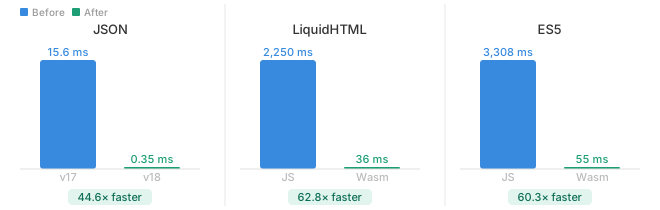
I also had an invited talk about this work at MoreVMs in March.
TILs
A few new TILs since my last newsletter:
- Python signal handling - 2026-04-01
- Multithreaded WebAssembly - 2026-03-05
- Fibonacci hashing - 2026-03-03
- Set
differencevssymmetricDifference- 2026-02-24 - api-extractor - 2026-02-18
- HTTP Range requests - 2026-01-31
✌️,
Pat
-
For those in the northern hemisphere, of course. ↩