
Green Shoots in Autumn
In which I am surprisingly optimistic about politics and arts journalism, for some reason.
Hi!
It’s already been a roller coaster of a month, with the election turning decisively toward the Democrats followed almost immediately by eight centrist Democrats blowing that capital and folding on the shutdown with basically nothing to show for it.
But generally, I’m still feeling pretty good about the results of the election. Any off-year election resulting in Mamdani elected in New York City and Wilson elected in Seattle has to represent some kind of change, and the down-ballot races in Georgia and Mississippi and in suburban Pennsylvania were essentially anti-Trump drubbings. It feels like people have had enough of the past decade’s politics and are looking for big, bold solutions.
There’s a lot of bad stuff to come, of course. President Trump’s staff of ghouls and anthropomorphic Streptococcus bacteria doesn’t care one single iota about their poll numbers, and they may be realizing that they’ve only got a limited amount of time to make all their demented dreams come true. People will suffer, things will break, and the world is in danger.
But listen: If you ever had a big idea, or if you ever wanted to change your community for the better, there has never been a better time to get involved. There are a lot of people out there who are hungry for big ideas and real leadership, and I don’t think that Chuck Fucking Schumer is going to be the one to give it to them.
So here’s my advice to you: Start small. Jump into your local elections, volunteer with the political group of your choice, speak out at zoning board meetings or at school boards. This election proves that there is real political will out there for something that doesn’t in any way resemble the politics of the last 20 years, and you can help shape what that world looks like if you get involved right now.
Whatever the next big political idea is, I can tell you for sure that it isn’t going to come from a high-priced political consulting firm. It’s going to come from the people.
I’ve Been Writing
For the Seattle Times, I highlighted a dozen or so of the most exciting paperback releases of November.
I’ve Been Reading
I’m sorry to report that Thomas Pynchon’s latest novel, Shadow Ticket, didn’t really do it for me—and I say this as someone who absolutely loved Inherent Vice (the novel, not the frustrating movie adaptation.) I enjoyed the first hundred pages or so of Shadow Ticket, which is pretty much pure private dick buffoonery, but the majority of the book felt a little chillier to me than Pynchon’s best fiction. Still, the thing I’ve learned about reinvestigating Pynchon’s work is that it changes over time and sometimes I need to age into it, so don’t skip the new one just because it didn’t sing to me.
I highly recommend listening to the audiobook version of Werner Herzog’s new book The Future of Truth, which is a short manifesto about truth in a time when algorithms can convince humans to doubt absolutely anything. The audiobook is read by the author, and even the darkest observations about AI and authenticity sound smooth and pleasurable when they’re delivered in Herzog’s accent.
I meant to take out Emma Pattee’s novel Tilt from the Seattle Public Library, but I took out a completely different book with a similar title, Amie Barrodale’s novel Trip, by mistake. (An edible may or may not have been involved.) I was about a chapter into Trip before I realized my mistake, but I happily finished the book anyway. It’s about a woman who dies and navigates the spirit world in an effort to save her son. Barrodale builds an interesting and mysterious spiritual afterlife with a set of rules based on eastern philosophy, and I appreciated the thought experiment a great deal.
And I also enjoyed Tilt, once I finally got around to it. It opens on a very pregnant woman shopping for a crib in the Portland, Oregon IKEA when an earthquake strikes. Without power or cell service, she has to make her way across the thoroughly damaged cityscape of Portland on foot in order to get back to her husband. This book is narrated by the mom-to-be to the child in her womb. The conceit mostly worked for me, though there was a part when the narrator describes having sex with her husband to her unborn child that pulled me out of the story due to general ickiness.
I’ve been haunted by RF Kuang’s words to me about why the hero narrative never actually works to effect real change in the world. I tend to think in narratives, and I’ve spent my whole life immersed in stories of one person who makes a difference to change the system, and so it’s very hard to shake myself free from that framework. I want to break out of this way of thinking so I’ve been reading a little bit about alternative ways to be a political actor. Mutual Aid is a short guidebook about building solidarity and community in times of crisis by Dean Spade for Verso Books. It’s an interesting and thorough description of how to use collective action to serve community needs in a way that doesn’t center one person above anyone else. Honestly, I’m still having a hard time picturing how to tell a compelling story about mutual aid that doesn’t violate the principles of mutual aid, but I’m enjoying the thought experiment a great deal.
It’s Not Over?
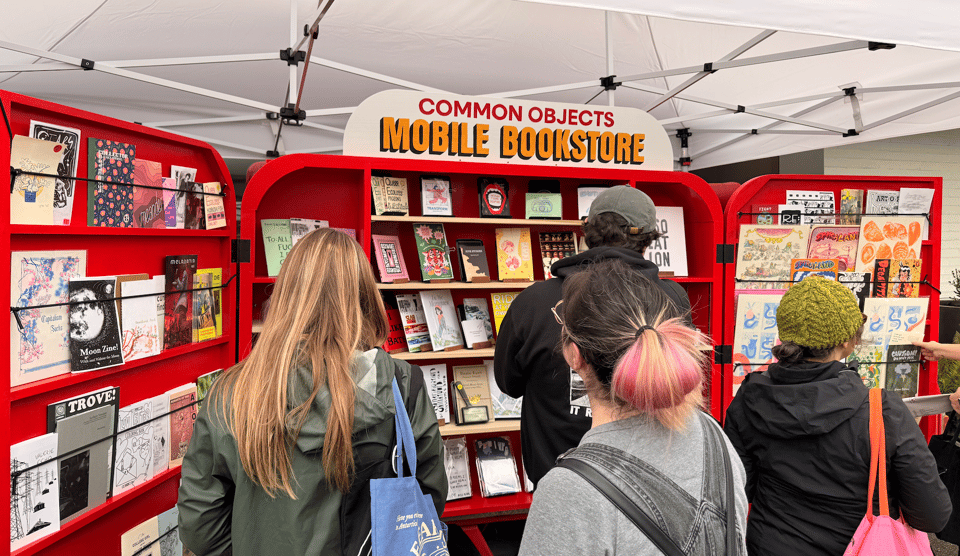
Earlier this month, I was interviewed by Chaitna Deshmukh, a reporter for the UW newspaper The Daily, about the Short Run Comix Festival. Deshmukh, who had never attended the festival before, wanted my perspective as someone who had been covering and attending Short Run since the very beginning.
The Daily ran Deshmukh’s article on November 7th, and it was positively delightful to experience the festival I’ve been attending for over a decade through fresh eyes.
“As an attendee, there’s a certain awkwardness in going up to artists, reaching out, and picking through hours, weeks, and months of the labor and passion of the person standing in front of you,” she wrote. “For close to an hour, my friend and I walked around, too afraid to make eye contact with anyone or touch anything.”
“I eventually realized that by not looking, I was actually ensuring I wouldn’t like anything,” Deshmukh continued. “It’s okay not to buy everything you flip through, as long as you’re polite, but looking closely was the only way I found the niche work I loved — and at Short Run, almost everything is niche.”
You should go read the whole thing.
A friend asked if I felt weird about being a historical reference for an article, and honestly I was over the moon about it. Not because I enjoy being interviewed—decidedly not—but because I was thrilled that a smart young journalist is excited to write about arts and books in Seattle.
I know that every generation of journalists believes they’re the last flickering lights of a golden age that’s quickly receding into the past. But for much of my career as an arts reporter I watched the arts budgets of newspapers get slashed to nothing, and I saw a bunch of literary-focused blogs and online publications disappear. Logically, I understood that it wasn’t the apocalypse for all arts journalism and criticism. But brother, it sure felt apocalypse-shaped to me.
So to meet someone who was excited about learning all about this arts festival that meant so much to me, and who was excited about sharing her enthusiasm for books and arts with an audience of readers, was a big deal. It’s heartening to know that I’m not the last dodo waiting it out on a rock in the middle of the Atlantic.
There are signs of life! All is not lost!
Paul