
AI Is Coming Home for the Holidays
In which I warn of a new battlefront in the coming artificial intelligence apocalypse: Your home!
Hi!
Right before Halloween, I was at a family member’s house and children were getting their faces painted for some festivity or another. I noticed that the picture on the packaging for the face paints was not a real photograph of a real human. Instead, the model was clearly created by AI. She had the too-toothy wide grin and tiny nose that you find in a lot of portraits generated by artificial intelligence.
Now, I’m online a lot and so obviously I’ve seen plenty of AI images. And I’ve seen those awful AI-forward Skecher ads on public transit—though I’m pretty sure that every single one of those ads has been defaced with anti-AI sentiment.
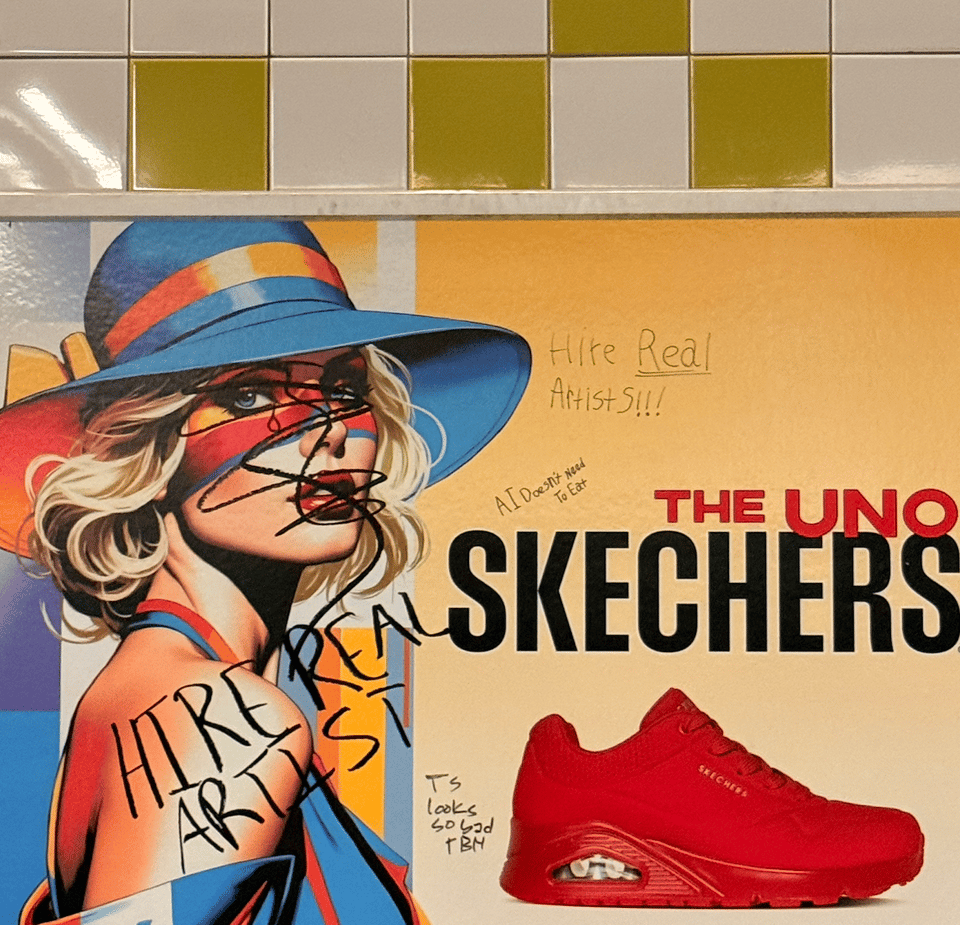
I think that box of face paints was the first time I’ve seen an AI image that was printed on a physical box that existed in a familiar space. It felt wrong, sitting there on the kitchen table, an unsettling intruder that signified a blending of worlds. The internet and real life had converged, and both felt a little cheaper for the interaction.
Of course, using an unreal image to advertise face paints is incredibly stupid. The artificial blond lady on the box was wearing face paint—I think she was made up to be a tiger—but obviously she wasn’t advertising the bold colors or smooth textures of the face paints in the box. She wasn’t real. Her face wasn’t really painted. Hell, her face wasn’t really a face.
We all know why a face paint manufacturer would use AI images on their products—because they’re significantly cheaper and faster than paying a real photographer and real models and a real artist to paint the model’s face. But the AI image is also not a useful advertisement for the face paint. Nothing about that image actually represented the quality of the product that was in the package, the way a real photograph would.
I’ve written before about the problem of using AI images to advertise real-world products. “I know people who have lost jobs to AI. It’s not because AI did their jobs better than they did, or even half as well as they did,” I wrote. “It’s because their bosses don’t care how poorly the job is done as long as it gets done quickly and cheaply. We’re learning how little good work matters to a large swath of the population—especially in fields that involve writing and art.”
Anyway, it was in that moment, staring into the vaguely cannibalistic grin of the AI slop model on a box of face paints, that I realized this coming holiday season is going to be the time when AI images significantly break containment into the real world. After the kids open the presents and dad admires his new coffee cup, people’s houses are going to be absolutely packed full of real-world manifestations of AI images, printed on cardboard and slapped onto products and woven into the daily fabric of our lives.
From this point on, all the cheap and gaudy housewares at Ross Dress for Less and TJ Maxx and Marshalls are going to be dripping with AI imagery. Fake models are going to pose with fake products on packages of decorative plates adorned with AI-created images of docks on lakes at sunset, and the wavy sherbet-colored water is going to look plasticine and a little bit oily. It’s now inevitable—AI images are going to become the aesthetic for cheap American junk for the foreseeable future.
This Christmas will be the moment in the zombie movie when the walking dead break inside the compound and start gnawing away. I’m not sure our collective mental health is quite prepared for that to happen.
I’ve Been Reading
Jon Raymond’s prose has always felt to me like a continuation of Raymond Carver’s—short, punchy sentences with just enough room for ornamentation to take a reader’s breath away. I’ve often thought of it as a signature Northwest literary style: Terse like the Nordic language but with something mossy and dark and weird hiding just underneath. Raymond’s latest novel, God and Sex, is basically that Northwestern aesthetic writ large. The plot is a stew of everything I hate about fiction—it’s a novel about a novelist (Boo!) who has an affair with his best friend’s wife (Booooo!) and then feels guilty about it (BOOOO!). But I’ll be goddamned if the book didn’t win me over. I love, for instance, that the protagonist is laboring on a hyper-ambitious novel about trees, which could be interpreted as wry commentary on the extravagant success of Richard Powers’s novel The Overstory. And both the affair and its aftermath somehow feels primal and mythic enough that it didn’t feel like yet another boring book about boring people having boring affairs. Things get weird—there may or may not be supernatural intrusion into the story—but Raymond keeps a straight enough face that it’s hard to tell where exactly he stands. I really loved this one.
Ian Fleming’s James Bond novels are favorite genre distractions of mine. I was intrigued by Anthony Horowitz’s first James Bond novel, Trigger Mortis, because it contains some passages that were written by Fleming and had gone unpublished until they were included in this volume. On the whole it’s a decent-enough thriller—though the first third, which is set mostly in a West German auto race, was an absolute swamp to trudge through. (The book is set right after the events of Goldfinger and Horowitz felt the need to answer a question that nobody on earth ever asked before: “Whatever happened to Pussy Galore?”) But I listened to the audiobook version of this one, and the real MVP is the narrator, actor David Oyelowo, who seems to be having the time of his life bringing a Bond movie to life with his voice. Oyelowo is an actor I’ll follow anywhere, and his performance lends the book a certain playfulness and urgency that I’m not sure Horowitz is capable of delivering.
I’m a big fan of Kate Zambreno. I particularly love her book Heroines, which really helped open my eyes to the larger feminist literary tradition, and how it differs from the patriarchal tradition of great literature. So it pains me to say that I did not like her new book Animal Stories, which is a series of meditations on zoos and the relationship between humans and animals. The first essay is about a primate house in a zoo that Zambreno visits often, and no less than three times in that essay does she bring up the observation that it’s hard to tell who’s observing who—the apes or the humans. For such an original thinker, she seems enamored of some very unoriginal thoughts in this one, which makes the book feel more cliche and less editorially sculpted than some of her other works.
When Zohran Mamdani name-checked Eugene Debs in his election night victory speech, I realized that while I know who Debs is, I haven’t read a biography of him or gone particularly deep into his life. So I read Eugene V. Debs: A Graphic Biography, written by Paul Buhle and Steve Max, with Dave Nance, with comic art by Noah Van Sciver. Unfortunately, I really didn’t like this book. It switches back and forth between prose sections and comics sections, which is a hybrid style I’ve never felt worked particularly well, and I wound up retaining virtually none of it. If anyone has any recommendations for a good book on Debs, I’d be eternally grateful.
I’ve Been Writing
For the Seattle Times, I wrote about the Fantagraphics Bookstore and Gallery in Georgetown. The piece is really more about the manager of the shop: the estimable Larry Reid, who did quite a lot of work to advance the idea of comics as a serious art in the 90s and early 2000s.
Also in the piece, I get to sing the praises of the store’s Damaged Room, which features slightly damaged and out-of-print books at a 50% discount: “In-the-know comics nerds — full disclosure, myself included — have lost dozens of hours to spelunking trips into the depths of the Damaged Room, hunting for unbelievable bargains on gorgeous graphic novels.”
If you love comics and you haven’t visited the Damaged Room, or spoken to Larry Reid, you owe it to yourself to drop by as soon as possible.
See you next month,
Paul