What's the Harm of Ed Tech Anyway? Or Why the Struggle, As Always, Is the Point
Friends,
In the past two months, we’ve seen the entire ground of local and national organizing shift around the topic of AI (and ed tech more broadly). We held a 7-hour PEP rally where hundreds of parents came out to tell the DOE that AI does not belong in schools—what Chalkbeat termed the AI rebellion. Fairplay became the first national organization to call for a pause on AI. This week, a reporter asked Mamdani point-blank whether he supported our moratorium (he dodged the issue). Here’s a small sampling of how much good trouble we’ve gotten into in the papers lately!
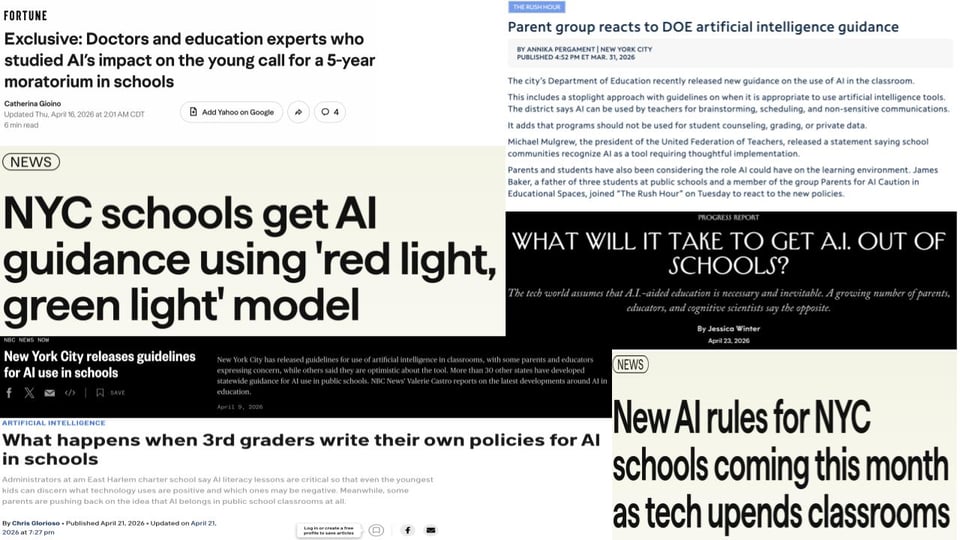
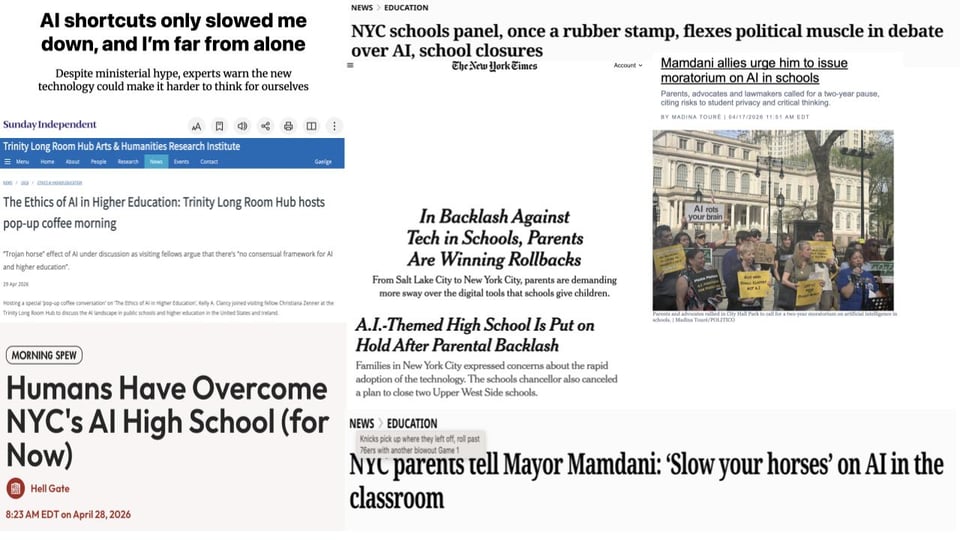
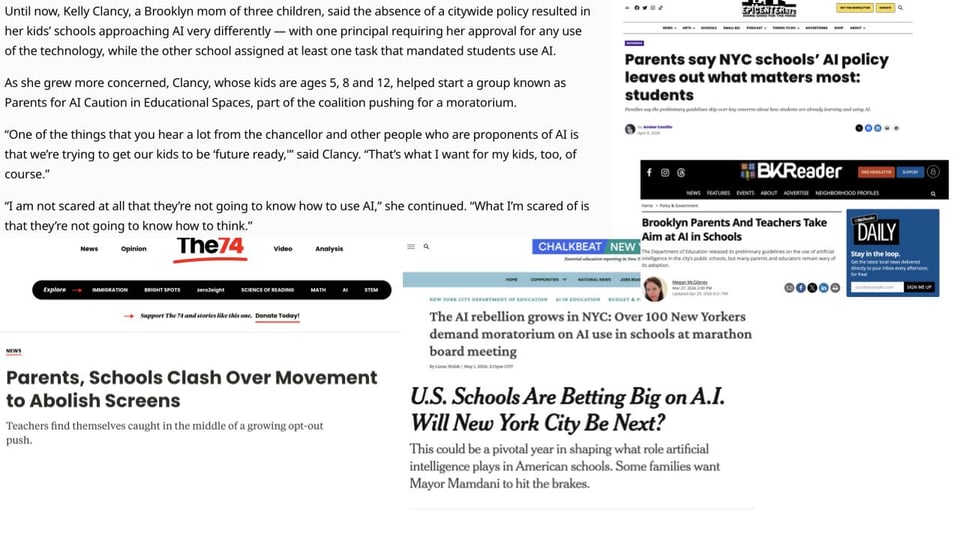
We are so appreciative of all of the work you all have done—and how you’re keeping up the fight. We are going to have a bunch of activities to end the year, so if you haven’t already signed our petition, now is your moment, and then you’ll be all set to get updates from the AIM Coalition.
But now I have something special for you: a guest piece written by a NYC parent who works in tech, who wrote this in response to parents saying “what’s the harm?” I’m so grateful for her putting the science together here—one of the smartest things I’ve read about why we need to keep AI out of the classroom. (And if you have something to say, reach out! I’d be happy to work with you on the piece and publish either anonymously or under your name!)
Subscribe nowWhat’s the harm?
By: A NYC parent who works in tech
As someone who works on the engineering side of these technologies, I want to offer a perspective for the “what’s the harm / we don’t want kids to fall behind” argument.
The tech companies want us to think these apps are patient, brilliant tutors. But structurally, that is a complete illusion. Here is what is actually happening under the hood:
The apps don’t “know” math or reading. AI doesn't have an internal logical number line, and it has no lived human experience. When an app solves a problem or parses a sentence, it isn't reasoning. It’s running a hyper-advanced version of predictive autocomplete. It calculates what symbol or word statistically comes next based on a massive database. Because it has zero actual comprehension, it cannot diagnose why a child’s mental model is broken. It can only spit out more text.
They are outsourcing our kids' cognitive architecture. True learning requires "productive struggle"—the literal, uncomfortable neural friction of figuring a hard thing out. These apps are designed by engineers to be highly addictive, gamified, and seamless to keep kids on the screen. By instantly stepping in to patch errors, provide hints, or make things "kid-friendly," the app short-circuits the exact neurological process required to build working memory and deep problem-solving skills. The scores look great, but actual long-term learning drops.
The machine is completely blind to the child. A computer can’t read the sudden slump in a child’s shoulders when they feel defeated, the furrow of their brow when they’re confused, or the wild clicking that means they’re feeling anxious. Human learning is an emotional, somatic process. Teachers and parents read these micro-expressions and co-regulate a child's nervous system so they feel safe enough to keep trying. An app abandons them emotionally in the exact moments they need a human anchor to build resilience.
Our kids aren't going to "fall behind" by spending less time with a machine. The future is going to be completely saturated with automated, predictive tools. What will be rare, highly valued, and non-negotiable are human beings who possess deep critical thinking, emotional resilience, and the ability to solve problems without an algorithmic crutch. We don't prepare them for the future by turning them into tech-dependent consumers in Pre-K; we prepare them by protecting the human interactions that actually wire a human brain.
In medicine, you cannot give an unproven, unvetted drug to a vulnerable population just because the marketing brochure says it works. Education should be held to that exact same ethical standard.
There is zero clinical validation for learning. If an ed tech company claims their AI app improves Pre-K reading scores, ask for the peer-reviewed, randomized control trials. They don't exist. What the data does show is a massive disconnect between app performance and actual cognitive development:
—The "gamified" illusion: Apps are clinically validated to do one thing exceptionally well: maximize dopamine and screen-time. They track a child's telemetry data (where they click, how fast they answer) to make the interface seamless.
—The "vanishing" skill: When a child gets a gold star on a tablet for matching a word to a picture, they are learning how to navigate that specific app's interface. Studies consistently show that when you take the tablet away and hand that same child a physical book or a real-world math problem, that apparent "knowledge" evaporates. It doesn’t transfer because it was never deeply processed by the brain's working memory.
It is Still Advanced Reasoning Mimicry. LLMs do not "know" math or reading. They run on advanced statistical interpolation. Major research institutions have exposed just how brittle this mimicry is. Two massive flaws break the illusion of AI reasoning:
—The GSM-symbolic collapse. Researchers tested top AI models on grade-school math problems. When they gave the AI a standard problem from its training data, it got it right. But when they changed just the names or the numerical values while keeping the math exactly the same, the AI's accuracy plummeted. It hadn't learned the mathematical principles; it had memorized the statistical pattern of the text.
—The "premise order" and "unreasonability" Flaws. If you give an AI a logic problem and simply randomize the order of the sentences, its ability to solve it drops sharply (whereas a human child, once they understand the logic, doesn't care what order you say the clues in). Furthermore, if you give an AI an impossible or mathematically absurd question (e.g., "If John has 5 apples and eats an umbrella, how many apples does he have left?"), the AI will often confidently hallucinate a math formula to solve it anyway.
The Harm to Developing Brains is Non-Linear. For an adult engineer, using an LLM as a productivity tool is fine because your cognitive architecture is already built. We already know how to read, critique, and reason; the AI is just accelerating your workflow.
A child’s brain is in a critical window of synaptogenesis—literally wiring its physical structure based on environmental inputs.
—Short-circuiting the struggle: When a child struggles to sound out a word or count blocks, their brain experiences a microscopic moment of stress. That stress triggers the release of neuromodulators that signal the brain to grow a new synaptic connection. When an AI app instantly pops up a hint, animates a character, or fixes the error to keep the game moving, it removes the struggle. It deprives the brain of the exact chemical catalyst it needs to wire itself for deep focus.
—The social deprivation: Human language and logic are entirely somatic (body-based) and social. A child learns what a number means by physically dropping heavy blocks into a bucket, watching their teacher's eyes widen, and hearing the change in their tone of voice. An iPad is a flat, unyielding sheet of glass with zero emotional feedback.
I know it’s easy to see the “magic” of all of these AI technologies but it’s very much an illusion.
Add a comment: