#4: Never Let Me Go on the Record
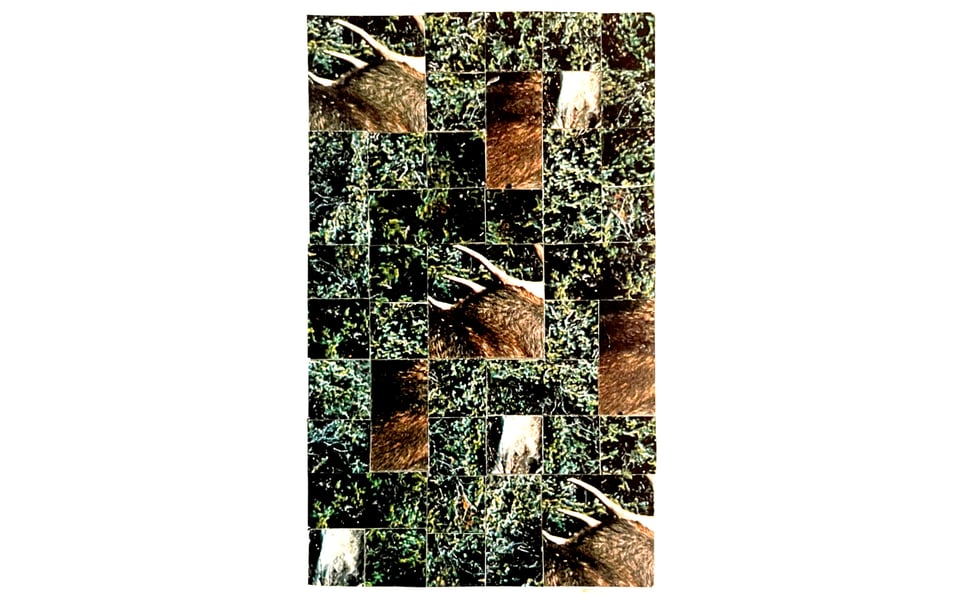
Yesterday morning, I was talking with someone about moose. It is the sort of thing one does here in Anchorage. I had just encountered one on the sidewalk, in fact, which is what had prompted the subject. And, out of a desire to contribute meaningfully to the conversation, I related a story I remembered from a few years before, which was basically this: a local man lured a moose into his garage and shot it.
It is a good story. If you have spent any time in Alaska, it is believable. But as soon as the story was out of my mouth, the details started pulling away from me. Was the man a state trooper or a police officer? Or not employed in law enforcement at all?1 Was it in Anchorage, or maybe Soldotna? I could not be sure. Had I ever read the story myself, or only received it second-hand? A while later, when I was alone, I tried to locate the original article online, to prove to myself that I had not invented it, and found nothing.
Even now, I can’t quite shake the dreadful sense that I might have made up the story, that I unwittingly shared a total falsehood (and that the people I told may now be resharing it). It must be an experience as old as human storytelling, some ancient precursor to what I hope contemporary people feel after reposting AI videos or spreading fake news. But beyond that guilt, I have been feeling something like the narrator in a Kazuo Ishiguro book.
This very specific connection has occurred to me because, as it happens, I’ve been reading through Ishiguro’s work over the past couple of months. I am not aware of any other writer so preoccupied with the nature of memory, so willing to resist absoluteness, so committed to exploring the reality of how time alters everything. The Remains of the Day, for example, is told from the perspective of an English butler as he drives through the countryside2 and contemplates his many years in unwavering service to a man of dubious morality; as he sifts through memories he carefully contextualizes them to avoid the conclusion that his life has been a failure. In An Artist of the Floating World, which is something of a partner to The Remains of the Day, a famous Japanese painter also reflects on his past and tries to come to terms with the ways in which his nationalistic-themed work may have contributed, even in a small way, to pushing Japan into what turned out to be a catastrophic war. And then there is Never Let Me Go, of course, in which the narrator struggles to make sense of her childhood at a seemingly-idyllic boarding school, which was (spoiler alert) in fact a place for raising clones destined for organ harvesting3.
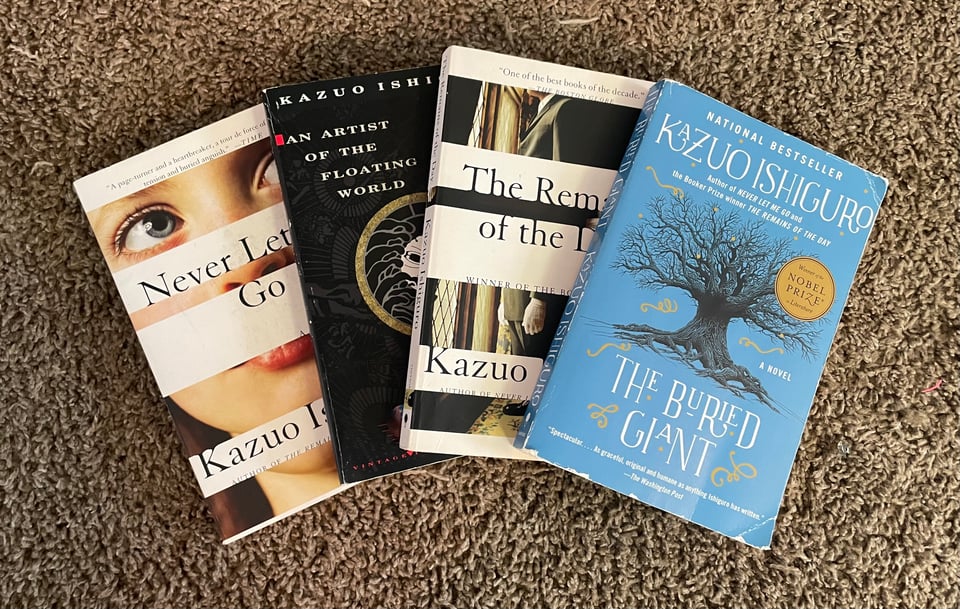
Ishiguro’s narrators and characters can be frustrating at times, being so uncertain, so full of confabulations, always questioning themselves as they tell their story. Maybe I said that, or maybe someone else did. Maybe this happened at a different time, or with a different person. But reading them makes me wonder about all the other books—especially past-tense, first-person narratives—in which the teller of the story has no doubts, no uncertainties, as if drawing each line from a crystal clear pool of pure truth. Which is actually more believable? Which is more honest about the nature of memory and time and the stories we tell?
Yet another Ishiguro novel, The Buried Giant, addresses memory even more directly, though through a more elaborate storytelling device. The story follows the journey of an elderly couple in a post-Aurthurian England enshrouded in a mist of forgetting. The characters are constantly being tested by sudden fragments of memories and a sense of something big and important being just out of mental reach. The significance of this premise is, I think, that we all do live in a kind of mist (metaphorically, of course). Individually as well as collectively, our identities are shaped as much by forgetting as remembering (although, if you’ve ever witnessed someone in the throes of dementia, you know that things can tip too far in one direction). In The Buried Giant, the characters at times try telling stories of the past, but those are really closer to acts of creation: small memories fed and puffed full of air like sourdough, only to collapse when tested.
The thing about that moose story is that I can recall not only the story itself, but the moment I heard it. I can picture the person (generally reliable) and the location and even the arrangement of bodies in that space. Is all that a creation of my mind, collaged together from other memories to support this other possibly false memory? I have many other moose memories, of course, including more personal, first-hand accounts that I like to think are more reliable. The New Year's Eve when we opened the door to find one standing on the doorstep. The time we returned home and found a yearling curled up in front of our gate, blocking access to the house. I know these are real, but I also fear that if I were to try to tell them at length, to flesh them out, I could not trust every detail. Was it snowing that New Year’s Eve? I think so. I want to believe so. But maybe that just makes for a better story.
It is snowing now. Of that I am certain. Outside, it feels quiet, peaceful, subdued. I suppose Ishiguro’s mist could have been snow, considering the way that it literally buries, the way that it suppresses sound and limits vision. Someone told me yesterday that there has been a bull moose in my neighborhood, but I have not yet seen it. I wonder, though, if one day in the future I may believe that I had.
1 Obviously, I never doubted that it was a man.
2 It sounds like the most boring book in the world, but is actually brilliant and often tragically funny.
3 There is much more that I could say about Never Let Me Go, especially from the perspective of a parent, but that will have to be a separate book report.