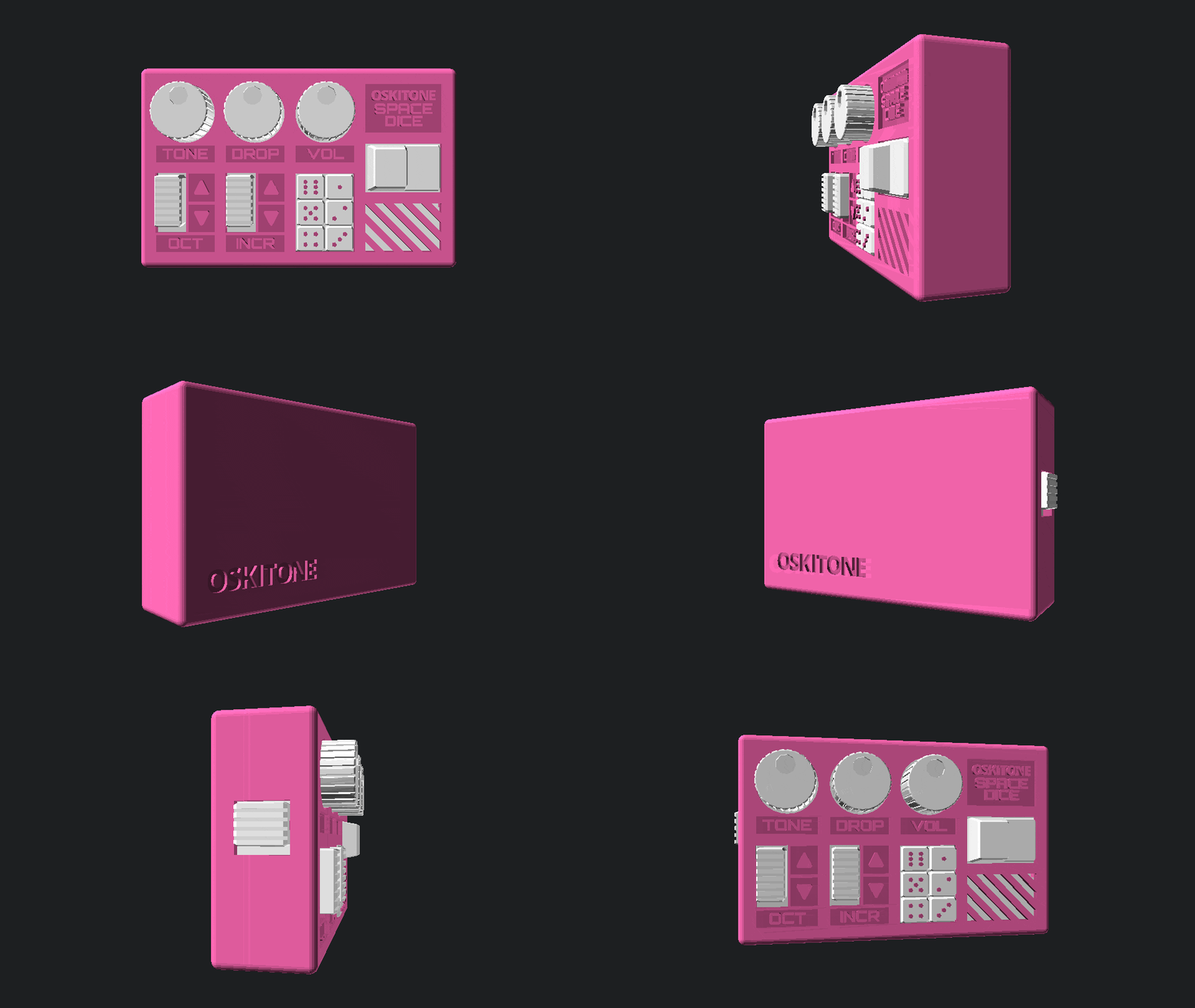
Space Dice
A space laser noise machine, an electronic dice machine. A combination space laser noise and electronic dice machine.
Introducing the Oskitone Space Dice, the electronic six-sided dice machine that also makes space laser noises. Pew pew pew, one; pew pew pew, five; peewwwww, five again?!; pew two.
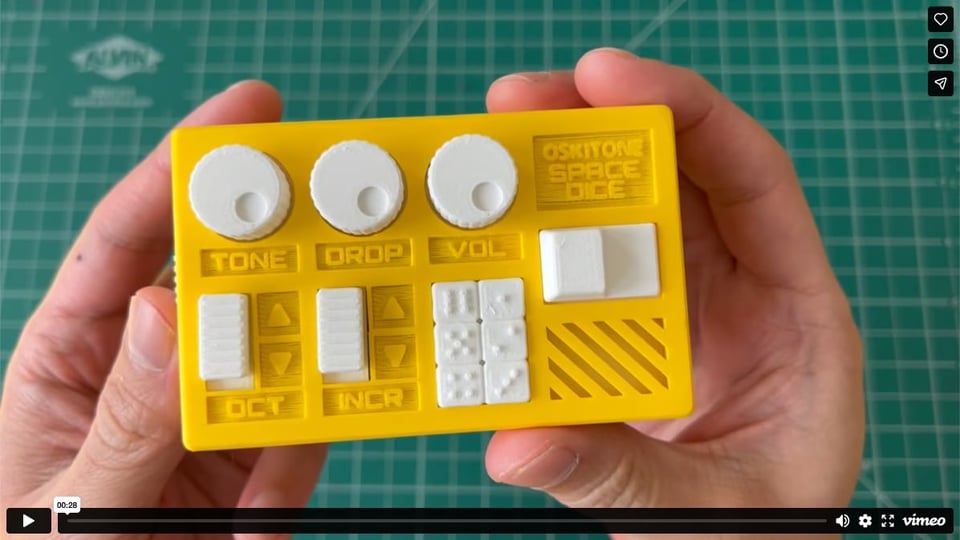
Use it to play Candyland, choose dinner, or foley a sci-fi film.
How it works
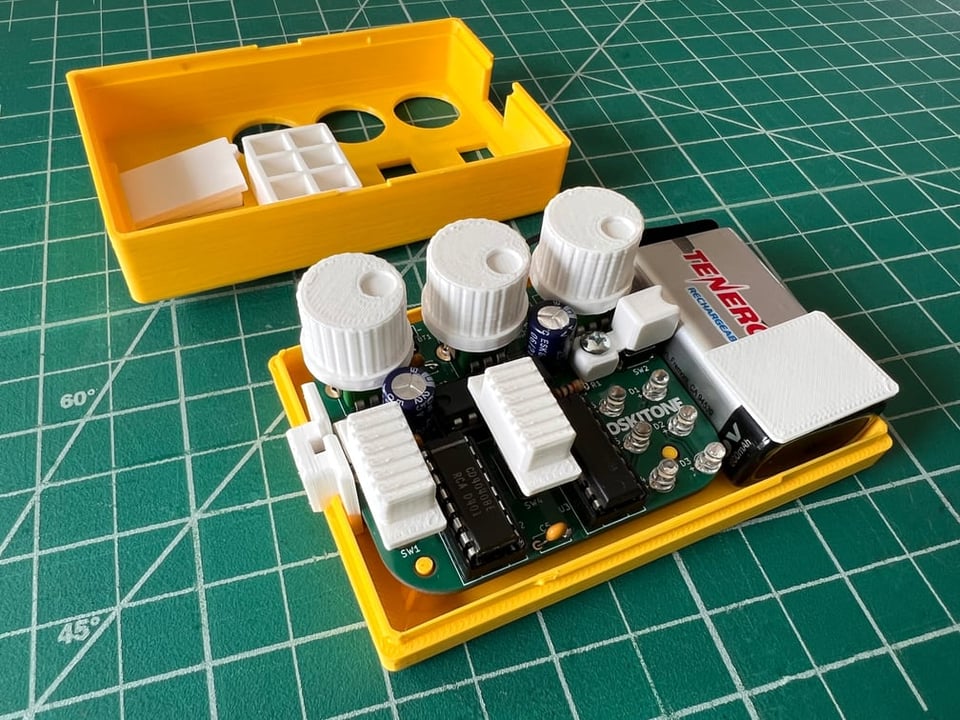
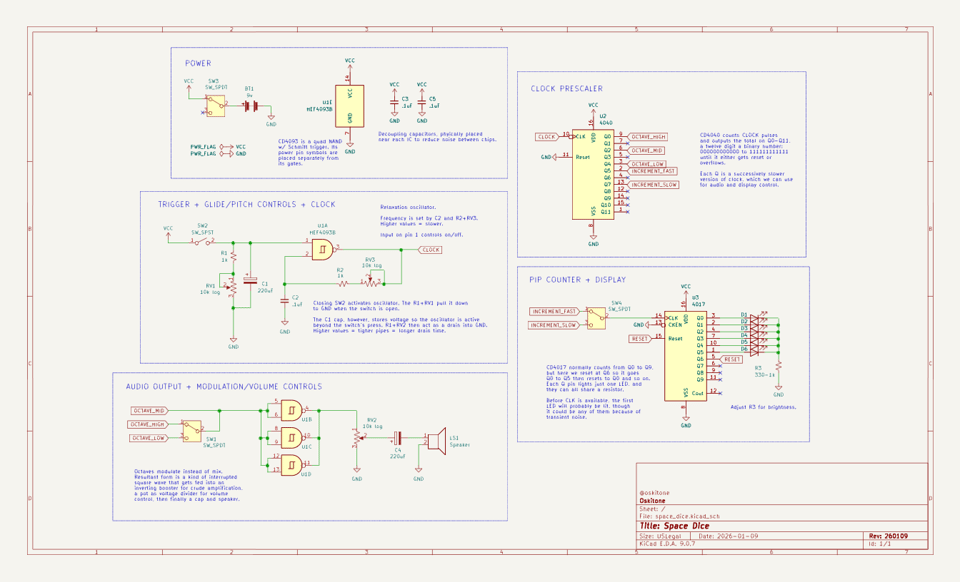
Under the hood and bells and whistles are three old standards:
- Chip 1 is a CD4093 quad NAND w/ Schmitt-triggers. One NAND gates makes a relaxation oscillator. The others boost audio output.
- Chip 2 is a CD4040 binary counter used as a prescaler. It sits between the oscillator and audio out, with a switch for octave selection.
- Chip 3 is a CD4017 decade counter. It's clocked by 4040 LFO outputs to cycle through the six LED lights. A switch selects incrementing speed. The cycle ends when the clock stops and with it the suspense of our electronic 1D6's roll.
And the CD4093 is exploiting two hacks:
- Hack 1: There's a big capacitor on the 4093 oscillator's on/off controlling pin. As its voltage drains, the osc frequency drops. A cursory, unexpected VCO! A pot controls drop length via drain rate.
- Hack 2: Instead of an extra chip for amplification, the 4093's three otherwise unused NANDs are wired in parallel as a crude square wave booster. It's not a proper amp but plenty strong enough to drive the little speaker.
Of course, you don't have to care about the Space Dice's mechanics to make or enjoy one.
OMG, that's SO RANDOM!
It's directly inspired by my time as a DIY Synths workshop instructor:
- Its CD4093's usage alone might be my all-time favorite circuit, which I taught as the "One Chip Star Tom," a result of unexpected but repeatable behavior.
- The CD4017's lightshow was part of a lesson on "randomicity." Can a human make random numbers? (Not really!) Can a machine? (Sometimes!) A very fun topic.
- As soon as the CD4040 was introduced in class, it never really left my breadboard. Twelve square waves with successively halved frequencies are surprisingly useful.
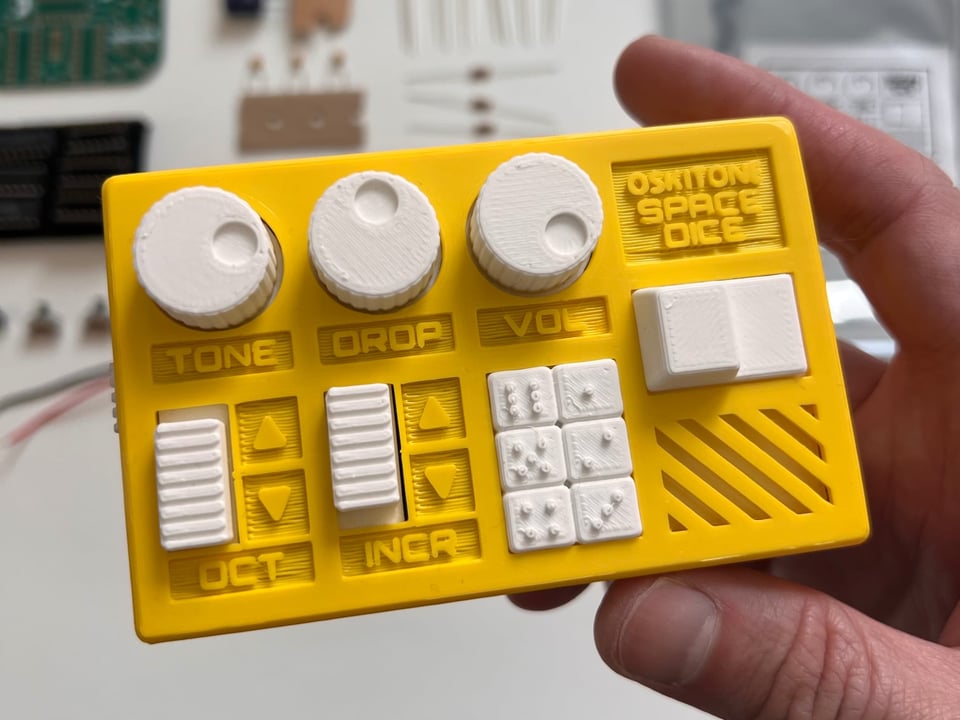
Other notes of pride:
- There's some slight of hand to obscure the bulky 9v battery inside. The big button is actually the long end of a lever that bridges over the battery to actuate the switch on the PCB. And the speaker grill is a facade; the speaker itself is under the PCB.
- The button cap's plateau is an affordance for optimal triggering, and it's on the right side for right-handed thumbing. Lefties, rotate 180.
- There are countless electronic dice soldering kits, but this one is mine: Scout knob, enclosure label engravings, up/down arrows from Higher Lower, power switch on the left between snap-fit enclosure halves, and bleeps and bloops that nobody really asked for.
- The PCB is shaped to fit in an Altoids tin, and the electronics work without any 3D-printed accompaniment. Go nuts, modders.
- The meticulous assembly guide continues the tradition of regular testing throughout. Each of the six soldering steps ends with a clear pass/fail before continuing.
- Additionally, I'm trying a new thing where the schematic also builds up to match. My increasingly hot take is that most "educational" STEM kits are no more educational than an Ikea coloring book.
A final Call to Action
The Space Dice DIY Electronics Kit is available for purchase now from the Oskitone website. It takes 30-60min to solder and assemble, and its 3D models are available free for 3D-printing.
Space Dice's PCB was designed in KiCad and its 3D prints in OpenSCAD. As with all of my work, it is 100% open source.
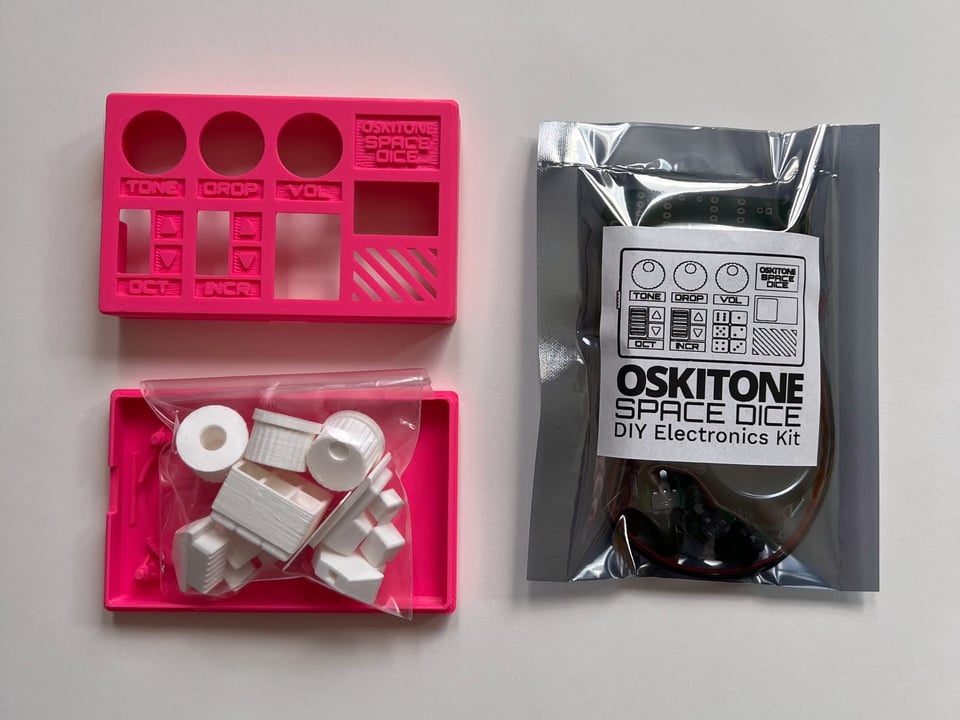
from your good pal Oskitone
LMK if you have any thoughts or questions or if the images in these emails aren't working right. Thanks for reading. My next email will have really good drawings. Really good!
Yours in RaNdOmNeSs,
Tommy from Oskitone