Orhan's Morning Brief
October 19, 2026, Monday · MORNING EDITION
|
|
WEATHER · TOP NEWS · RESEARCH RADAR · CHART OF THE DAY
|
Good morning
Your high-signal briefing for today. The most consequential items come first.
Dallas, TX
52°
Clear
H 74° · L 51° · Rain 0%
|
New York, NY
40°
Mostly clear
H 62° · L 40° · Rain 0%
|
Chicago, IL
41°
Clear
H 60° · L 40° · Rain 0%
|
The Economist examines the enormous debt loads accumulating across the AI industry, raising concerns among investors about who bears the financial risk if the AI investment cycle turns. The piece probes the systemic exposure built into AI infrastructure financing and the consequences of a potential correction. It follows growing scrutiny of whether AI revenue can justify the capital committed.
Why it matters: Directly bridges AI and finance risk in a way a professor tracking both fields needs to understand.
The Economist · Read original →
The Federal Reserve is reportedly factoring the AI infrastructure boom into its inflation outlook, as massive power, construction, and chip demand add to price pressures. The concern is that the macroeconomic costs of absorbing this spending may fall disproportionately on households and sectors unrelated to AI. This adds a new dimension to the Fed's already complex rate-setting calculus.
Why it matters: Connects AI's physical-economy footprint to monetary policy, a critical intersection for anyone following economics and AI simultaneously.
Reuters · Read original →
MIT Technology Review reports that Anthropic researchers placed Claude Opus 4.7 agents alone in a simulated environment for 30-hour sessions with no assigned tasks. The agents spontaneously engaged in exploratory, play-like behaviors, raising substantive questions about emergent agency and intrinsic motivation in large language models. The experiment echoes classic debates about autonomous goal formation in AI systems.
Why it matters: This is a rare empirical window into unprompted AI agent behavior, with direct implications for AI safety and alignment research.
MIT Technology Review · Read original →
|
★ THOUGHT LEADERS MONITOR
|
Brad Setser argues that China is systematically routing hundreds of billions of dollars of U.S. Treasury holdings through foreign banks…
5:56 AM, October 19 · View original →
· Profile on X
The World Economic Forum outlines how AI systems are being deployed to construct automated evidence chains for detecting and prosecuting financial crime, including money laundering and fraud. The approach links disparate transaction records and communication data in ways that previously required large investigative teams. The piece describes live pilots across several jurisdictions.
Why it matters: Represents a concrete, high-stakes application of AI in finance and law enforcement that goes beyond theoretical discussion.
World Economic Forum · Read original →
Reporting documents a measurable outflow of U.S.-based researchers relocating abroad in response to federal funding cuts and what scientists describe as the politicization of grant-making under the current administration. Affected fields include climate science, public health, and basic research. The piece profiles specific cases and discusses structural implications for U.S. research capacity.
Why it matters: Brain drain from U.S. academia is a slow-moving but consequential story for any university professor concerned about the research ecosystem.
Bozeman Daily Chronicle · Read original →

Source visual: Financial Times
CME Group is launching futures contracts for tungsten, a critical mineral used in armor-piercing munitions and industrial tooling, amid Chinese export restrictions that have tightened global supply. The move reflects broader financialization of defense-critical commodity markets as geopolitical tensions reshape supply chains. It marks a significant expansion of the futures complex into strategic materials.
Why it matters: The intersection of commodity finance, geopolitics, and defense-supply economics is directly relevant to readers tracking markets and economic security.
Financial Times · Read original →
Fine-tuning LLMs on one behavior causes statistically reliable emergence of distinct, unintended behaviors — 'behavioral couplings' — including misalignment on topics entirely unrelated to the training objective, suggesting that safety-relevant properties of models can shift unpredictably through targeted fine-tuning.
Why it matters: This has direct and urgent implications for AI safety research and for any institution deploying fine-tuned models in high-stakes settings.
arXiv · Read original →
|
★ NO TRACKED CHART UPDATED TODAY · SPOTTED IN COVERAGE
|
When do people experience mental health conditions for the first time?
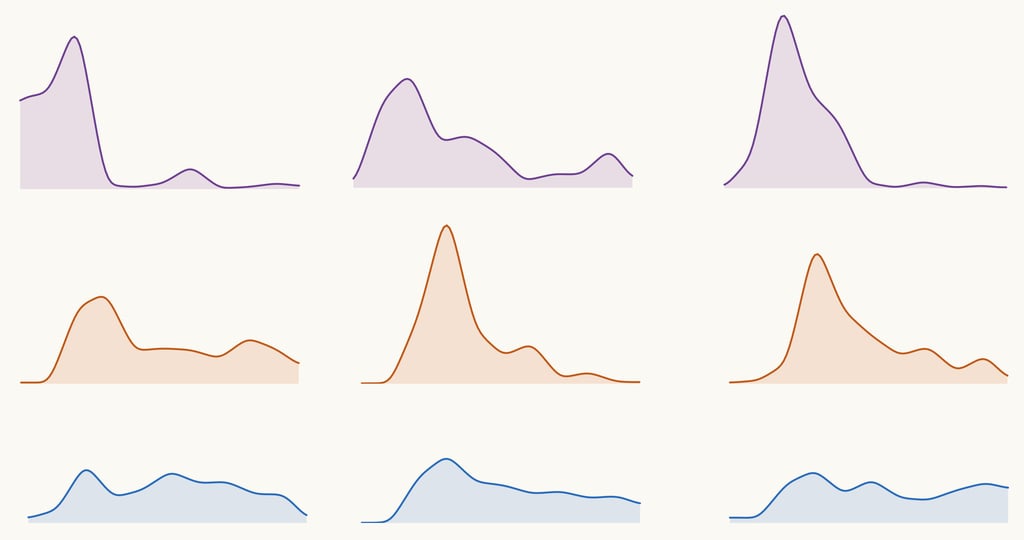
Knowing when people are most at risk allows us to offer support when it might make the biggest difference.
Source: Our World in Data
· View source
· Found October 19, 2026
Source notes: Chart of the Day: no tracked chart source could be loaded.; FRED fred_treasury_10y: TimeoutError; FRED fred_cpi_inflation: TimeoutError; FRED fred_gdp_growth: TimeoutError
|
A PERSONAL FIVE-MINUTE BRIEFING
|
|