openwashdata news 23 - new look
A new look, household waste in Kampala as our first dataset of the month, and two reflections on a year as Data Steward in Malawi.
View this email in your browser
Welcome back to our newsletter! This month, openwashdata has a new look, and each issue now shows one dataset of the month with a chart made from its data. The first is solidwastekampala, a new package on household waste in Kampala. We also pass on two reflections by Emmanuel Mhango on his year as Data Steward at BASEflow Malawi, and thank Charles Niwagaba as our contributor of the month.
🎨 A new look for openwashdata
openwashdata has a new look. The website and this newsletter now share the same colours, fonts and logos, in a light and a dark mode. The landing page shows the dataset of the month, the latest blog posts and a button to subscribe to this newsletter.
Let us know how you like it: openwashdata.org
Every blog post is now also available as a PDF for download, so you can read it offline or pass it on. Reports about openwashdata datasets can carry the same look through our quarto-owd extension, which produces PDF and Word documents. Browse the brand guide at: https://openwashdata.github.io/brand/.
📊 Dataset of the Month: solidwastekampala
Our first dataset of the month is solidwastekampala, a new data package from Makerere University with the quantity and composition of domestic solid waste from 103 households in three Kampala parishes of low, middle and high income, weighed over one week. Waste per person rises with income, from 0.43 to 0.98 kg per day, and food makes up at least three quarters of the mass in every parish.
The package holds the raw data as collected, before the analysis in the paper the team published this month in Frontiers in Environmental Science, Quantity and composition of domestic solid waste in Kampala City as influenced by socioeconomic factors. Anyone can start from the same records the authors worked with.
solidwastekampala- https://openwashdata.github.io/solidwastekampala: Quantity and Composition of Domestic Solid Waste in Kampala City
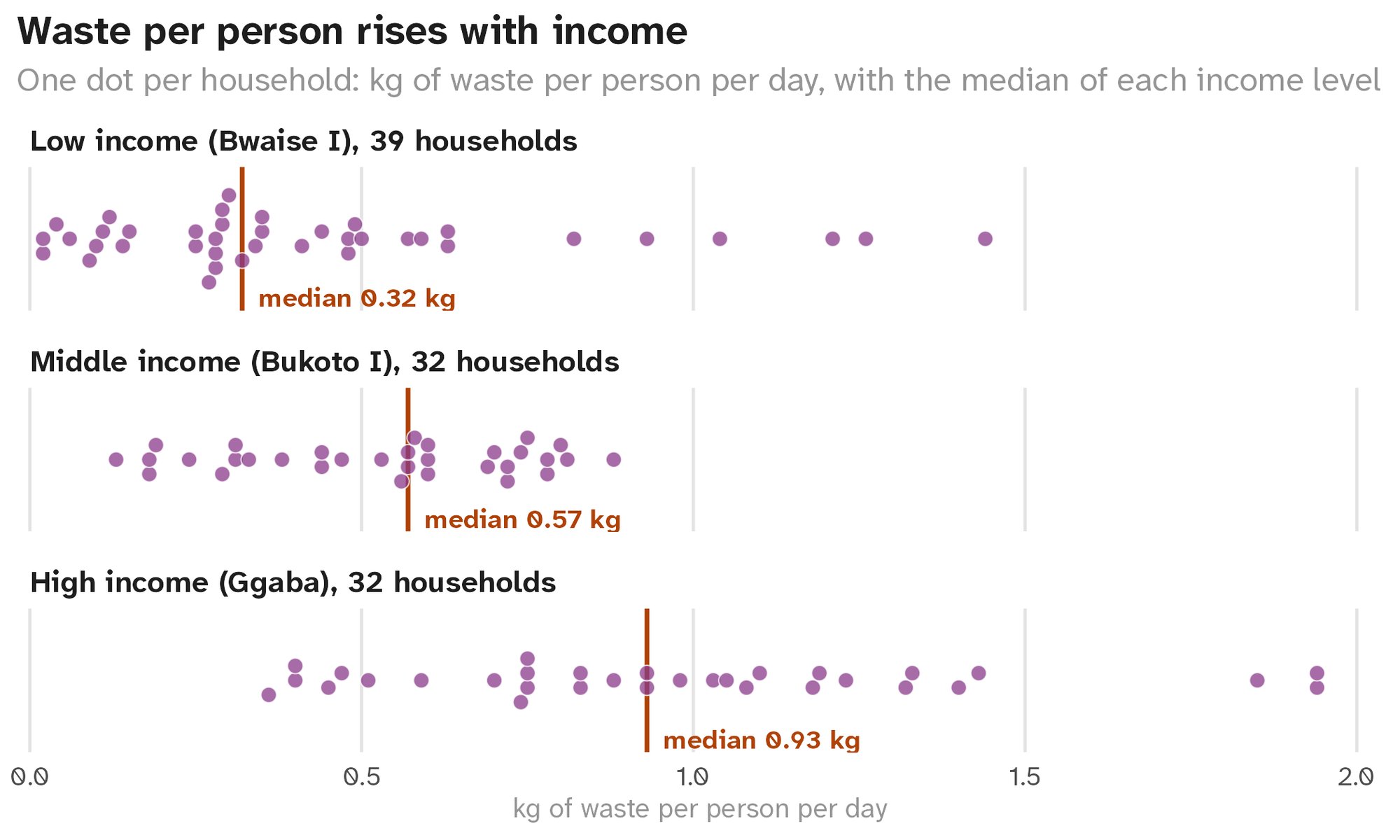
103 observations | Kampala, Uganda | CC BY 4.0 | https://openwashdata.github.io/solidwastekampala
The package took a couple of hours to build. Our data publishing pipeline has matured to the point where we can take a dataset in any format, with minimal documentation from the author, and turn it into a complete data package with documented variables, a website and a citation. This is possible because agentic AI tools now work together with the data publishing software we have invested in for years. Going forward, openwashdata will focus more on giving others the opportunity to benefit from these possibilities.
📄 Blog Highlights: a year as Data Steward at BASEflow Malawi
Emmanuel Mhango works as Data Steward at BASEflow Malawi within the openwashdata project and has published more than ten WASH datasets with us. He wrote two reflections on that year, first published on LinkedIn and now on our blog.
The first post starts with one question, what data does the organization actually have, and follows the answer from a data inventory to a Data Management Strategy, and to the lesson that data stewardship begins with people. The second looks at what happened once BASEflow started publishing data: the questions Open Science raised about ownership, permission and documentation, and a groundwater dataset that UNICEF Malawi used to identify where boreholes need attention.
I thought my job was about data. It turned out to be about people.
Beyond publishing data: what we learned building an open science culture at BASEflow Malawi
🌟 Contributor of the Month
Our contributor of the month is Charles Niwagaba of Makerere University, who shared the household solid waste data behind the solidwastekampala package with the community. The package names the whole team that collected the data in Kampala as authors. Thank you, Charles.
Charles and his co-authors published their raw data with us before the analysis, and their paper came out in Frontiers in Environmental Science on 11 September. This is the second publication where authors have worked with us to publish the raw data behind a paper. We are looking for more volunteers. If you have a manuscript in progress and data you can share, share your data with us or send us an E-Mail at [email protected].
Get Involved
We believe the openwashdata project prospers when we have YOU work together and promote open science and data practice! No matter what background you are from, we come up with some ways for you to get involved:
Spread the word. Forward this email.
Got more ideas? Leave us a message on Matrix to collaborate!
You just read issue #23 of openwashdata news. You can also browse the full archives of this newsletter.
