Last weekend someone asked me what is the name of my newsletter. I guess it’s a thing nowadays. Many newsletters that I follow do come with a name. I honestly didn't think about that until that point, this was simply - my newsletter - Nuno's newsletter - you all might call it. I do like the ring of giving it a name though. As I type this now I am reminded of my old blog, it was called Sayings of a Scorpion - borrowing from my university nickname. But this is not my hotmail anymore, so I can change the name of the place on the internet where I share my words, so perhaps you might see name emerging for future, perhaps not!
Amy, the person that posed this question, is also thinking about creating a newsletter. The bug keeps spreading and there's a nice little community generating around this. :)
Working on…
My next installment of the Dialogues series is now live on my website.
Summer in the City has also been published on my site. Boris and I have the second edition of our Riso Zine in the works — keep an eye on my socials for updates!
I finally launched my Patreon page. The idea is to make it easier for anyone who might want to support or engage with my photographic practice. I had a draft sitting around for a long time, but after reading up on fees and the option for one-time donations, I initially leaned toward Ko-Fi. Since that hasn’t really gained any traction, I decided to finalize the Patreon page. It's more popular and has a much better user experience — let’s see where it goes!
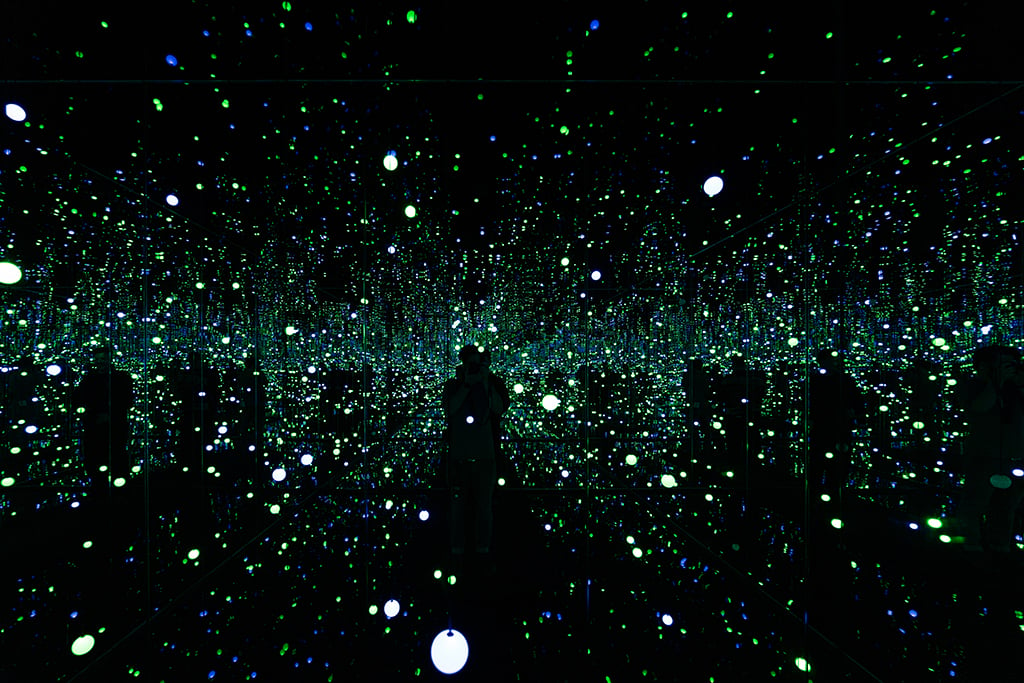
Editing was nearly impossible to get to this month. That feeling actually influenced my choice of banner image for this newsletter — a photo of Kusama’s Infinity Room. It perfectly captures how April felt: boxed in, while feeling like a lot was going on, as my mind dreamed to escape the room it found itself in. I struggled to find quality time and focus. That certainly took a hit on my mental health and well-being, something that I am paying attention to. Although in writing this section I am realizing that I did quite a bit this month :)
With the point above in mind, I’m planning to finally release another project that’s been ready for a long time. I had dreamed of launching it with a physical event and exhibition — the ideal scenario — but I realize that’s not where I’m at right now, and that’s okay. I'll go for a more humble launch. You can expect it to first show up on my Ko-Fi and Patreon pages next month, and then it’ll follow on public platforms too.
Now that everything above is addressed, I’m excited to get back to editing. There are so many photos I want to deliver to friends — from shoots we’ve done together to events we shared.
Book corner
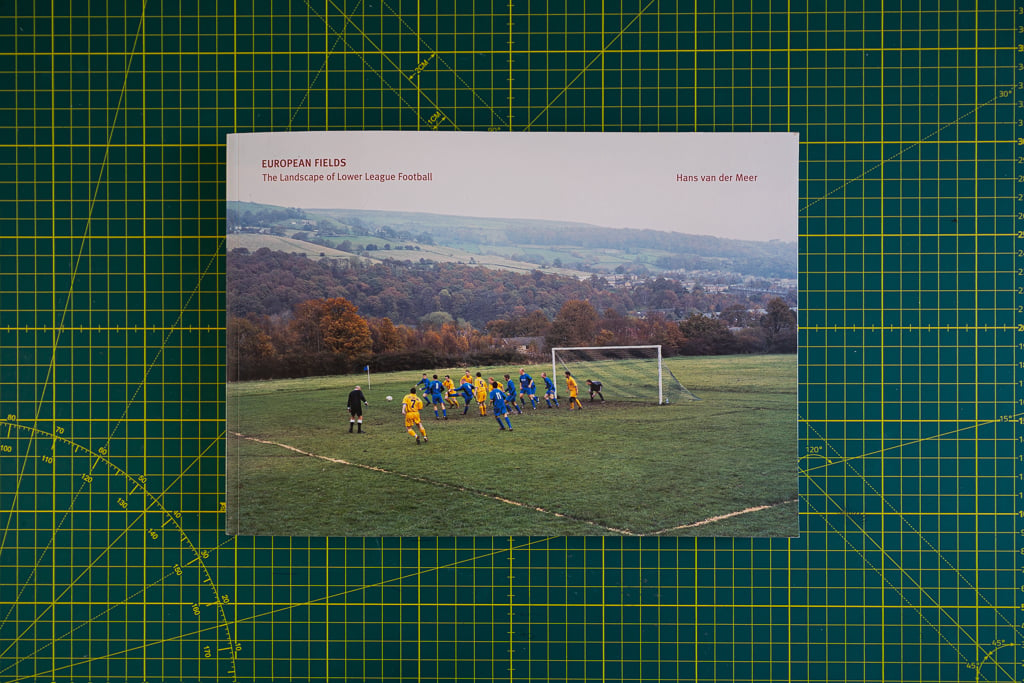
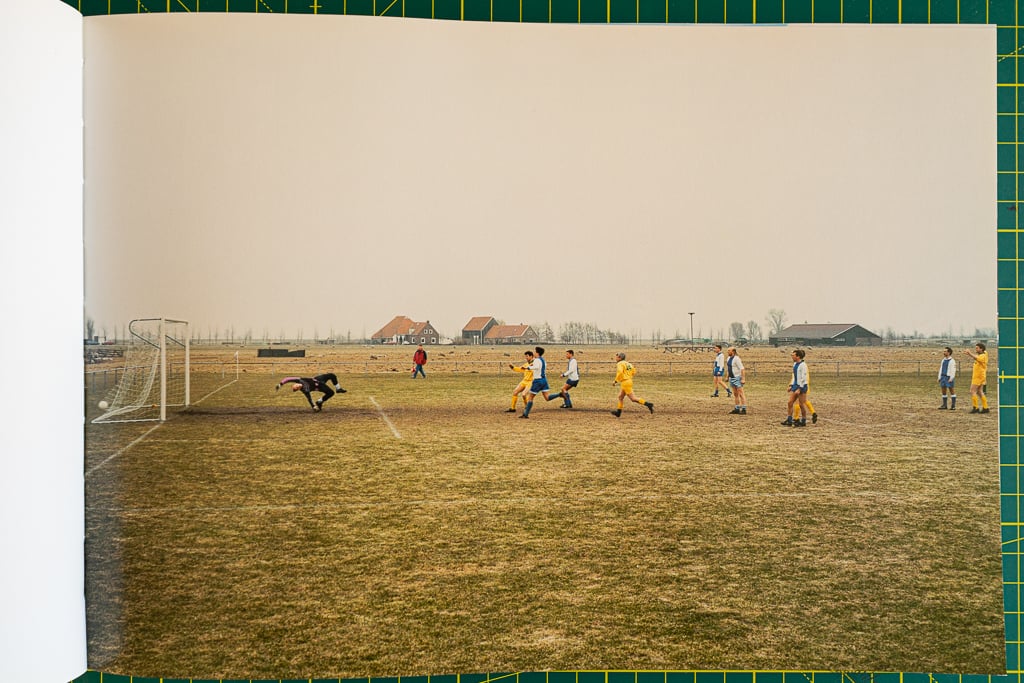
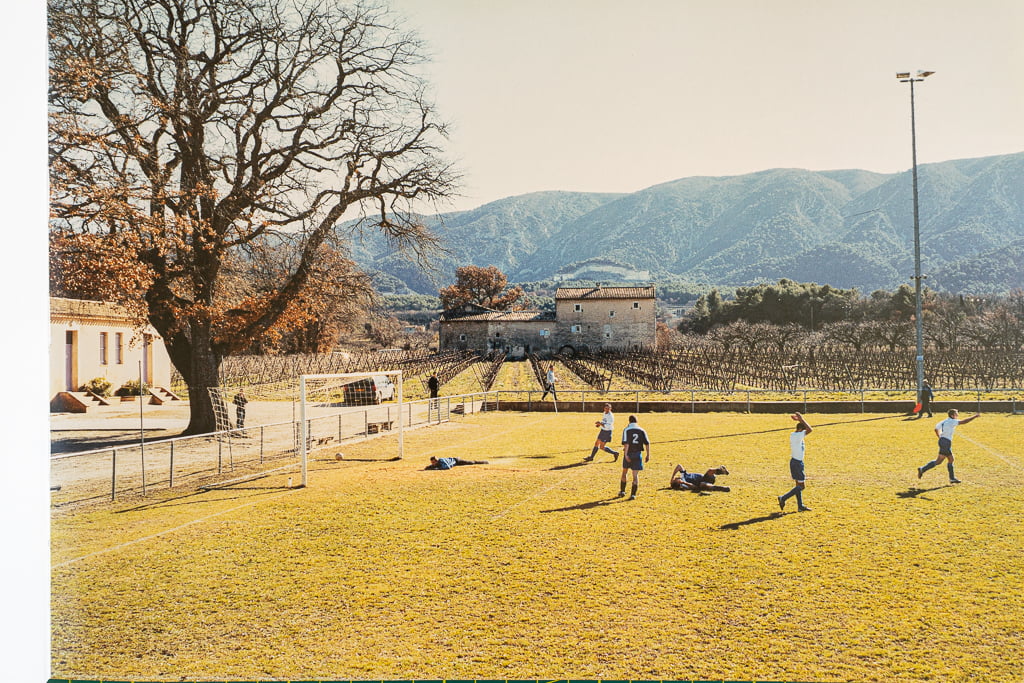
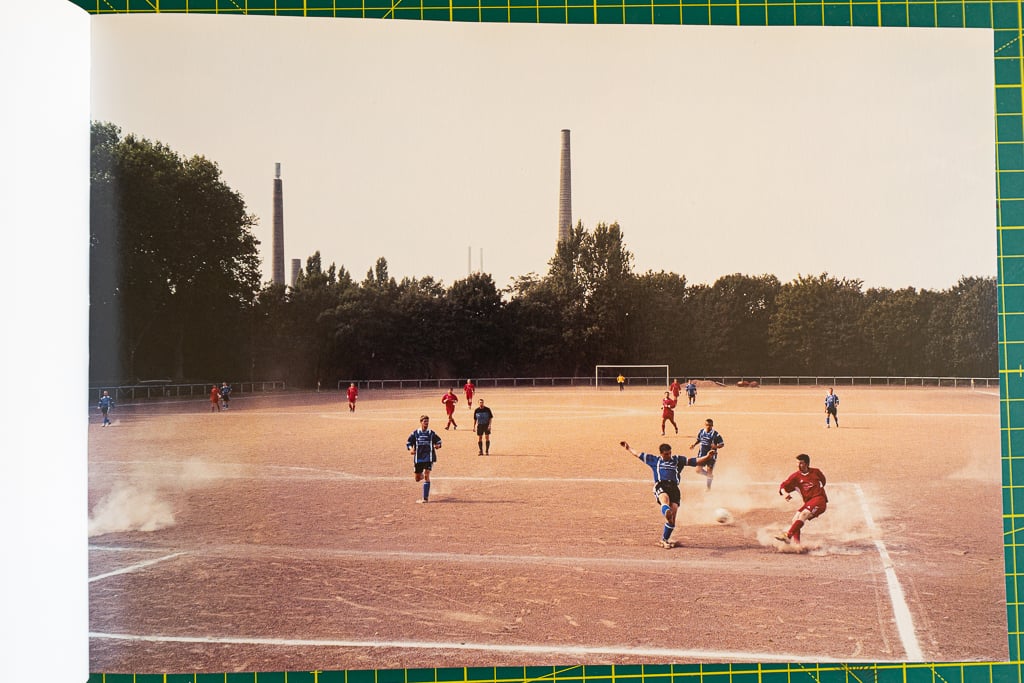
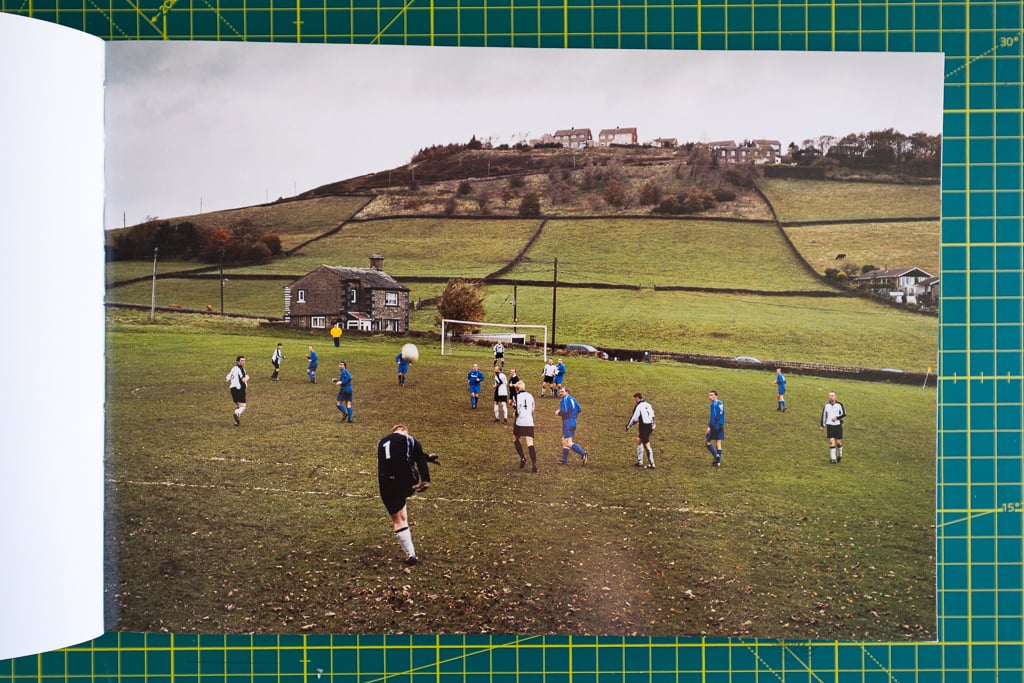
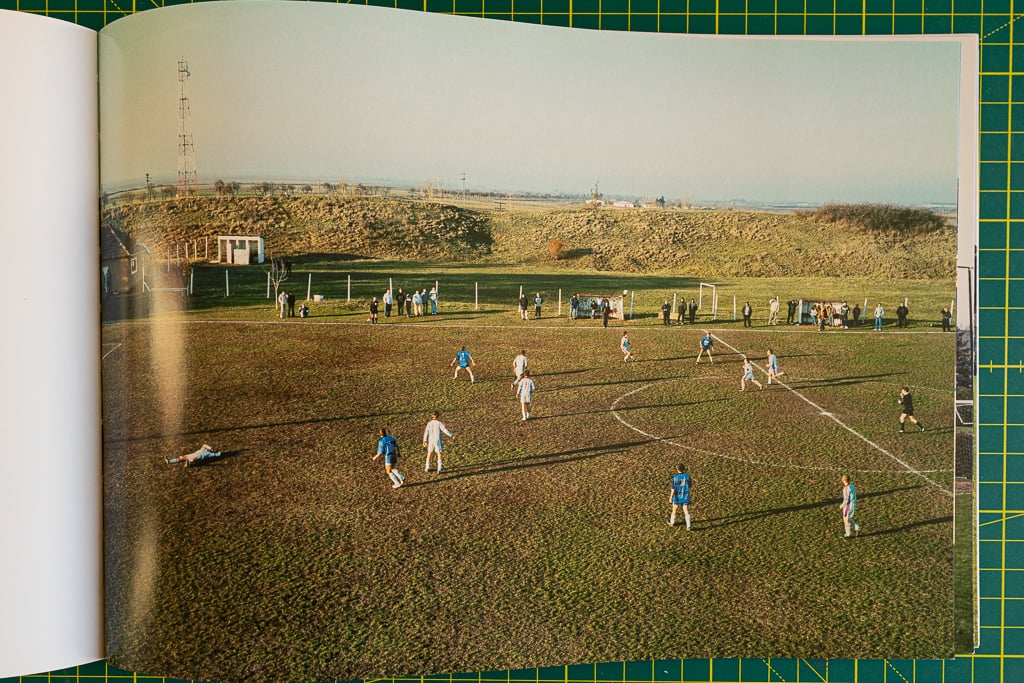
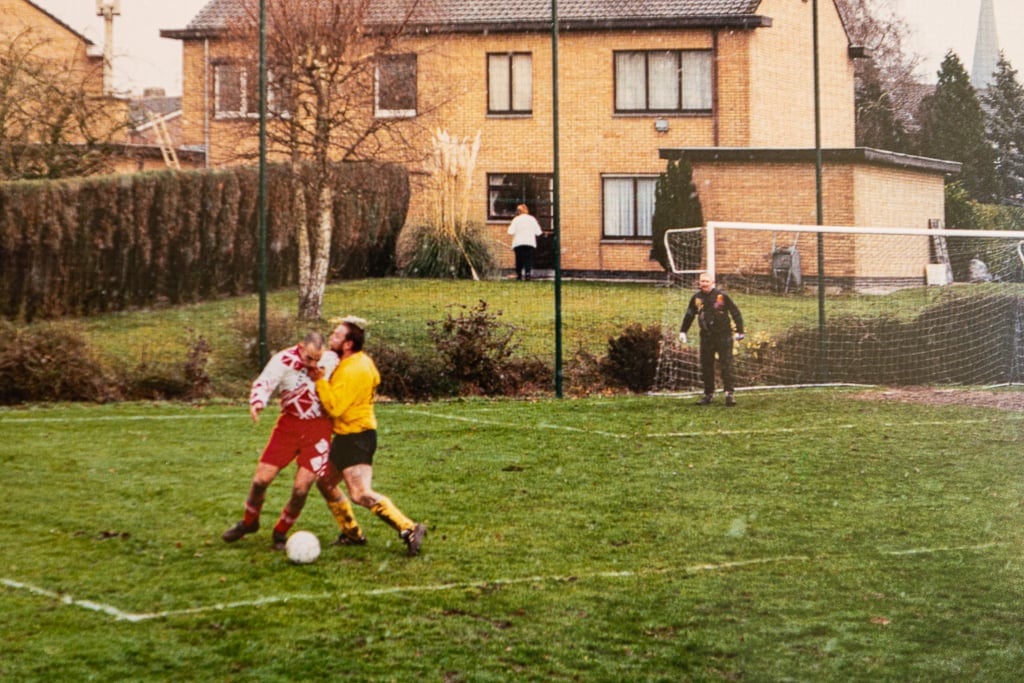
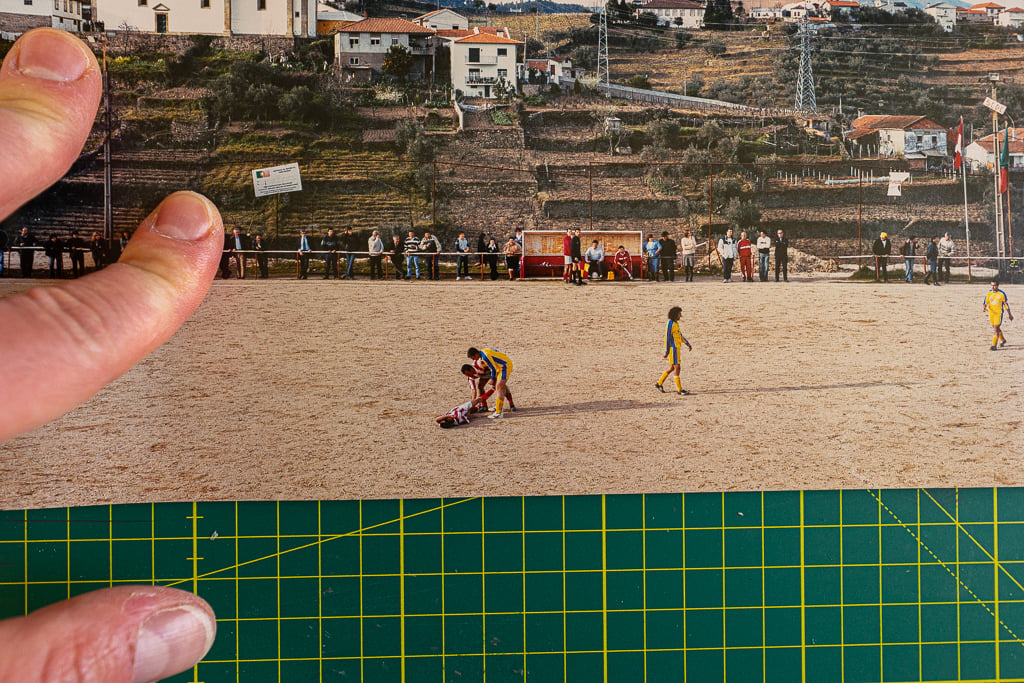
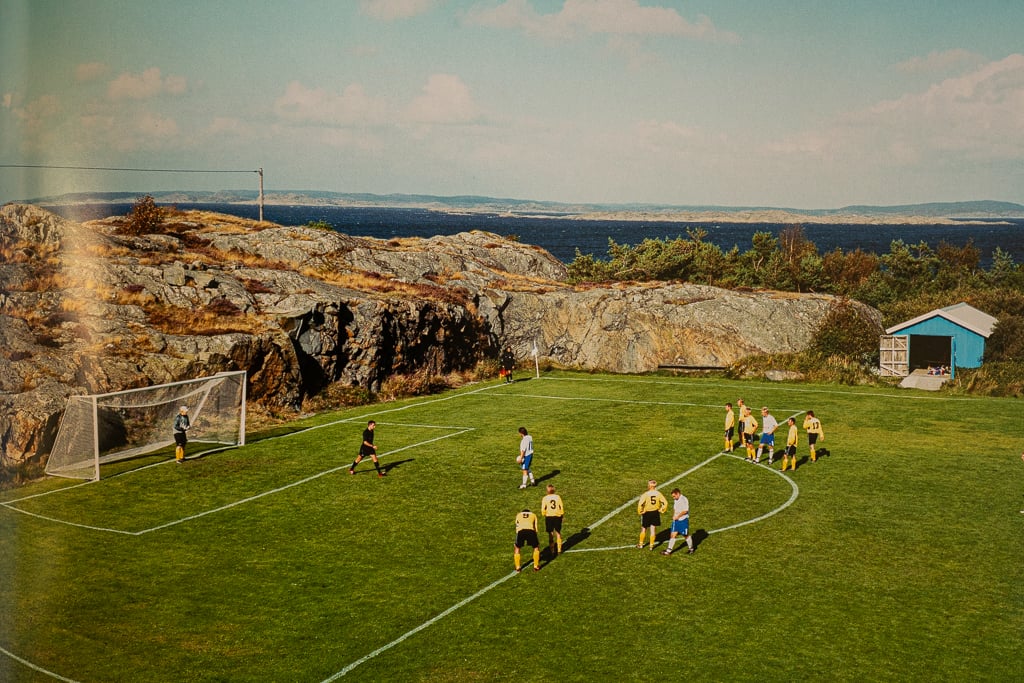
European Fields: The Landscape of Lower League Football
I can't quite remember when I first stumbled upon Hans van der Meer’s work. What I do know is that European Fields struck a chord in me the moment I encountered it. It immediately transported me home — to a familiar landscape of patchy fields in small towns.
There’s a particular magic in photo reportage that I find wonderful: the documentation of everyday aspects of culture that might not seem grand at first glance, but when carefully put together, these fragments form something beautiful and enduring.
European Fields is a perfect example of this. It brings out these humble fields in a way that is hard for me to put into words. Perhaps that is why this will be the longest review that I have made so far. With this work Hans van der Meer’s reveals that he has a deep understanding of a quiet aspect of culture, and by taking time to document it, it becomes a precious body of work.
Personally, this book also plays on a powerful spell: nostalgia! I grew up surrounded by fields like these. Every public school had one, sometimes rough and made of concrete, sometimes bare and with sandy soil.
Hans van der Meer’s focus on lower league fields is not a coincidence, it is essential to the spirit of this project. Quoting his intentions for the project:
“As far away as possible from the Champions League. “
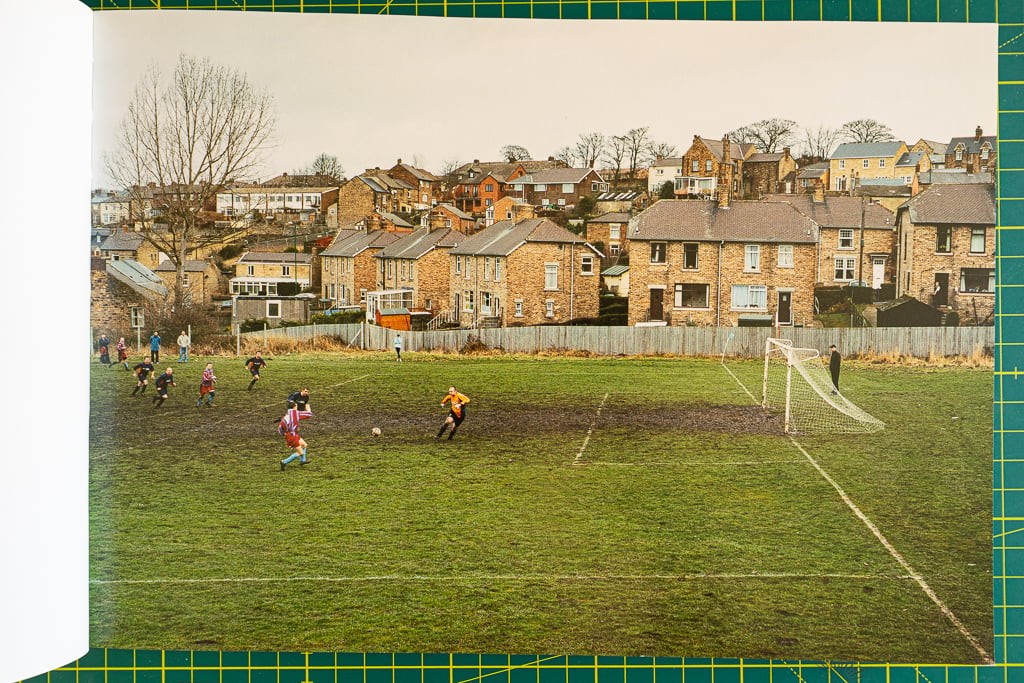
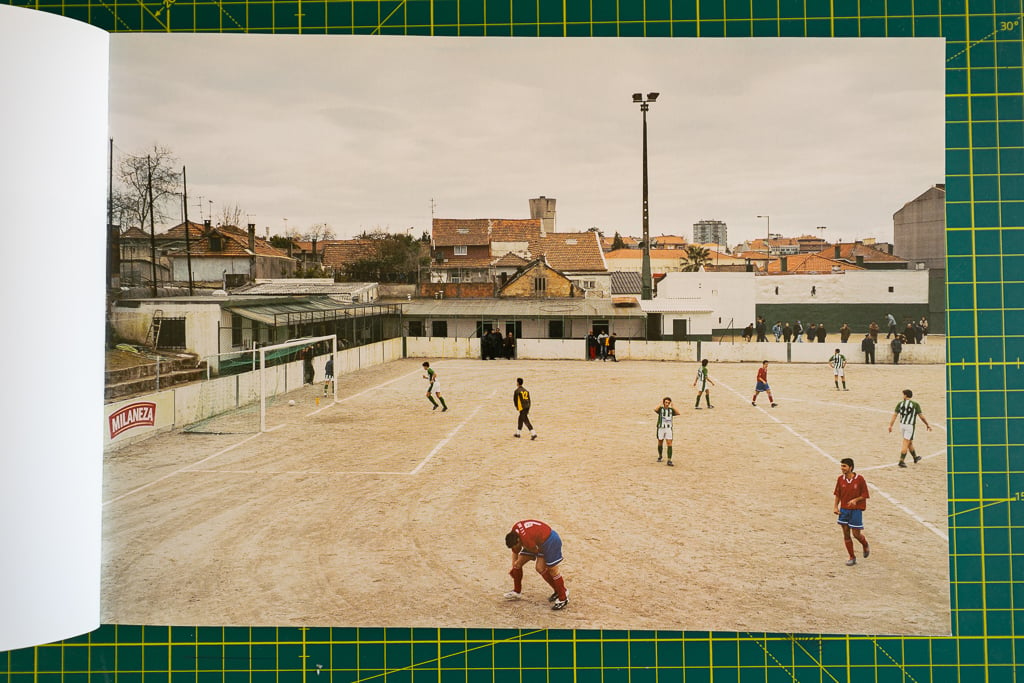
These aren’t grand stadiums built for show, they are modest fields dropped into the heart of communities, often at the threshold where the urban gives way to the rural.
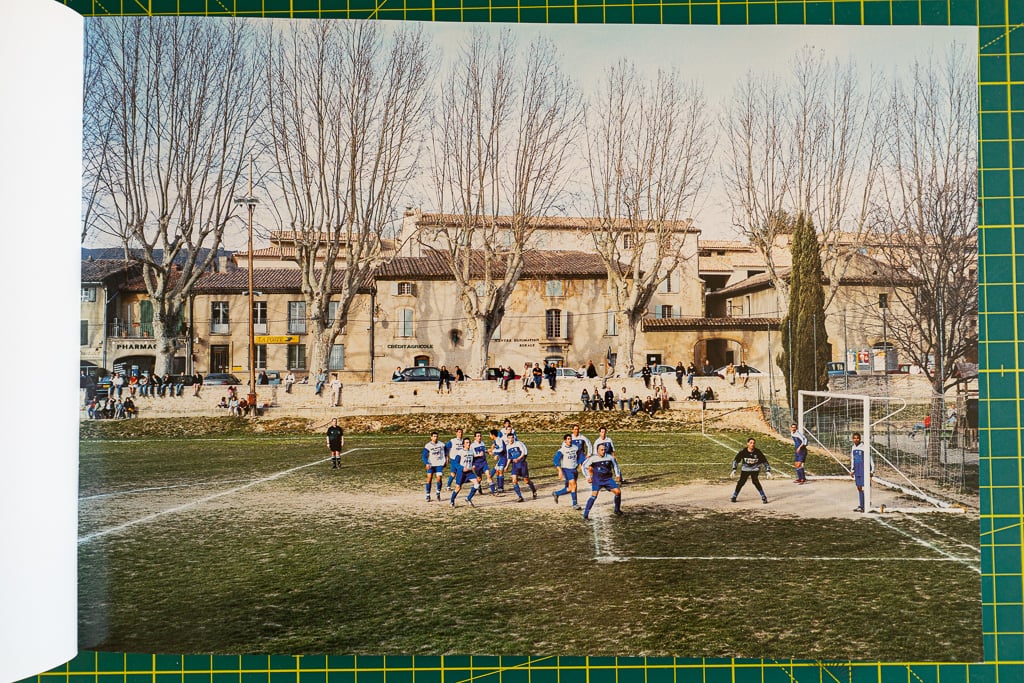
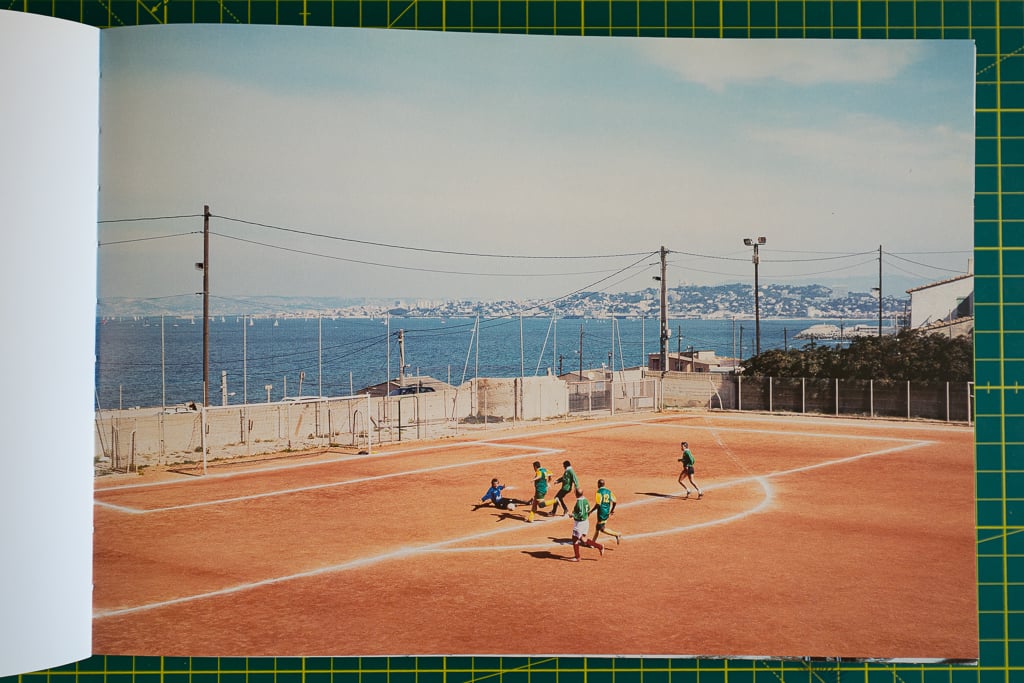
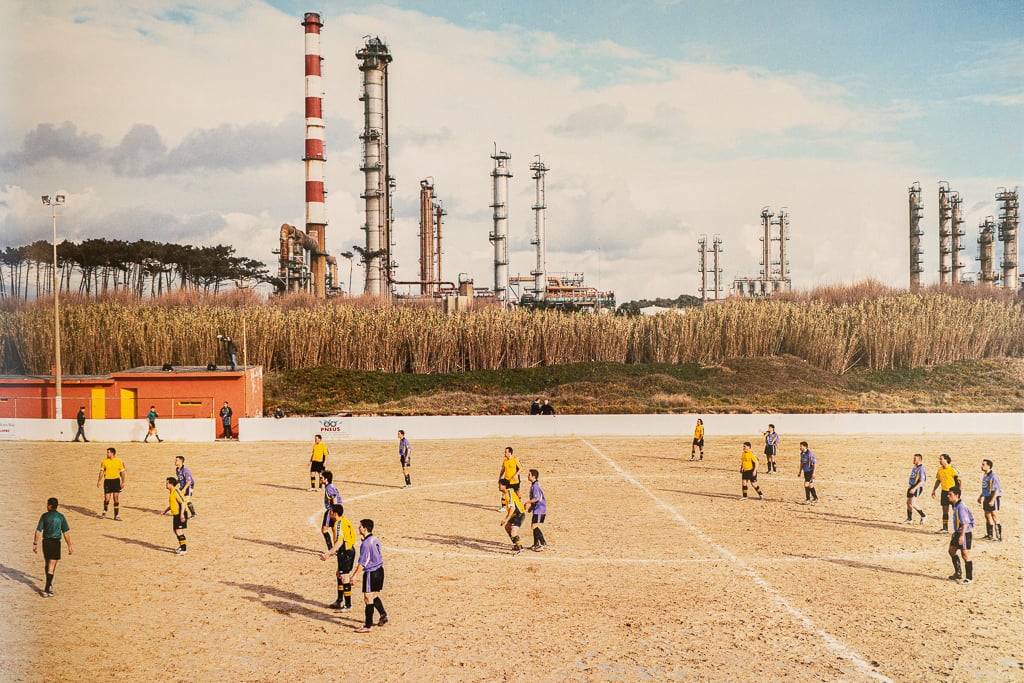
Some are edged by rocky hills, some by clusters of apartment buildings, others framed by vineyards or looming chimneys, some pushed against the ocean or sea. The locations alone offer a rich canvas for van der Meer’s keen eye for composition, which can be seen in almost every frame of this book.
My generation in Portugal, is all too familiar with this concept and it holds a special place in our hearts. That’s because the Portuguese public broadcaster RTP, had a TV-Show visiting these kind of fields and recording hilarious local characters that would feverishly attend all the games, and have no shame or filter when talking to the cameras, being their natural authentic selves. The show was called “Liga dos Últimos”, literally translates to League of the Last or more naturally to League of the Underdogs.
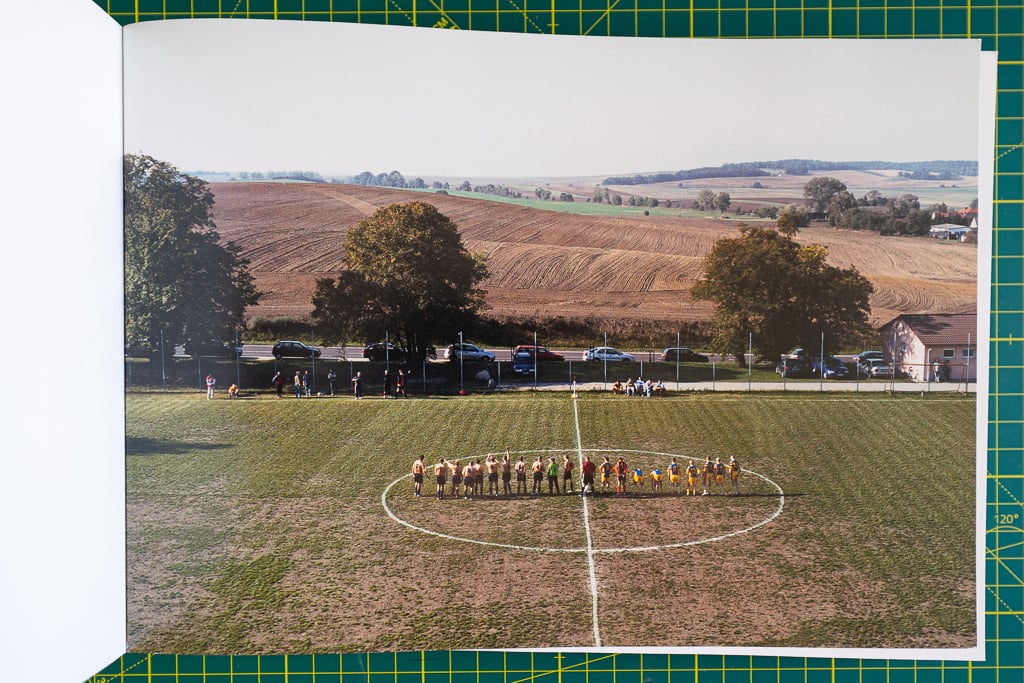
European Fields opens with a visually rich image: an agricultural landscape of rolling hills, freshly worked soil siding with grassy patches. Sliced horizontally by a road, dotted with perfectly spaced parked cars, likely from the players.
On the foreground lies a football field — dry patches of grass, two teams ready to begin their game, and a scattering of spectators. Some people perhaps family, others look recently ushered off the field as if they had been playing there before, and now they are about to see the real deal! Finally two figures lean in the shade of the building to the right, possibly the restrooms.
This photo sets the stage perfectly for what the book reveals: football not as spectacle, but as a dynamic, picturesque part of life, full of little details for us to discover.
Han’s broad view approach, can be seen throughout the whole book. It’s a conscious choice to which he speaks about in the foreword:
“In the archive, you could see how radically the photography of football had changed at the end of the fifties: space disappeared from the images.
In a sport, which is all about the position of the players on the pitch, the photographer had given up one of their most powerful weapons: the overview.”
Today, much of football's photography is about capturing fast movement and dynamic close-ups. But in doing so, it often loses the sense of the field as a space, of the relationships between players. In European Fields, Hans revives this lost language, offering sweeping overviews that make each match feel like a painting.
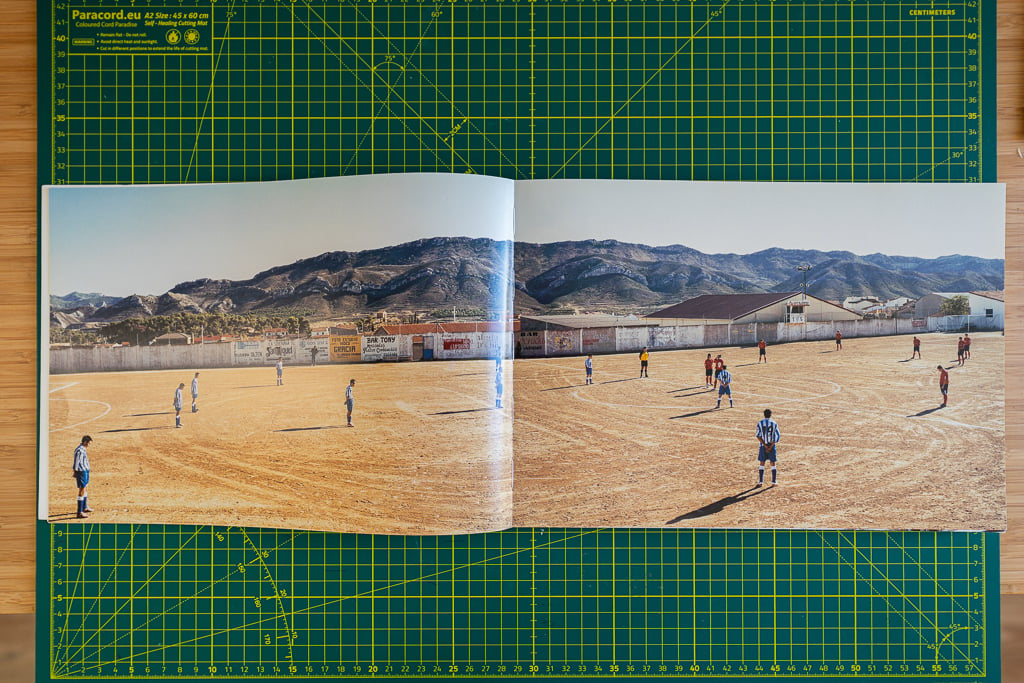
Technically, the book is printed in a horizontal format, allowing Meer’s wide compositions to follow the flow of the fields. In some spreads, a panoramic format stretches across two pages, creating immersive and textured landscapes.
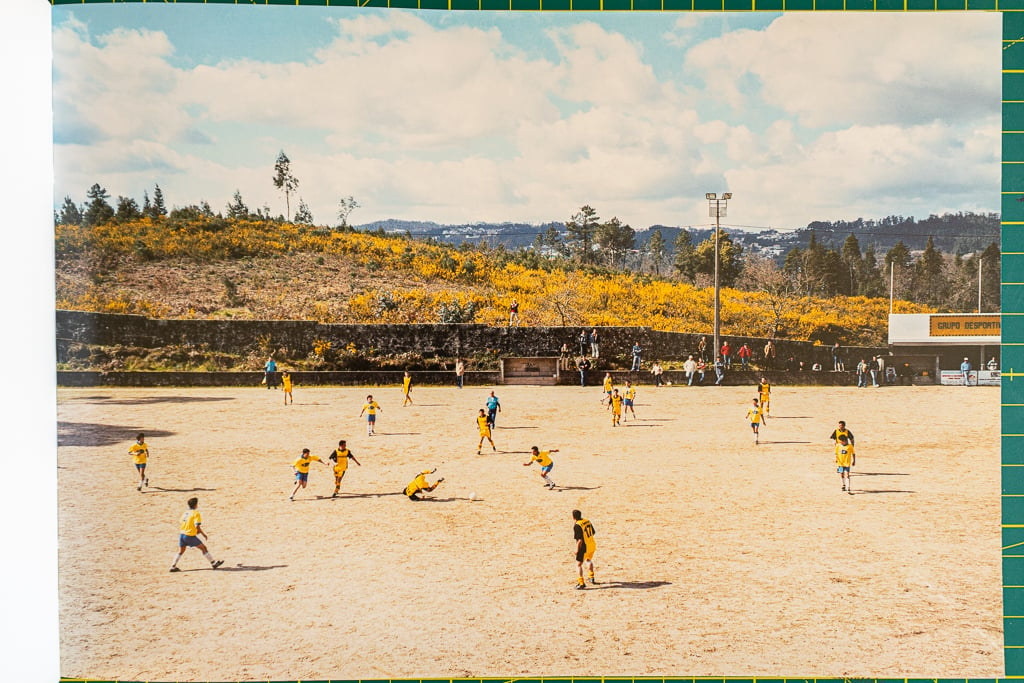
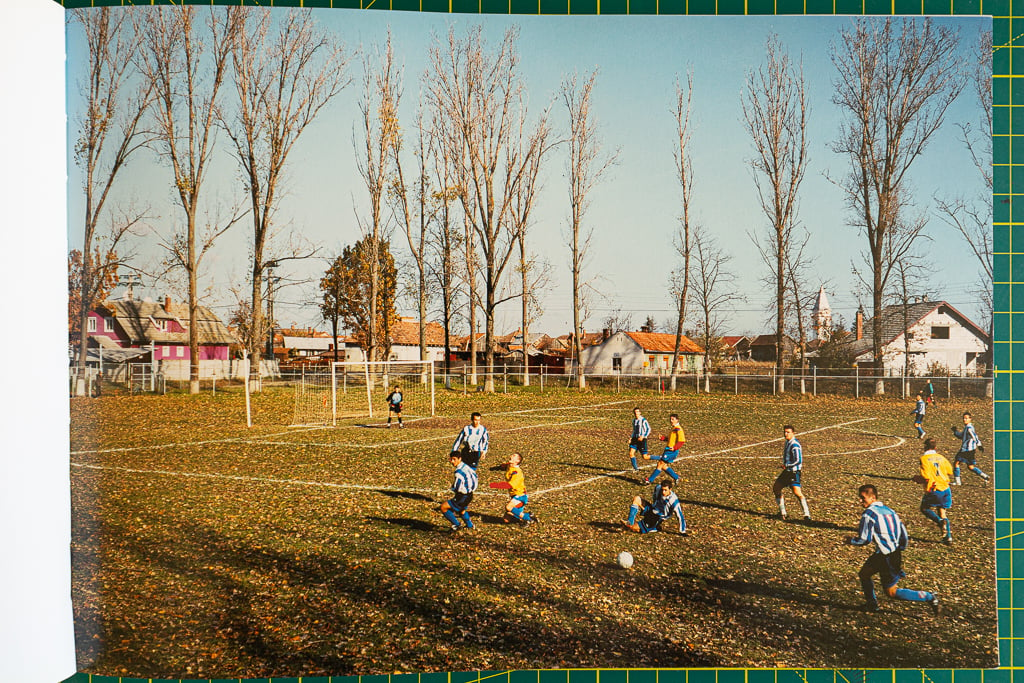
Certain photographs stand out vividly, like the one bellow. It shows players running across a field littered with autumn leaves, creating the impression that they are playing on a golden tapestry. Above, rocky dry hills and desert-like tones dominate the background, contrasting with the bright colors of the players' jerseys.
These details, like a game being played on a field of gold, root the book in the very specific aspect that Hans set out to capture. One far removed from the pristine ever green pitches and polished images of professional sports.
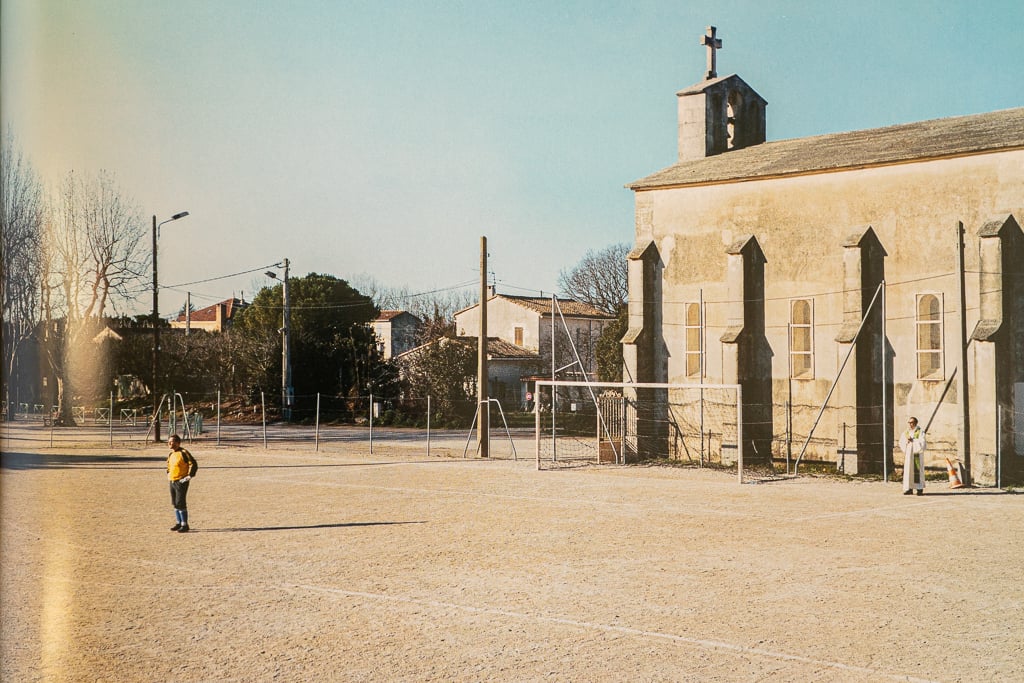
Every frame in European Fields feels considered, Hans finds compositions where the background — be it a church, industrial chimneys, the sea, or a mountain — become an integral part of the story.
His work is a gentle but profound reminder that beauty doesn't need spectacle. It doesn’t need stadium lights or roaring crowds. Sometimes, it’s just a group of neighbors - and to quote from him one last time:
“... they are a plumber, teacher, tax inspector, system analyst, salesman, bank clerk, farmer, garage owner, glass cutter, student or baker.”
They all gather on a muddy field, framed by the landscape they live in, playing for the love of the game.
Inspiration
Happy little mistakes
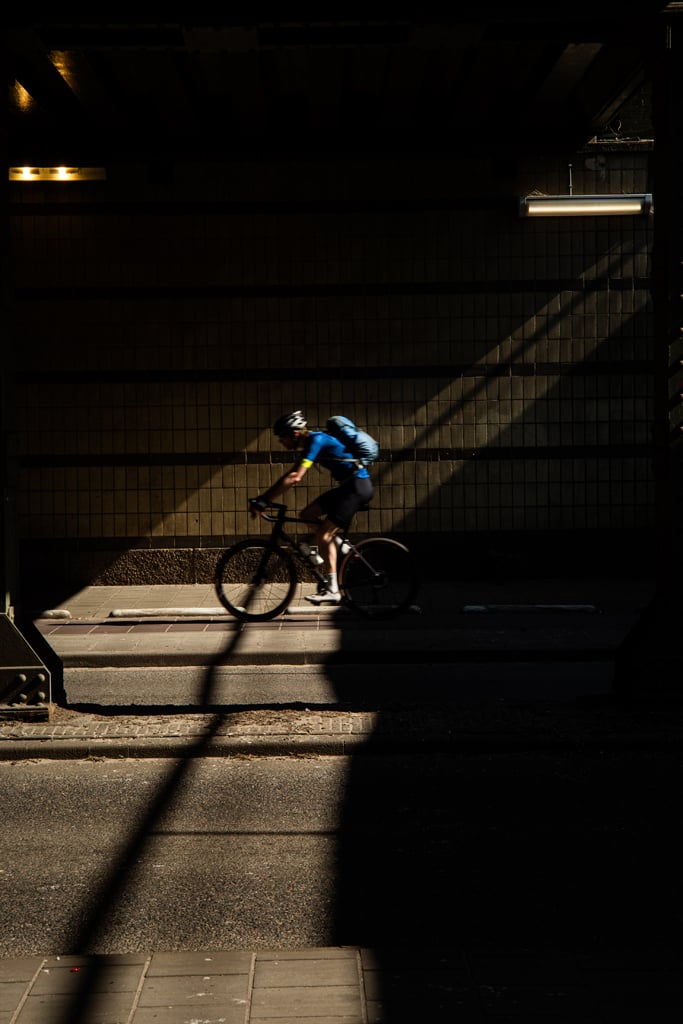
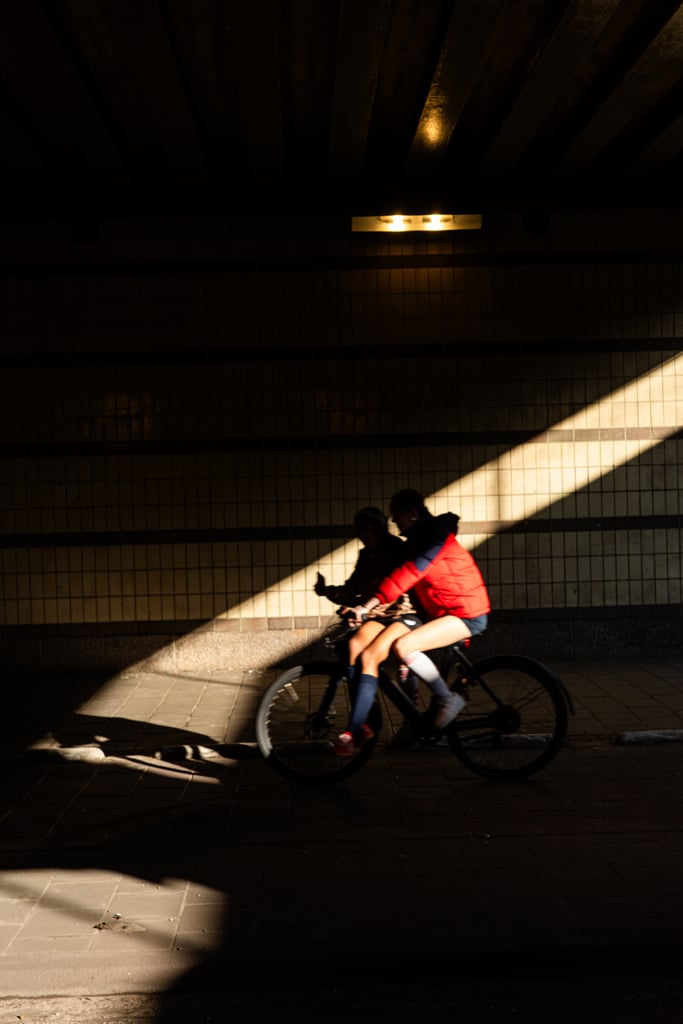
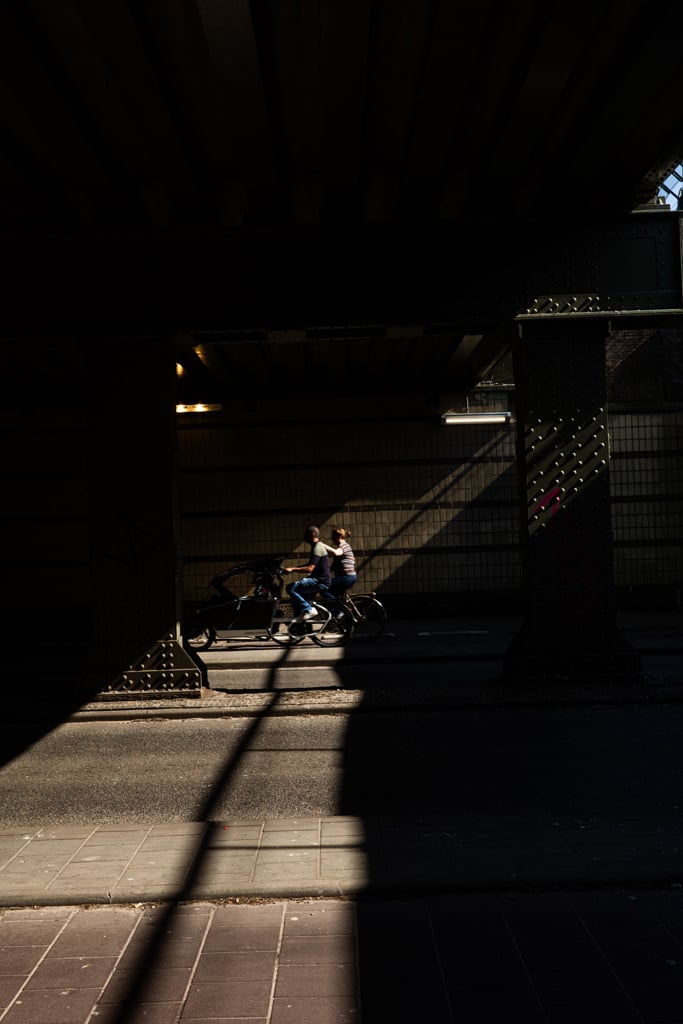
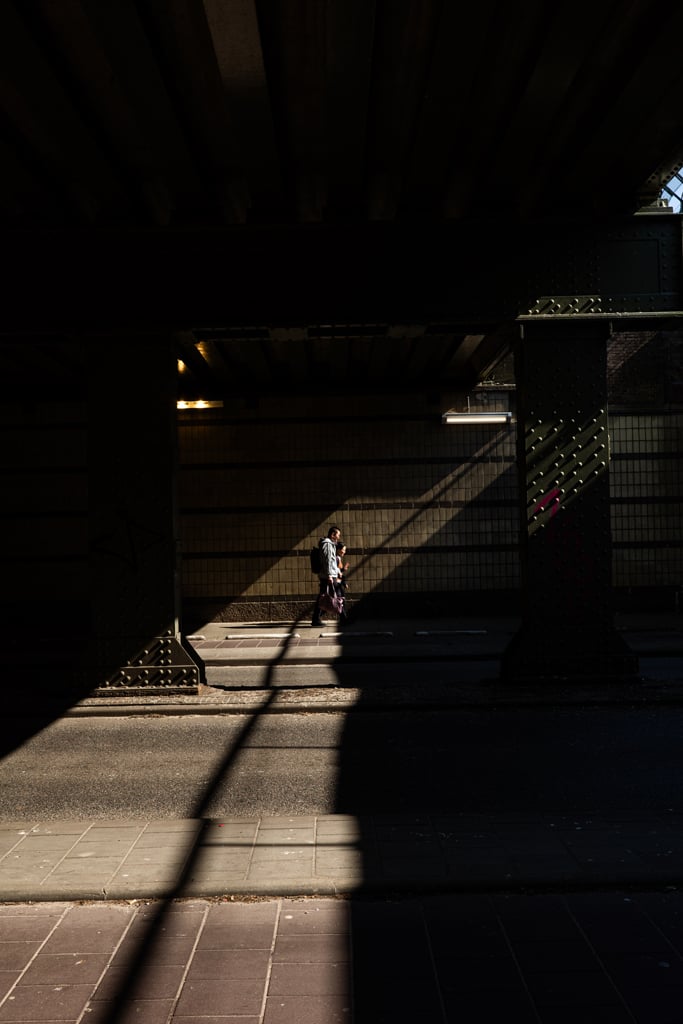
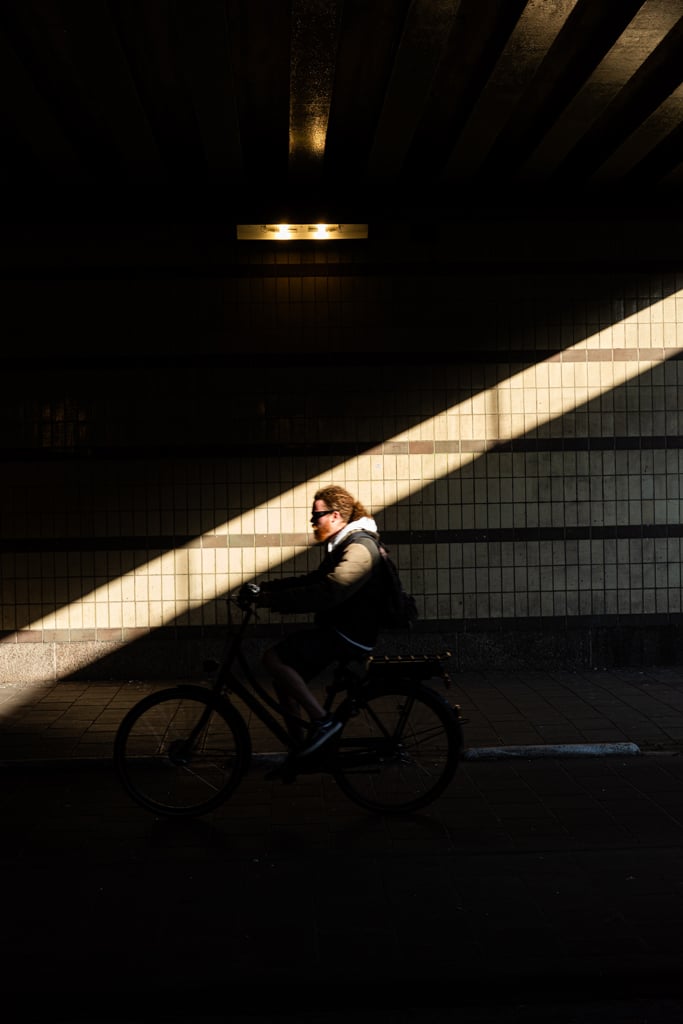
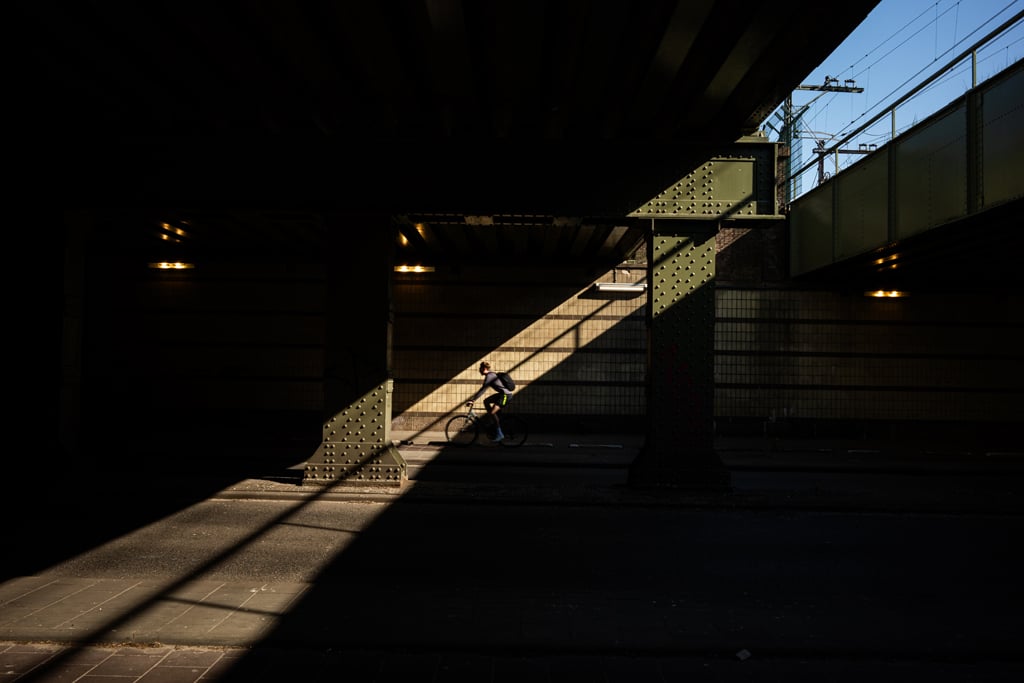
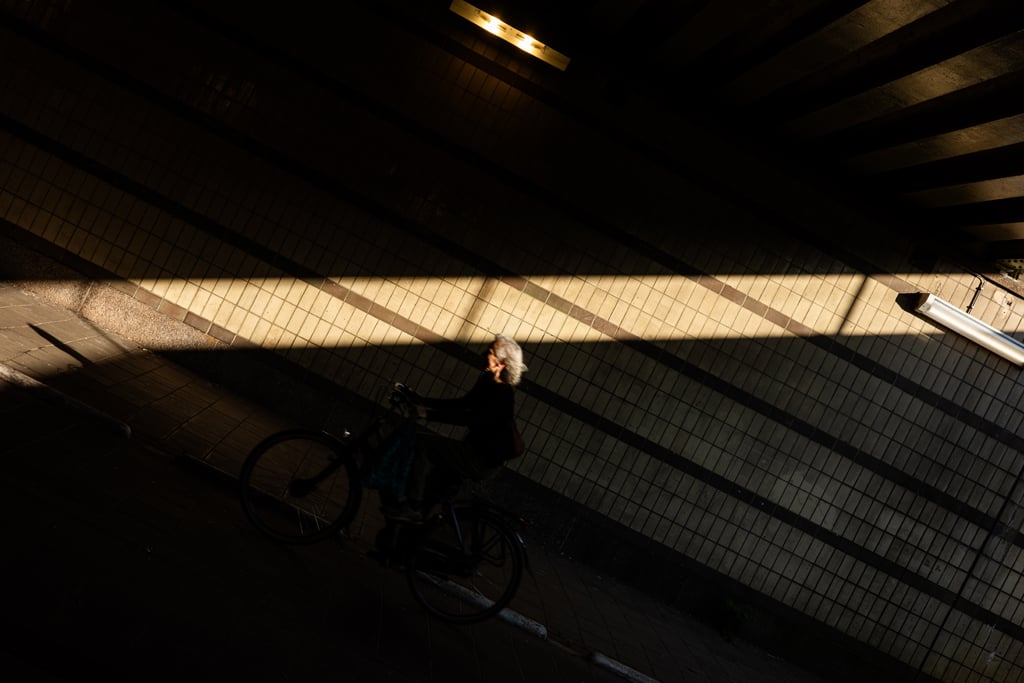
The other day I spent rather long amount of time meandering about on the same place. The reason was a mix of preparedness that combined with the Summer time change, placed me way to early under a train bridge waiting for a beam of light.
I had seen this beam of light during a run with a friend that took us under this train bridge. A sharp beam of light was there at 17:30 CET.
Since the hour went forward: 17:30 CET became 18:30 CEST
but in my mind I hast lost one hour of sleep, so time lost one hour right?
17:30 became 16:30
because 5 -1 =4
Brilliant Nuno!
To be sure I caught the light accounting for the days stretching and the exact time changing, I went there around 16:15 CEST, which means I had 2h:30m to wait for the exact moment I had seen some weeks prior.
Fortunately, with the art of mindfulness in my toolkit, and some podcasts too, I was able to kill the time. I got quite entertained people watching, there was constant stream of people going about their day, or bending the corner to go the local grocery shop.
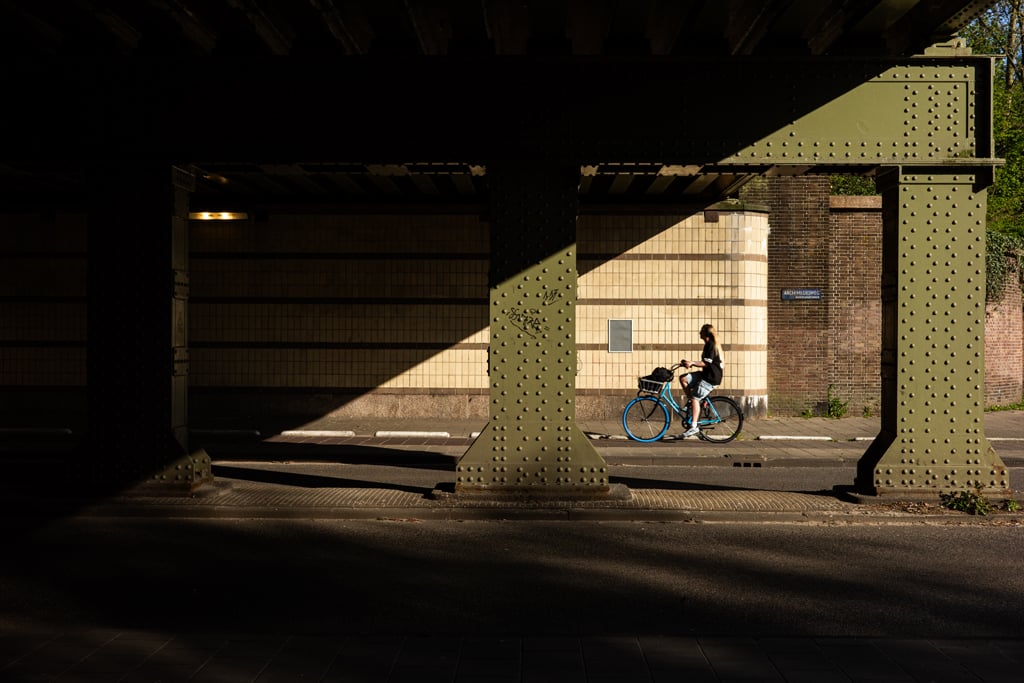
I spent a lovely time there, working the scene as we say in street photography. I was quite entertained to see and read the people traversing the under passage and their reaction to a weirdo with 2 cameras around his neck.
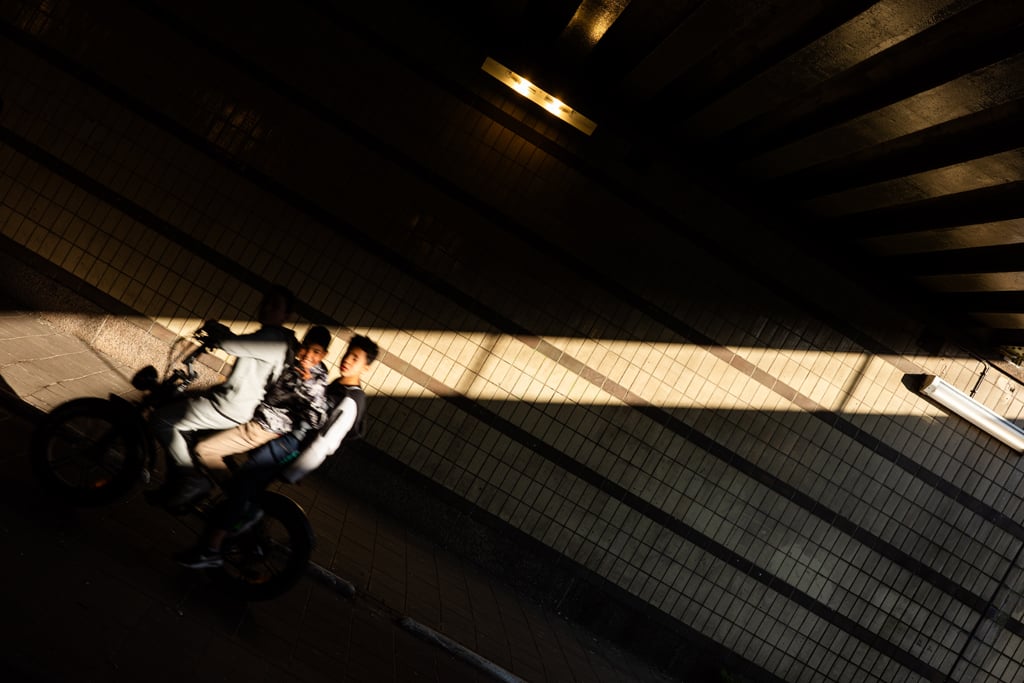
Some were skeptic with a side-eye; some were curious with a soft smile and a hi; some made a gesture while they crossed the frame. Everyone's different personality feeling the space of my awareness and little details jumping out. Like all the kids on box bikes would shout to play with the bridge echo, literally all of them. Just shows how growing up on a bike can bring such different interactions with the world.
At some point, a local boy stopped close by, not by choice, but by the will of a stubborn chain on his bike.
At first, I watched from a distance, thinking it best to let him figure it out on his own. He wrestled with the mechanism, determined but getting nowhere. You see, Dutch bikes are usually single speed and have a housing protecting the whole drive-train system. That thing can be quiet fiddly, specially on a rusty old one, which was the case.
After a while, I walked over and offered a hand. He shook his head, his focus unbroken, so I stepped back and let him be.
Later, when I glanced his way again, our eyes met — a silent, unmistakable plea for help could be read on his gaze. Without a word, I reached over with a faint smile, saying, let’s figure this out together. For a brief moment, I set aside the cameras, trading the role of photographer for that of a mechanic. A few minutes later the boy was on his way, and I hope with the knowledge to do this again on his own.
I am still keen to return to the spot to leverage the sharp light line for a portrait, but for a street scene the contrast revealed itself to hard to work with. That's when I started to play with the geometry of it.
I ended up spending a good time there and made enough photos that I was happy with. I didn’t even wait long enough for when the beam of light would be at its sharpest and how I had seen it for the first time. I had enough material I was happy with and left with a smile on my face, because of the happy little mistake that I made that day.
Poetry
Poetry is a thing in my life that don't consume enough of. It's really something I am very ignorant about, but every time I came across it I love it.
I draw a lot of parallelisms with it though, because a purposefully ambiguous street scene will be interpreted with a lot of weight from the viewer. We, people that do street photography, are highly drawn to visual metaphors.
So I will share a poem with you, a poem that was recently shared with me and resonated a lot within myself. I can't really tell why, but I loved it.


Add a comment: