Supervictims, Part III: El Porqué
Sometimes you think you're the one telling the joke, and sometimes the rule of three happens to you.
By the time I was seven, my father and I both knew I couldn’t draw.
Many years later, when I realized that the man who painted the cabinet of knickknacks in our front hallway with a pastoral scene that in later years I’d realize was “what if Van Gogh had been from the Caribbean and, you know, saner” might actually have intended to make a living from art once, I wondered how sad it must’ve made him.
Times in Puerto Rico were better then, but I can’t imagine that the money that went into painting classes at the Liga de Arte, some random dude’s mangaka classes, a copy of How to Draw Comics, and probably a bunch of other stuff I don’t remember right now, was filed under “Well Spent.” I walked away with a decent eye for color theory and, in time, an appreciation of how hard it is to translate the picture in your head to paper.
Later in life, when it was in vogue for each of my young charges to identify as visual, auditory, kinesthetic, or whatever other kind of learner made me a bad teacher for them, I realized that part of the problem was precisely that I have a lot of trouble painting a full picture in my head.
By then, in any case, I had chosen words as the preferred vector for my imagination.
Thing is, I didn’t stop drawing for another several years. I was never good at it, and I never became much better, but it wasn’t like anyone was offering to draw for me, and I didn’t have money to pay for it. If I wanted to design trading cards or sketch out a fictional superhero, I either accepted crap product or there was none at all. Adolescence, in its infinite mercy, brought with it the embarrassment necessary for me to properly assess my lack of skill.1
I was not planning to write a third part of Supervictims. Then I read The Amazing Adventures of Kavalier & Clay.
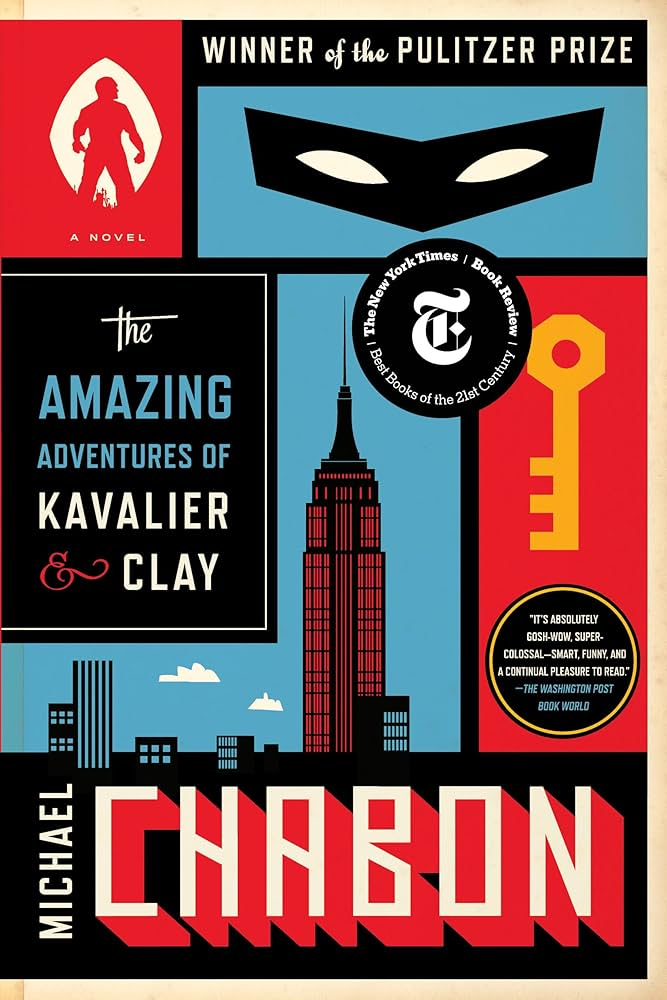
Since I would heavily recommend you read the book if you have an interest in comic books, the 1940s, stage magic, or creativity writ large, I’ll try to keep things as spoiler-free as possible, but I’m also well aware that some of you consider it a spoiler to be told an actor will eventually show up in a television program, so this might be the end of the road for you.
Spoiler warning: I’m serious here.
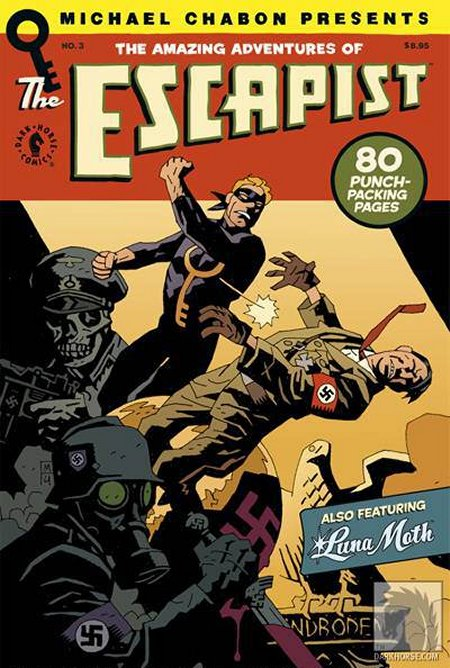
(Also, while I’m at this, there’s going to be a few swastikas in a bit—in the context of Adolf Hitler getting properly rocked.)
Lasciate ogni sorpresa, voi ch’intrate. [Really? You still need it translated?]
Despite this being a book full of guys who hang out at Tannen’s Magic Shop and know the name Theo Hardeen off the dome, it’s Chabon who pulls off the greatest trick of all in disguising a manual of creation—from the difficulties in transacting with the fickle deity Inspiration to how ignorance is constantly weaponized against artists in a country as spiritually and intellectually devoid as the United States—as a story about two Jewish kids in 1940s New York City who become part of the Golden Age of Comic Books through a combination of talent, hard work, and bullshit. If this had been an equally skillful and profound book about, say, a photographer and novelist at Yaddo, I don’t know that it would be as beloved.2
It may come as a surprise that I am not Jewish (and even more so that I was not a teenager in the 1940s), but if you and I have talked more than once or twice, you probably understand why this book had a downhill battle to appeal to me. When Josef Kavalier and Sammy Klayman3 sally forth with their great leap of artistic faith, we’re at most a year removed from the German-American Bund’s 20,000-plus, police-guarded rally at Madison Square Garden. War, and the totalizing nationalism that finally turns most USians against Nazi Germany, has not yet ended Charles Coughlin’s career as an alb-clad antisemitic fascist demagogue. Charles Lindbergh, one of the most famous men in the United States, is stumping for an organization whose entire raison d’être is to keep the United States from joining the second war it has fought against true evil.
In other words—though in a few years, in the book’s reality as in ours, no one will admit to being against this kind of symbolic resistance—it is a dangerous time to create a hero that punches Adolf Hitler in the face on the cover of his very first issue. Kavalier & Clay’s first employers, both Jews like them and appropriately horrified at the odious deeds of the Third Reich, nonetheless recoil at the thought of getting too “political” with their first issue.
Sam Clay forces the issue, because the hero they’ve created—the Escapist—isn’t Harry Houdini in tights, getting his rocks off by beating up street criminals.
In the brainstorm that creates the Escapist, Kavalier & Clay go in a single bound from cousins sharing a bed in a cramped New York City apartment to equal partners in the enterprise that will define their lives, for good and for ill.
One paragraph shows you every facet of the young Sammy: his understandable desperation to scrabble out of a meager existence, his resentment at everyone whom he feels stands in the way of him attaining it (whether that be his liar of a father or the Führer), his need to be recognized and appreciated and loved, his tendency to promise the moon whether he can deliver it or not, his burning desire to help his cousin Josef free the Kavaliers from occupied Prague.
“To all those who toil in the bonds of slavery and, uh, the, the shackles of oppression, he offers the hope of liberation and the promise of freedom!” His delivery grew more assured now. “Armed with superb physical and mental training, a crack team of assistants, and ancient wisdom, he roams the globe, performing amazing feats and coming to the aid of those who languish in tyranny’s chains! He is”—he paused and threw Joe a helpless, gleeful glance, on the point of vanishing completely into his story now—“the Escapist!”
Rousing stuff, isn’t it? In part II, I complained that I wish Puerto Rican superheroes who were dealing more directly with the causes of my people’s problems—crypto bros, federal neglect, a corrupt political class. You can see a similar passion undergirding Sammy’s narrative here, although, as we will discover over the course of the book, the tenement walls are only the first and most physical set that he feels closing in on him.
He probably doesn’t even realize it, which is why after Kavalier draws the first ever picture of the Escapist, he reminds Sammy of a previous conversation they had.
I didn’t need the reminder, both because the days that had passed for Kavalier & Clay were mere minutes for me reading, and because I knew this conversation would stick with me for the rest of my days.
“What is the reason for Batman? The why?”
“His parents were killed, see? In cold blood. Right in front of his eyes, when he was a kid. By a robber.”
“It’s revenge.”
“That’s interesting,” Sammy said. “See?”
“And he was driven mad.”
“Well . . . ”
“And that’s why he puts on the bat’s clothes.”
“Actually, they don’t go so far as to say that,” Sammy said. “But I guess it’s there between the lines.”
“So, we need to figure out what is the why.”
“‘What is the why,’” Sammy agreed.
If there were a way to tattoo a thought upon the mind, this would be among my first choices.
Like Sam Clay, I’m familiar with being respected for what I can provide in the same measure as I’m expected to stay out of sight and forgo any credit. That’s the double curse of being Puerto Rican and a teacher.
Also like Sam Clay, I’ve been a bullshitter my whole life, ever since I landed in the principal’s office in fourth grade because I promised to pay a few classmates money I didn’t have for helping me to script a movie that was a by-the-numbers knockoff of Star Wars.
The lesson was obvious: stop overpromising. It went unlearned.
Worse yet, the chief target of all that hornswoggling, the person I’ve most disappointed over the decades, is me.
My creative life is littered with unfinished books, messes of worlds that keep getting rebuilt as I realize how immature they are, plotted-out stories that just need to be written, half-baked game ideas that never make it past design bibles if that, deep dives complete with nice-looking graphs into baseball players that don’t exist, great overarching lesson plans that fall apart by midquarter. Each new project crumbles the moment it becomes clear in my head that it will not, in fact, be the reason I never have to work again; most never even reach a monetizable form. Frankly (and I realize how ridiculous this sounds in a world where almost no one makes a living via the written word) unless someone ever hires me to do the kind of stuff I want to do, I’ll never know if I truly have the capacity to write well and plentifully enough to be successful at it.
If I were doing the things I do for money, for fame, for respect, it would be delusional to continue. Maybe that’s what I am, but I think there’s something else at play in this Noah McKinnon character.
Namely, throughout my entire life, I’ve been convinced of two things: that I don’t know what I’m doing, and that no one actually wants to be around me, that they’re just pretending to be polite, or worse yet, that once they find out who I really am4, they’ll disappear. I have no real, objective reason to believe that—of the friendships I’ve lost over the years, most broke under the siege of the calendar and the odometer, or I ruined them myself in a moment of imperfection or jealousy or to reify the grief I anticipated—but it is nonetheless dug deep into my bedrock.
The bluster, the constant projects, the pretense of creative industriousness, are a shield: if I’m always thinking up new things to do, I don’t have to wallow in failures and half-starts. There’s no time for that.
Better yet, what if I got two birds stoned at once? What if I could get someone else to share the burden, refine ideas, commiserate over failures, celebrate successes? Then I wouldn’t feel so alone, and maybe being responsible to someone else would activate the guilt center in my brain enough to keep me on task.
So I’ve spent most of my life looking for that person: someone who has the talents I know I don’t, who can riff continuously on the same thought until it’s perfected, who has the same drive to leave something in the world that wasn’t there before, who wants to do good through their art. In short, the Kavalier to my Clay.
My track record hasn’t been great here, and can you blame the rest of the world? There’s no point in partnering with someone who will promise you anything to keep you from abandoning him. After all, the only person I’d ever worked with for any length of time, my oldest friend, simply dropped out of my life and went to work for a guy possessed by a sentient beanie.
Even now, half a decade into a real partnership that could scarcely be closer to this Holy Grail—not only has it produced (at the risk of self-plugging) some really excellent stuff, it’s lasted through a pandemic, the current disaster that passes for a federal government, several personal and professional tragedies—the idea that someone might actively want to work with me refuses to stabilize in my mind.
There are many reasons for that, but one I’m beginning to realize is that this whole time I’ve had the wrong idea in my head as to why I write, record, design logos, uniforms, build other worlds.
After all, why do I have a fictional Puerto Rican baseball league? So I can see a fairly realistic world in which Puerto Rico is free? No, it’s because I want you to see a fairly realistic world in which Puerto Rico is free.
It’s because every time someone tells me about a conversation that was enabled by a shirt with a mascot and a Puerto Rican town name, I feel like I played a small part in bringing the world closer to singing in perfect harmony.
Why do I keep talking about food every other week, when it’s clear at this point that I know a lot less about cooking than I thought I did and I’m running out of new jokes to make? Because it guarantees that, for a few hours every week, I get to talk face-to-face with a good friend.
Why did I write all those books, design all those games, make all those lists? Because those ideas excited me, and I wanted other people to be excited about them with me.
That’s the last thing Sam Clay and I, and probably other artists with similarly saturnine dispositions, have in common. Our art is not only our way of striking blows for freedom and justice; it’s how we feel less alone, even when we most piteously hate everything we are and everything we’ve ever done. It’s how we plant the seeds of the connections that sustain us in our worst moments. It’s how we reassure ourselves that we’re part of the world, by stamping it with our handiwork.
Now that my ability to express Big Feelings has gone on cooldown, I’m supposed to wrap this up with a bit of humor. Unfortunately, I’ll have to outsource it to Chabon.
At one point, Clay says to Kavalier:
“Christ, Joe, you fucking idiot,” Sammy said. “We love you.”
May each of us find all the people willing to say that to us—and mean every word of it.
On the other hand, I’m thirty-six now and decades of negative reinforcement have not stopped me from singing, which suggests that perhaps I dragooned adolescence into serving as an excuse. ↩
To be clear, I would also be firmly in that camp of skeptics. Francis Spufford, whose Cahokia Jazz is the kind of intricate alternate history I die for every time, told me once that “making things up is a fundamentally childlike, undignified activity; and I think you should lean into that.” I think we can all agree, no matter how many Contracts With God are out there, that the comic book is better suited for exploring that fundamental immaturity. ↩
Chabon openly acknowledges that his main inspiration for the book is Jack Kirby (and in researching for this article, I discovered that Kirby’s writing partner Joe Simon was born in Rochester, yet another point of pride for the Flower City), but when Sam chooses to Anglicize his name to “Clay,” it obscures what I think is an homage-via-alliteration to an equally famous duo of the era. ↩
If you know, do me a favor and tell me. I’ve been wondering for years. ↩

Add a comment: