Machines of Eventual Disappointment
It's a bad time to be a Team USA fan—and if you are, you deserve every second of it.

Allow me to tack another entry on the unending list of intelligent decisions I make. After starting a brand-new online publication one day ago, I’m now going to go after everyone’s favorite feel-good baseball player on everyone’s favorite feel-good baseball team: Cal “Big Dumper” Raleigh, of the Seattle Mariners.
If you want a quick overview of the situation, you can read about it here, but basically: Raleigh, who is catching for the US baseball team, refused to shake his own teammate’s hand; that teammate, who is playing for Mexico, cussed him out fairly extensively and in two different languages to a number of reporters; and before the next US game, Raleigh addressed it in a fairly vague, boilerplate way, as Major League Baseball players usually do.
That’s not actually what I’m here to talk about. Raleigh claims he told Arozarena beforehand not to be overly friendly during the WBC, and it wouldn’t be the first time Arozarena gets bent out of shape in an emotionally charged situation. Even if I find Big Dumper’s answers on the incident rather evasive, I’m willing to give everyone involved some benefit of the doubt.
What I’m not willing to put up with is a ballplayer wearing this fucking thing while talking to the press:
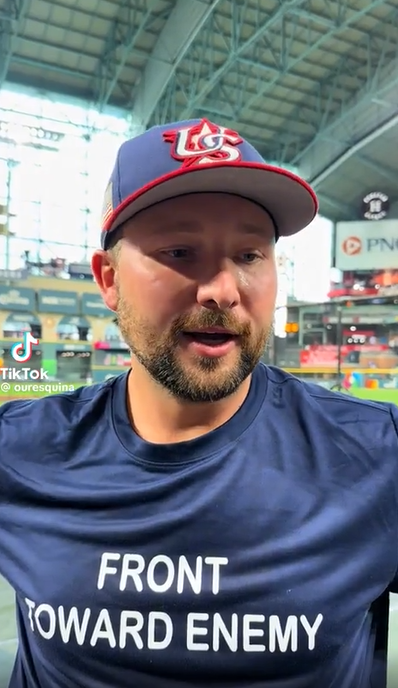
Again, I want to give Raleigh the benefit of the doubt that he had tried to prevent this situation ahead of time and it didn’t work out for him.
Regardless, I’d hope we can all agree that it’s wild to talk about how much you love your teammate, who’s playing for the Mexican national team, and repeatedly mention that he’s your “brother,” while wearing a shirt that implies you consider opposing teams (most of which are from Latin American countries) not just competitors, but literally “the enemy.”
I’m neither the first nor the smartest person to observe this, but the vibes for this edition of Team USA are dire.
Korean players are throwing their bats around. Dominicans are redefining the home run celebration. Italy has a dang espresso machine in the dugout. Literal first-percentile baserunner Martín Maldonado, freed from the vicissitudes of a long baseball season, added to his heroics for Team Rubio by hitting a bases-clearing double.
Meanwhile, US outfielders are snapping off salutes to each other like they just got done double-tapping an elementary school. Reigning Cy Young winner Paul Skenes is writing 1,750-word letters to kids about how even though he transferred out of a military academy so he could make actual money playing baseball, he’s still a Troop at Heart, and don’t you forget it.
It’s weird, because you know what Paul Skenes and I have in common? Neither one of us will ever deploy as an active-duty member of the United States Air Force, but you don’t see me bragging about how the only military value I’ve stopped honoring is hair regulations.
Bluntly put, no matter how many times Mark DeRosa gets surprised by one of his players actually showing some personality (or by the structure of the tournament he volunteered to manage in) Team Stolen Valor seems like a particularly humorless edition of the US national side, and that is going some.
I can’t help but notice that this is also an impressively white version of the US national side (Buxton, Judge, and coach George Lombard excepted), and given how Caucasian ballplayers trend in both politics and general personality, I can only imagine what a circle of hell that locker room must be. Maybe that’s why Nolan Arenado is playing for Team Rubio this time around.1
Here’s where I might get myself into trouble again: I know it’s suddenly en vogue in lefty online circles to hate on Team USA, and maybe even cheer for other teams, but the thing is I’ve been there for most of my life, and (and lefties love to point this exact thing out) you get no points for being early.
Quoting myself, courtesy of my friend and editor Zoë, about a different international competition:
It's a very familiar assumption, and when you've been reminded your whole life that you and your family live on one of those possessions – that everything you had, material or otherwise, was by the so-called grace of your overlords – it is difficult not to find it disturbing, especially when you see even people who are politically sympathetic take the Olympics as a chance to let their patriotic hair down and be Americans for a change, soothed by the supposed neutrality of sports, while your people's victories, infrequent though they may be, become acts of athletic defiance against the empire that subjected them to a century and a quarter of deprivation.
Everywhere else sports and American patriotism intersect – two-anthem baseball games; the pushback on athletes who take a stand against police brutality; the direct involvement of the military in sporting events – a lot of us see through it, but the marketing teams for the Olympics have truly gone above and beyond to convince us that they are somehow above such petty concerns.
My feelings on the matter have not changed. Unless you’re so USian you can’t deal with tiebreaker rules including run differential, in which case I already don’t expect much better from you, I have every right to judge you if you’re cheering for this bunch of military cosplayers. The World Baseball Classic reveals a fact any of us lucky enough to fly another flag have known our whole lives: most of the players that make baseball a special sport aren’t from the United States.
That’s one reason I’m annoyed at the fact that you can now actually score points by talking about how much you hate this version of Team USA, as though they were somehow uniquely boring.
The other is that this should be old news at this point, because we had the dress rehearsal for this last month.
No matter how Jack Hughes feels about Pride Night, he and most of the U.S. men’s hockey team were perfectly happy to serve as symbols for Trump and his fascist party. Hughes himself defended that decision in a fairly vague, boilerplate way, as National Hockey League players usually do.
It must’ve felt really painful to be one of the people who rushed to defend his honor right after the game, before they partied with noted domestic intelligence chief and podcaster Kash Patel and laughed at the president’s misogynistic joke. I wouldn’t know, because when people tell me to expect hockey players to have shit politics, I take them at their word.
That’s ultimately what both of these sports stories show us, more than anything: people, even people who accurately see every horror and nightmare the United States creates or abets, were willing to lock a lot of their thinking brains in an attic in order to cheer for the red, white and blue. The real reason people are so angry at these teams isn’t because the players have terrible politics; as noted above, it is common knowledge that white baseball and hockey players mostly have garbage brains incapable of humanizing anyone who isn’t already a pro athlete. I’ve never seen someone stop cheering for the Dodgers because Clayton Kershaw’s a homophobe.2
It’s because the players broke the contract. In openly identifying themselves with the government and military of the United States—murderous enterprises whose monstrousness grows by the day—rather than any of the actual positive traditions of the United States, they ripped the veil in two. Now no one can pretend not to know the exact dimensions of chuddishness they’re cheering on.
The worst part is that on top of ongoing support and adulation, which is bad enough, these athletes also get the benefit of the lowest expectations I’ve ever seen put on anyone, and let me remind you: I teach the children of rich people who didn’t feel like sending kids to an actually competitive boarding school.
The conversation about how white ballplayers should behave themselves in public begins and ends at “I don’t want to know.” Fans generally acknowledge that if they knew more about Kyle Schwarber’s beliefs on law enforcement than his face has already told us (which is everything) they might have a hard time enjoying the next 460-footer he hits.
It’s not that I don’t get it. Somehow, given my experience with stateside Cubans (to most of which I’m related), I don’t think most ballplayers who’ve defected are quite as het up about their country being starved to death as they were about the antigovernment protests a few years ago.
On the other side of my heritage, for every Carlos Delgado or Roberto Clemente, there’s quite a few guys who keep their mouths shut, show up to the ballpark, do their job, and go home to their families.
The difference is that I am capable of holding the players who share my ancestry to a higher standard. We share, at least theoretically, some elements of our cultural understanding in the world; we may have grown up seeing the same things, living through the same things, and even if we feel differently about them, we should at least be able to hold a conversation about them where I can reasonably expect to find the other person somewhat knowledgeable and thoughtful.
Sure, not every Puerto Rican player can be Delgado or Clemente, but every Puerto Rican player who holds them up as their heroes should try to be as much like them as they can, and frankly, as a Puerto Rican baseball fan who considers Clemente a personal hero, I expect them to try, because trying was Clemente’s whole deal.
By the same token, not every white ballplayer can be Joey Votto—and they shouldn’t, because Joey Votto is not a repeatable experience—but I sure wish more of them would make the effort to be more like him. Maybe being Canadian helps. Or maybe it doesn’t.
These are men who, for the most part, will enjoy immense social privilege and the kind of wealth most of us will never acquire over our entire working lives. They do not need you, I promise, to insist on their right to be ignorant, or incurious, or narrow-minded, or all the other things they already are.
After all, the one thing in their favor is that they’re constantly pushing themselves to be the best version of themselves they can be on the field, and that’s the excuse fans trot out to defend their inability to be thoughtful citizens.
I’m just asking them to have that same commitment in the rest of their lives, and I’m asking you to hold them to it.
Given Arenado’s likely politics, there’s a “Team Marco Rubio” joke somewhere here anyway, but let me go on a pure baseball tangent for a minute: the World Baseball Classic is supposed to be the best players from around the world competing against each other, and yet, for some reason, Latin American teams are continually denied the chance to roster demonstrable superstars who are prone to injury.
Puerto Rico lost all three of its natural shortstops (Báez, Correa and Lindor), despite Bad Bunny offering to put himself on the hook for their salaries. Venezuela couldn’t play José Altuve, because he might get hit in the hand again. Particularly disturbing is that a workhorse pitcher like Framber Valdez, who is extremely non-injury-prone, hasn’t been able to suit up for the Dominican Republic.
Sure, you can tell me that this is because insurance companies are on the hook for these players’ salaries. What you can’t tell me is that that policy is meaningfully applied to USian players, because apparently those same companies are perfectly fine with being on the hook for millions of dollars if Alex Bregman takes a pitch to the hand, or Bryce “Robocop Brace” Harper’s newly-ionized blood decides to repel itself out of his body, or Aaron Judge pulls a Bump Bailey.
I’d note that Shohei Ohtani is also playing, but he’s in somewhat unique circumstances (so what else is new?) because he’s Japan’s designated hitter, so he’s not likely to get injured much. Plus, the tax evasion scheme he personally came up with means that insurance would be on the hook for just $2 million. That makes him a pretty safe bet.
Just in case you need me to spell it out: the WBC is rigged to all hell and back. ↩
I do remember a number of people trying to quit the Cubs, with varying degrees of success, while domestic abuser Addison Russell was on the team. I know I was one of several fans who quit the Astros during the tenure of domestic abuser Roberto Osuna.
I will note that Russell is African-American and Filipino, and Osuna is Mexican. That feels like a cheap shot, but I think it’s notable how much less “complicated” the case was for them than for white ballplayers in similar circumstances.
Of course, even if you take Bauer out of the equation, the Dodgers also had Julio Urías (who is Mexican and who is also the first player to ever get suspended twice under MLB’s current domestic violence protocol) and that also didn’t stop their fans, so maybe it’s a fanbase issue. ↩
You just read issue #2 of Forsan et Haec. You can also browse the full archives of this newsletter.

Add a comment: