
Heroes of Emergent Labor
Some people get to do the cool jobs. This article is about the rest of them.
Twice now—fifteen years apart, in diametrically opposite tones of voice—my father has informed me of my inability to find an underdog I do not immediately feel the need to defend.
Guilty as charged: I have semi-regularly managed to get myself in trouble by appointing myself the public defender for someone who in many cases did not welcome my help, assuming they even knew of it. In fact, one of the reasons I ended up in the soup this year is because I was rather overzealous in defending one of my students from bullying.
On the other hand, this tendency of mine is also why I have historically been much more chill about the existence of LGBT people1 than someone with my upbringing usually would be. It’s why I can sniff out a fake victim complex as easily as I can spot a comma splice. Most importantly, it’s why I often find myself looking to refine, if not outright disprove, what I see as dominant narratives that too often go unquestioned.
Anyway, this article is about middle relievers.
Wait, what?
You heard me.
I know it’s au courant to complain that starting pitchers don’t go far enough into games, with which I can hardly disagree; despite being at several decades’ disadvantage, I also mostly agree with the greybeards who’ve been complaining about astronomical strikeout rates since Obama was still president2; and I am extremely aware that the only correct statement about bullpen usage is “I don’t know what the hell the manager is doing.”
Nonetheless, I’m going to stick up for these guys, because someone has to.
No, no. What is a “middle reliever?”
Oh, whoops. Luckily, I know exactly whom to ask.
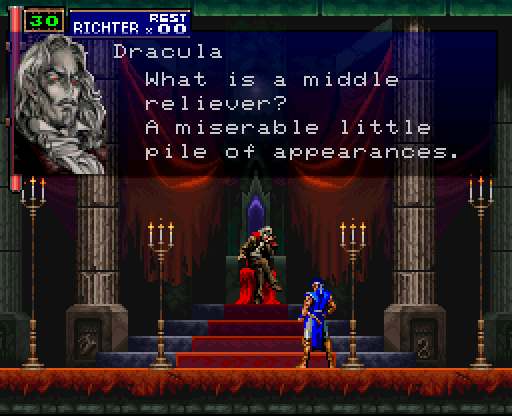
Anyway, for those of you who aren’t baseball fans (and therefore could never have picked my cover athlete Tim Herrin3 out of a lineup), let’s go over a few types of relievers.
Closers: If you’ve seen a guy walk to the mound accompanied by flashing lights and/or an iconic musical intro that makes them look like a pro wrestler, that’s a closer. The highest-paid bullpen arms (and the only ones to get their own two-letter designation on Baseball Reference), closers’ jobs are to protect ninth-inning leads, lock in victories, and extinguish all hope.
Setup men: Bridesmaids to closers’ brides, setup men are usually the second-best reliever in any given bullpen and often former closers, future closers, or both. They pitch some combination of the 7th and 8th innings, hold the score (either to keep their team ahead or let them mount a rally), and are sometimes chosen because their pitching style contrasts with the closer: Mark Eichhorn, for example, was a very effective setup man for the 1986 Blue Jays in part because his lack of velocity and odd arm angle made Tom Henke’s 95 MPH fireballs look that much more dominant.
Long relievers: Given the rate at which starters leave the mound early, whether because of actual injury or a spooked training staff, teams usually have one or two armbarners who have sufficiently loose arms to come into a game at any point and pinch-pitch six or nine outs. If a game seems beyond decided (say, 11-1 in the 4th or 6-0 in the 8th), a long reliever might be sent out on “mop-up duty.”
Firemen: Full disclosure: I’m not even convinced these guys are a real, identifiable thing, kind of like “Stanford,” but I’ve seen enough baseball to know that some teams keep a particular armbarner behind emergency glass for times when the bases get loaded or the game is suddenly tied with a shit-hot bat next up.
Specialists / LOOGYs: Before the three-batter minimum, some pitchers could enjoy stable (if unremarkable) careers by dominating hitters with a given handedness. These days, all relievers are specialists in some sense or another: it’s not uncommon to see a manager throw his closer earlier because the heart of the order is coming up, or send the setup man out for the save if his delivery matches up better with the likely batters’ swing planes.
“Noah,” you say, smirking like the smug jerk you are, “you didn’t mention middle relievers at all in there.”4
That’s because a middle reliever is, basically, none of the above. They don’t have a formal designation. They don’t specialize in facing particular hitters. They don’t tend to strand bases purely on ice-veined willpower. They don’t even usually go out expecting to throw more than three outs. If they have an inning at all, it’s the sixth5, when starters hit triple digits on the pitch counter, or simply get tired of seeing the same guys come up to bat.
In short, they’re the human mortar that connects the rotation to the part of the bullpen everyone actually cares about.
To me, these guys are the most relatable members of any Major League Baseball team. They’re paid less than almost anyone on the 26-man roster and they’re not dominant enough at any of the more important roles, so they tend to come into games still within reach for either team. If they want to avoid wallowing for the next few years in whichever team will stick them in AAA as injury depth,6 they’d better put up some strong zeroes, even if the guy before them left a real mess, or everyone will get mad at them instead.
What’s particularly notable is that, just as a reliever’s performance can diverge wildly between seasons as he bounces between different catchers, stadia, pitching coaches, analysts, and favor with the Baseball Gods, there’s even odds that the same people you see clamoring for a given armbarner to go play in Taiwan already were the same ones who bestowed a suitably badass nickname on him when he last did well. To paraphrase Catullus, what a baseball fan says about a reliever is fitting to write on the wind, on rapid water.
If I were given to extending baseball fans any grace, I’d say their fickleness is a weirdly fitting tribute to an equally cruel profession. Unfortunately, I’m on record as calling most baseball fans hogs who can’t read.
Combine that with my day job and how I feel about it, and I think you see why I can relate.
Make no mistake: my loyalty is pure and clear-eyed. I enter into this bargain in full knowledge of who it is I’m choosing as my baseball avatar, and I don’t only mean in the sense that I’m aware most of them have politics roughly two ticks right of Lester Maddox.
After all, these are the guys that get trotted out as rhetorical ballast with every looming lockout, another one of which is likely after this season. If you’re a proper leftist, you don’t bring up (noted tax evader) Shohei Ohtani or Kyle Tucker; you bring up Carl Edwards Jr., who is a relatively effective pitcher with a career ERA+ around 121, and whose career earnings are around $5 million.7
There are reasons, both financial and emotional, for me to find that technique infuriating, but the chief one is this: it is the only time you are asked, as a baseball fan, to see these guys as people. For the Thirty Tyrants and their court jester, they’re useful, profitable contrasts to the high-profile multimillionaires who litter video game covers and sell hundreds of jerseys. For baseball fans who cannot stomach settling for silver in progressivism, they’re perfect avatars of just how little ballplayers ever see of their franchise’s overall worth. Then the lockout or strike ends, and it’s back to getting mad every time they give up a run.
It makes sense: they’re a class of ballplayer that exists not because they’re particularly exciting or as a result of a rule change (if anything, MLB keeps pretending to consider rule changes that would reduce their number), but because most starting pitchers and closers are brushing up against the limits of what the human body can do without super-soldier serum.
Which is another way of saying that you probably don’t go to the ballpark to watch (e.g.) Anthony Bender pitch unless you’re related to him.8
Lack of familiarity breeds its own sort of contempt. If Garrett Crochet has a few bad games (and as of this writing, he’s had some real stinkers in 2026), he has both a sufficient record of success and enough name recognition that you can instinctively trust he’ll right the ship.9 When it’s a guy whose mere presence on your team puzzles you, there’s no emotional attachment (from you or your fellow fans) to complicate things. You can just hate on them with no restraint.
To be fair, I don’t think any of us secretly yearn for the days of Charlie Sweeney and Old Hoss Radbourn.10 On some level, I think we’re all a little annoyed that the 200-inning pitcher is going extinct,11 and we’re taking that out on the guys replacing them. But it’s not their fault their jobs have grown more significant; that’s down to the baseball product we’ve all decided we prefer, which is fast, sleek, shiny, and also unfortunately happens to eat collateral ligaments for breakfast.
Without inventing some sort of Harrison-Bergeron-like limiter that forces pitchers to throw at 80% strength or another equally fantastical solution, or unless we are willing to accept an operational standard of baseball where pitchers throw more slowly and ERAs hit 1894-like levels, I have to imagine that these pitchers’ usage rates will continue to go up, their job descriptions continue to widen, and, well, we’ll just have to see how people react.
Which, of course, will only make them more relatable to me. Vivat membrum quodlibet, indeed.
Of course, it would also eventually turn out that I am an “LGBT people.” ↩
I wished condolences to two of my favorite greybeards on John Sterling’s passing and went off to teach. Hand to God, an hour and 15 minutes later, they were texting about how often Anthony Volpe strikes out. ↩
Granted, I’m going to bet that a decent number of you are baseball fans and still couldn’t pick Tim Herrin out of a lineup. ↩
The eagle eyes among you probably noticed I also didn’t mention openers, which are their own distinct can of worms. ↩
For the record, I specifically chose Tim Herrin as my exemplar because, when I wrote this footnote, he had pitched part or all of the sixth inning in three of his five most recent appearances. ↩
Sadly, not every reliever gets to have a Rico García arc. Most of them end up closer to Cy Sneed. ↩
Carl Edwards Jr. got DFA’d and elected free agency the day after I’d written him into this article. I don’t know what that means, but it seems ominous.
(For those of you who feel that this article has not included enough Tim Herrin content, based on available MLB minimum salary data, Tim Herrin’s career earnings likely amount to somewhere around $2 million.) ↩
Anthony, you seem like a normal dude and respectable pitcher. I just needed to throw another name in there so my readers wouldn’t suspect this was an excuse to mention Tim Herrin one last time. ↩
Howdy, fellow Astros fans! This is where we can talk about how every time noted chud Lance McCullers Jr. has a decent outing, a bunch of you get misty-eyed for that one time he threw 24 curveballs in a row and forget that he is a very slightly above-average pitcher over the course of his career. ↩
Radbourn has two particularly notable records: his 59-62 wins in 1884, and being the first person to do this in a photograph. ↩
As recently as 2019, all top-10 finishers in innings pitched threw over 200 frames. Last season, there were three.
Whether this is purely out of injury risk aversion or because fewer innings means less earning potential for starting pitchers, which are often the most sought-after players in the baseball labor market, is left up to the reader to decide. ↩

Add a comment: