
[LNP] 1909/09/16: ¿Qué Pasa?
One, two pitchers become deities. That's what I said; now, also, a hitting streak for the ages; two teams become more talented; four leagues have champions.
(All LNP-related articles visible here.)
(Also, our Pride campaign and the semifinal round of 2026’s Mascot Bowl are still going!)
Forty-One Games, and What Do You Get?
Another day playing around the Great Lakes, apparently, if you’re 🇵🇷 Héctor Ríos.
🧂 Syracuse’s third bat and first baseman, Ríos carried a 41-game hitting streak across almost two months of playing around Lake Ontario, beginning with a triple on June 27th and ending
During those 41 games, he went 691/165, tacking on 10 doubles, 3 triples, 2 home runs, 19 walks and 4 hits-by-pitch. That’s a slash line of .418/.489/.552, which is the kind of thing you tend to see from good batsmen in Class II leagues when they get on a heater.
The fact that Ríos’ league-leading on-base percentage has barely moved during this entire season suggests that the streak was mostly the result of him putting harder and more frequent swings on the ball, as does the fact that he went on the bench with a strained oblique just days after the streak ended and he no longer felt desperate to torch the ball every time he went to the plate.
before the streak | after the | as of | |
|---|---|---|---|
batting average | .357 | .381 | .363 |
on-base percentage | .452 | .467 | .457 |
slugging | .459 | .495 | .472 |
Famously, at this point in Liga Nacional Puertorriqueña history, the longest hitting streak is 🇵🇷 Domingo Godoy’s 50-game mockery of Liga Hostos pitching in 1881, but we wondered if anyone had come close in a major league during the 20th century.
Short answer: kind of. 🇨🇺 Timoteo Ortiz put a 34-game heater together for the ❄️ Fríos in 1901. His season wasn’t quite as dominant as Ríos is being (plate-wise, anyway; he led Liga Hostos in WAR that year), but Ortiz—who cut his teeth playing in Texas—was generally regarded as one of the major reasons the 20th-century LNP opened up to international talent.
Preheated Stove League
If you thought the 🫏 Mulos hadn’t already loaded up for bear, their signing of 🇸🇮 Gorazd Prelec might convince you. Prelec was the obvious standout of the 🐉 Zmaji back in the European Baseball Federation, and made his debut (as the first Slovene player in the LNP) with the ⚒️ Martilleros, who cut him after 58 games due to a horrific .145/.237/.175 batting line. Two days after being signed by Aguas Buenas (i.e., a team that was actually going somewhere), he promptly hit his first home run—a grand slam the Mulos ended up needing every run of. Prelec does lead the entire LNP for plunks: he’s been hit by 18 pitches despite playing in only 65 games.
Last time we corresponded, we mentioned the odd plight of one 🏴 Harry Jones, released after an injury rehabilitation despite being very much in his prime. Well, Jones signed with the 🦇 Murciélagos on September 4th to work primarily out of the DH spot. In his eleven games in violet and turquoise, Jones hit his first two home runs of the year and walked 12 times while striking out, uh, zero. That’s a slash line of .256/.423/.487, good for a 191 wRC+ that would make him the third-best hitter in the entire LNP. There’s no way he’ll maintain this pace, but it’s always fun to see a player succeed against expectations.
Around the World, Around the World
A few leagues have decided their champions:
Let’s start in the League of the Free Frontier, where Nacogdoches, seeking its fourth championship, instead became the final hurdle for 🎨 Taos winning its third. We don’t like bullpen blaming around here . . . so we won’t. The fact that Nacogdoches lost in seven games implies they were never likely to take the title.
From there, we go to the Crown of the Four Flowers, where 🇮🇪 Limerick stamped their second shamrock by defeating rising power 🏴Bangor. That puts the count at two thistles (Scottish titles), three roses (English), four daffodils (Welsh) . . . and eight Irish championships. Éirinn go Brách, indeed.
Newer still, the Baseball League of New England saw Griswold become the first team from Connecticut to win a title, and the first from Southern New England since 1904, by defeating the Lightermen on Vermonter soil.
Lastly (for now), and despite being sixth in runs scored and third in runs allowed in their circuit, Iga became the first champion of the Nihon Yakyu Kyokai over Aomori, who scored seven fewer runs . . . and allowed 102 fewer. That’s baseball for you.
Gods of the Mound
There are two pitchers who have surprised us this year, for very different reasons.
El Relámpago
The first is 🇵🇷 Curro Terrazas, a very good pitcher for the ⚡ Eléctricos who has spent the past few years training himself into what the 1900s would probably regard as a freak of nature.
Terrazas, despite his obvious talent, seemed doomed to anchor a bad rotation in Guayanilla until he decided to spend every offseason doing the same thing: throwing harder, and harder, and harder.
It paid off: after a middling 1907 that ended in a second-round playoff exit—a result that, under the circumstances, was above expectations—Terrazas turned himself into one of the LNP’s deadliest fireballers. His ERA promptly dropped seventy ticks, and while it’s true that he has a losing record this year, that’s because La Energía is one of the worst teams in the entire league at scoring runs. The fact that their 66-74 record is somehow good enough for first place in their division is entirely due to their pitching.
While velocity was not the primary concern of the early 20th-century’s pitching coaches, Terrazas threw hard enough that people noticed. In July, after he was snubbed for the Partido de Campeones2, Terrazas set up an exhibition where he threw against some rudimentary measuring tools from the era.
Based on those measurements, which seem impossible to modern eyes, his fastball hit a minimum speed of 158 kilometers/hour . . . and a maximum of 165.
Stack Overflow3
You don’t need to be a Naguabo fan to be more than familiar with 🇯🇲 Everton Stack, whose borderline-unfair monticular sorcery has him in line for his third successive Excelentísimo4 award. If his current pitching line holds, he’ll break his own record for lowest single-season ERA (the 0.87 he logged two years ago)5, last year’s WHIP record of 0.62, and tying his 42 quality starts from 1906.
Furthermore, at 431 strikeouts with five starts remaining and a current K/9 rate of 12.7, Stack has a decent shot at breaking a record once thought unassailable: 🇵🇷 Carlos Chávez’s 492 strikeouts in a single season. This gives us one lens by which to analyze Stack’s absurd proficiency at pitching.
After all, Chávez was the 19th century’s most prolific strikeout artist, and his long and successful career as a power pitcher inspired dozens of imitators, but Stack is clearly his heir apparent.
Just look at this list of 15-strikeout games over the course of Liga Nacional Puertorriqueña history. There’s been exactly 123 of them, 12 of which—a full ten—were the ones Chávez logged between 1884 and 1886.
Chávez is not, however, the current leader in them.
Not by a long shot.
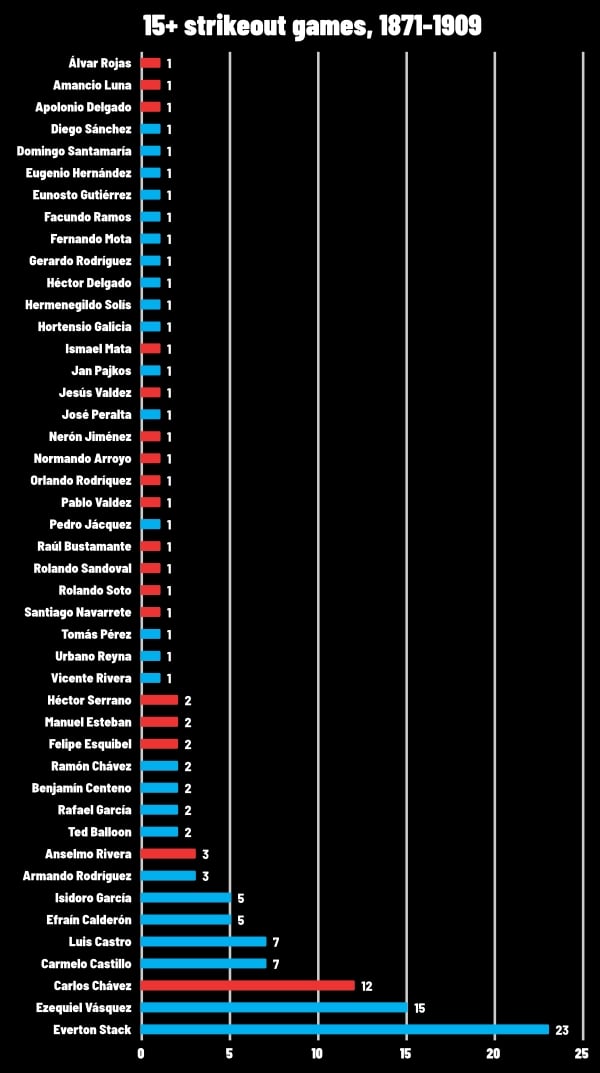
Stack, by himself, accounts for 18.6% of 15-strikeout games. That’s almost 1 in 5, and if that’s not impressive, think about the fact that each game in this sample represents .8% of the totality.
In other words, the 29 pitchers who’ve thrown one apiece, collectively, represent 23.5% of the sample—only 5% more than one guy.
Stack may also break another record. At 14 shutouts with 37 starts on the year, he’s throwing just under two shutouts per five starts. Coincidentally, that is the exact number Stack needs to break the current record of 15 shutouts in a single season, which he is one of three pitchers to manage.
He’s also got a very good chance of doing that, because as of this writing, he’s likely to only face teams he’s already shut out in his career.
It should shock you that we even thought of making that distinction—or perhaps it doesn’t, given everything we’ve told you about Stack.
Of the 38 other teams in Liga Betances, Stack has shut out 31. He got to work right away on that list: his first major-league start was a 2-hit, 9-K, 1-walk blanking of 🐐 Canóvanas on April 9th, 1904.
As his career blossomed and he presented a continual challenge to even the best hitters of Liga Betances, Stack would add multiple notches to his pitching belt with each successive season; in particular, between 1906 and 1907, he shut out over a third of Betances for the first time, including the hated 🦇 Murciélagos.
YEAR | TEAMS |
|---|---|
1904 | Canóvanas, Hatillo, Lares, Maricao, San Juan |
1905 | Ceiba, Luquillo, Yauco |
1906 | Arecibo, Cidra, Comerío, Morovis, Peñuelas, Santa Isabel, Vega Baja |
1907 | Arroyo, Camuy, Coamo, Guaynabo, Lajas, Moca, Río Grande |
1908 | Ciales, Hormigueros, Juncos, Vega Alta |
1909 | Las Marías, Maunabo, Orocovis, Patillas, Salinas |
Currently, only six teams have proven immune to the Stackman’s prowess: ⛪ Aguada, 🦈 Aguadilla, 🫏 Aguas Buenas, ⚔️ Cabo Rojo, ⚓ Cataño, 🛡️ Dorado, and ⚡ Guayanilla. Why all six are in the upper half of the alphabet, and three begin with “A,” we have no idea; most of these have been dealt with by other pitchers in 1909, although Dorado did, remarkably, shut the Naves out a few months ago over Stack’s objections.
Both of these records were once thought unassailable. In all likelihood, given the improved offenses teams usually deploy the playoffs and the grind of a six-month season, Stack will fall short. We’d expect him to land somewhere around 470 strikeouts and 15 shutouts, win the Excelentísimo in a walk, and return next year to mount another campaign to try it again, barring grievous injury.
Were he any other pitcher, we’d already consider his chances cooked and look towards 1910, but this is Everton Stack, who—in a decade full of men who redefined what it means to be a major-league pitcher—has somehow found an atmospheric layer to call his own.
In Anglophone, the All-Star Game. ↩
Yes, we’ve been waiting to use that one for a while. ↩
The Hispanophone (and therefore much cooler) equivalent of the Cy Young Award. ↩
Right behind him, teammate 🇷🇸 Jan Pajkos is sitting at 0.84. ↩

Add a comment: