
New podcast, GAAD, and purposeful anger
Welcome to my newsletter.
I originally aimed to publish once or twice a month. I skipped two weeks ago. I was deep in the final stages of releasing my new podcast.
Today's mainly inspired by a couple comments I got on LinkedIn when I was saying accessibility advocates need to do better with adding alt text. And by Global Accessibility Awareness Day (GAAD), which happens to be the day I decided to send the newsletter out.
And I'm telling you about the amazing new episode for my amazing new podcast. Yes, it's amazing, even if I say so myself!
Let's dive in.
In this newsletter
Anger is a tool. I'm going to keep using it.
People tell me to be nicer. Soften the edges. More honey, less vinegar. You catch more flies that way.
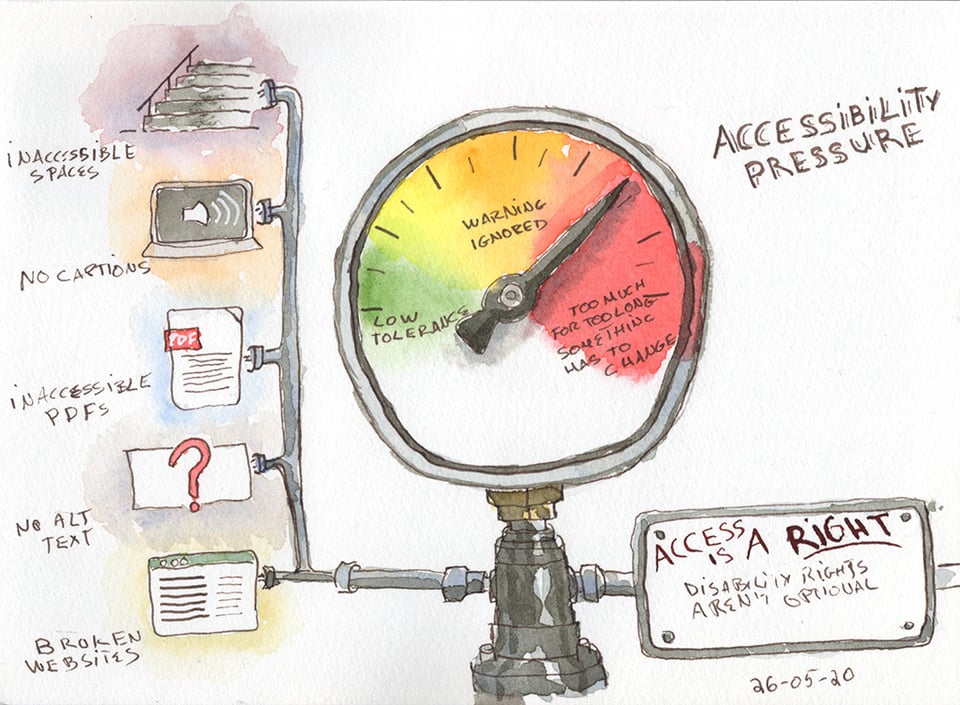
I've heard some version of this for most of my career, and for a long time I took it seriously. I'm a teacher by instinct. I build tutorials. I explain things patiently. I create how-tos, give talks, run podcasts, write newsletters. A significant part of my professional life revolves around making accessibility work easier for people to understand and implement.
I like doing that work. I'd go as far as saying I'm good at it.
I also have, and show, anger. And that anger is not accidental. I use it deliberately.
That's the part people often miss. They treat anger as loss of control, as if raising the temperature means someone has stopped thinking clearly. But anger can be strategic. It can be focused. It can be used to force visibility onto problems people would rather minimize, ignore, or quietly step around.
That's how I use it.
The ask
What frustrates me most about the “be nicer” advice is that it almost always places the burden on the wrong person.
A little empathy goes a long way, someone told me recently. Fine. Empathy for whom? The person encountering the barrier, or the person who created it?
I encounter barriers constantly. Some of them affect me directly as a wheelchair user navigating the physical world. Buildings without proper access. Spaces designed with the assumption that disabled people simply won't be there.
But a large amount of the anger I express publicly comes from barriers I encounter professionally and online that I know are excluding other disabled people. Websites that don't work with screen readers. PDFs that can't be parsed properly. Videos without captions. Images without alt text. Accessibility consultants publishing inaccessible documents. Disabled advocates releasing podcasts without transcripts at all, or with transcripts so poor they're barely usable.
These are not beginners making honest mistakes while learning. These are people who know better. People who teach this work. People who are paid specifically because they claim expertise in accessibility.
And somehow the emotional responsibility still lands on disabled people. We are expected to remain calm, patient, educational, understanding. We are expected to phrase exclusion gently enough that the people responsible for it do not feel uncomfortable hearing about it.
I've done that for years.
I've written the careful email. I've provided the quiet private feedback. I've framed problems as collaborative learning opportunities. I've softened language to avoid defensiveness. I've spent enormous amounts of energy trying to make criticism feel safe and welcoming for the people causing harm.
I'm tired of doing that.
The 504 sit-in
In 1977, disabled activists occupied the San Francisco federal building for 28 days to demand implementation of Section 504 of the Rehabilitation Act.
The regulations already existed. They had been delayed for years through bureaucratic stalling and political cowardice. Disabled people had already asked politely. They had already waited patiently. None of it worked.
So they occupied a federal building and refused to leave.
The protesters were angry. They disrupted daily operations. They made people uncomfortable. They forced the issue into public view and made it impossible to ignore.
And it worked.
The 504 sit-in remains the longest successful occupation of a federal building in American history. That did not happen because disabled people carefully protected the feelings of those in power. It happened because they were done accepting delay as a reasonable answer.
I'm not comparing myself to those activists. I know/knew some of them personally, and the comparison would be absurd. But I am paying attention to the lesson.
Anger, used strategically, produces pressure. Pressure produces change.
Discomfort is often the mechanism.
What “be nicer” actually means
When people tell disabled advocates to soften their tone, what they're usually asking for is emotional protection for the people creating barriers.
- Be gentler with the organization that excluded you.
- Be more patient with the accessibility professional who published inaccessible content.
- Be more understanding toward the company that still hasn't fixed problems they have known about for years.
That is what the empathy ask often becomes in practice.
And I do have empathy. I understand that most accessibility failures are not rooted in cruelty. Most organizations are not actively trying to exclude disabled people. Most inaccessible systems are built out of ignorance, indifference, lack of accountability, competing priorities, or simple failure to think about disabled people at all.
But inaccessible outcomes still exclude people regardless of intent.
- The inaccessible PDF still locks someone out.
- The missing transcript still excludes Deaf people.
- The broken website still prevents access to services, employment, education, community, and daily life.
Good intentions do not remove barriers.
And honestly, I think that's part of why my anger has sharpened over time. Not because I believe most people are malicious, but because exclusion remains everywhere despite decades of supposedly caring about accessibility.
The ADA notice requirement
You can see the consequences of this framing in repeated attempts to weaken disability rights enforcement.
One proposed approach would require disabled people to notify businesses about accessibility barriers before being allowed to pursue legal action under the American with Disabilities Act. Businesses would receive a grace period to fix the issue before facing consequences.
The Americans with Disabilities Act was signed into law in 1990. Most of its accessibility requirements have been in effect since 1992. Businesses have already had more than thirty years of "notice".
At some point, “we didn't know” stops being a reasonable defense. Ignorance of the law is not generally considered protection from the law, except somehow when disability access is involved.
Think about what that proposal means structurally.
A disabled person encounters a barrier. Instead of immediate recourse, they take on additional labour. They report the problem. They wait. They hope the organization decides to care this time. The burden shifts directly onto the person already excluded by the barrier in the first place.
That proposal did not emerge in isolation. It comes from years of portraying disabled people as unreasonable for demanding access. Years of framing accessibility complaints as attacks on innocent businesses rather than responses to exclusion.
That framing matters. It shapes policy. It shapes public opinion. It shapes who people believe deserves empathy.
My anger about that is not irrational. It is a response to a political and cultural environment that repeatedly asks disabled people to absorb exclusion quietly so other people can remain comfortable. Systemic discrimination against disabled people.
I'm not interested in sanding that down into something softer and easier to ignore.
What I'm actually saying
Anger is a tool.
Not the only tool. Not always the right tool. But a legitimate one.
Every major disability rights victory in North America involved disabled people who were no longer willing to stay polite and accommodating. The 504 sit-in. ADAPT blocking buses (hello fellow ADAPTers, I remember well Columbus, OH, among many others). Disabled protesters crawling up the Capitol steps before passage of the ADA. These movements were strategic, disruptive, and unapologetically visible.
That's the tradition I think about when people tell me anger is counterproductive.
I still teach. I still help people. I still build resources, answer questions, and try to move accessibility work forward in practical ways. None of that disappears because I sometimes choose confrontation instead of reassurance.
But when accessibility professionals publish inaccessible content, I'm going to say so directly.
When organizations create barriers, I'm going to name the barrier clearly instead of cushioning it in careful corporate language.
And when people tell me to be nicer about that, I'm going to ask a very simple question:
Who exactly is that niceness protecting?
Disabled people are tired. That exhaustion is information. I'm going to keep using it.
The Work Between podcast
After months of work getting everything lined up, my new podcast has officially launched. The first interview is now live.
The show is called The Work Between. It’s a podcast about artists, makers, and creators who happen to be disabled. Not inspiration porn. Not stories about “overcoming.” Conversations about creative practice, identity, work, and the complicated realities that sit underneath all of it.
The first episode features Mia Seljubac. Mia works as a games lawyer, which was a profession I genuinely did not know existed until this conversation. She’s also developing a game called I Am the Cat, using her watercolor paintings as the basis for animation and visual design.
I had a great time talking with her, and I think people will enjoy where the conversation goes.
And because accessibility matters, every episode includes two human-edited transcripts. One is designed to be read on its own, like an article. The other is synchronized to the audio so you can follow along while listening.
Take a look:
I'm Not Interested in Global Accessibility Awareness Day This Year
Every May, Global Accessibility Awareness Day comes around.
Companies post graphics on LinkedIn. Developers share articles. People who have not mentioned accessibility once all year suddenly talk about inclusive design for 24 hours.
Then Friday comes, and most of it disappears.
I’ve watched this cycle repeat for years. The excitement is genuine for some people. I don’t doubt that. But the gap between what gets posted on GAAD and what actually changes the other 364 days of the year has become impossible for me to ignore.
Before I go further, I want to be clear about something. I know some of the people who created GAAD. I have nothing but respect for them and for what they built. They created something that put accessibility into conversations that otherwise would never have happened. That matters. It has value. A lot of people discovered accessibility because of GAAD, and some of those people went on to do meaningful work.
This isn’t criticism of the founders.
It’s criticism of what too many organizations have turned the day into.
Awareness is not the problem
The word “awareness” has started to grate on me.
Disabled people are already aware inaccessible systems exist. We are aware when a checkout flow traps keyboard focus. We are aware when captions are missing. We are aware when a podcast transcript is unusable, when a mobile app ignores dynamic text sizing, when a form fails with a screen reader, when a doorway is too narrow for a wheelchair.
None of that becomes less real because a company posts an accessibility statement once a year.
At this point, most organizations do not have an awareness problem. They have a prioritization problem.
They know accessibility exists. They know disabled people use their products. They know many barriers are fixable. The issue is that accessibility work is still treated as optional the moment timelines tighten or budgets shrink.
That is not a lack of awareness.
That is a decision.
Accessibility is work
Real accessibility work is often slow, repetitive, and unglamorous.
It is reviewing designs before they ship. It is fixing heading structures and form labels. It is testing with disabled users. It is budgeting for captioning and transcripts before launch instead of scrambling afterward. It is training teams. It is procurement policies. It is QA. It is listening when disabled people explain that something does not work.
None of that fits neatly into a celebratory social media post.
I have worked with teams that were enthusiastic about GAAD while simultaneously pushing back against accessibility remediation work. I have seen organizations proudly publish awareness posts while refusing to allocate time for proper testing. I have watched people celebrate accessibility publicly while privately treating disabled users as edge cases.
That disconnect wears on you after enough years.
One day cannot carry a year
GAAD is one day.
Accessibility barriers exist every day.
Disabled people do not stop needing access on Friday morning because the awareness campaign ended Thursday night.
If organizations invested even a fraction of their GAAD energy into sustained implementation work, we would see measurable change. More usable websites. Better hiring practices. Cleaner procurement requirements. Fewer broken experiences shipped to production.
Instead, much of the effort goes into visibility about accessibility rather than accessibility itself.
The math does not work for me anymore.
What I would rather see
I would rather see a company quietly fix its broken checkout flow than publish another GAAD graphic.
I would rather see a team budget for disabled user testing than spend a week polishing an awareness campaign.
I would rather see podcasts invest in accurate transcripts than post about inclusion once a year.
Do one thing that materially improves access for disabled people. Fix one known issue. Review one critical user flow. Bring disabled testers into the process. Give your developers time to learn how assistive technology actually works.
That matters more than performative enthusiasm ever will.
GAAD still has value
I do not think GAAD is worthless.
For some people, it genuinely is the beginning of deeper accessibility work. Some students discover accessibility through GAAD and build careers around it. Some organizations use it to start conversations that eventually lead to structural change. That is real, and I do not want to dismiss it.
But awareness is supposed to be the starting point, not the destination.
Too often, the industry treats it as the finish line.
Disabled people deserve more than temporary attention. We deserve products, services, spaces, and systems that work consistently.
That is where I want my energy to go now.
Wrapping up
That's it for now! I hope you enjoyed the newsletter. I'd love to get feedback - What was good? What could be improved? What topic would you like me to talk about? I'm not making any promise, but if a topic you suggest catches my fancy, I'll share my opinion on it.
Just hit reply to this email, or send an email at [email protected]. I read every response.
And a reminder that my content is Human Generated Content #HumanGeneratedContent