
Disability levels, language and identity, Quality
Hello there!
Here I am, with another newsletter. Here you are, reading it. I do hope that what I write resonates with you. Or that you're learning new stuff. Or that I'm phrasing things you already knew in a new way. As always, I'm open for discussion. Ping me by just responding to this email. I'd really appreciate knowing if it's worth writing these things.
Once more, I'm covering a range of topics this week.
In this newsletter
- Depression is more disabling than having to use a wheelchair
- Language as a question of identity
- Underline your links even if it's not fashionable
- Accessibility is part of Quality
- Wrapping up
Depression is more disabling than having to use a wheelchair
Trigger warning: Depression, Sexual abuse
Having depression is more disabling than having to use a wheelchair. Yep. I'm ranking how disabling disabilities are. Because it's not obvious to many people.
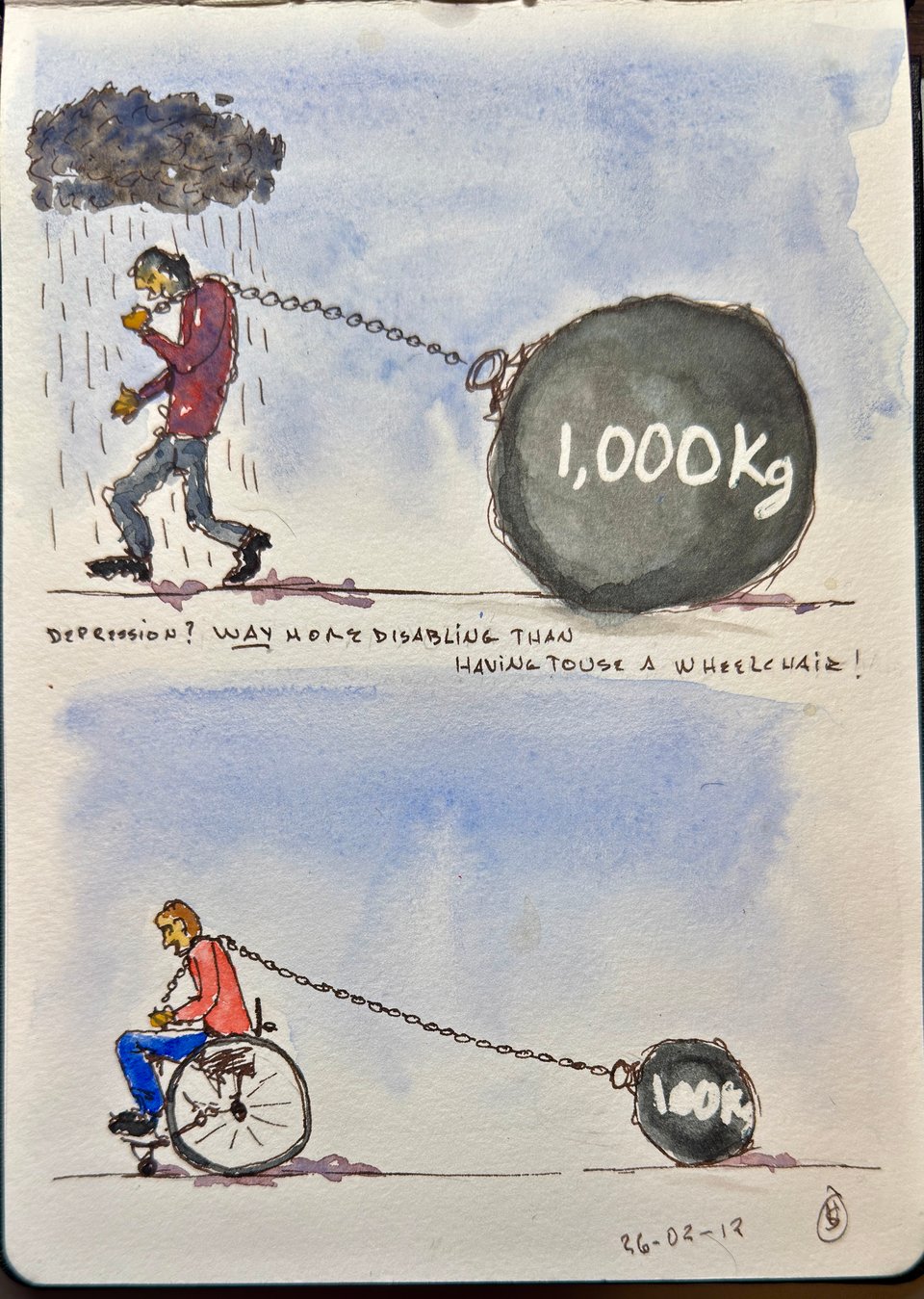
I'm not talking about depression as "a case of the blues", or "feeling in the dumps because your partner left you". I'm not minimizing these things. But it's also not the same as chronic depression.
I've had depression for a very long time. Chronic "low grade" depression (it was known as Dysthymia, but is now termed "Persistent Depressive Disorder") as well as acute phases of depression. My "normal" would probably send a lot of people reeling. I've come entirely too close to succeeding at unaliving myself. A couple times. My depression has been deemed "treatment resistant" by 3 separate mental health professionals over the years.
Mental health professionals aren't all that helpful
I've not had great luck finding mental health professionals that help. There were a few that were somewhat helpful. But there were others that... Were not. The first therapist I saw, as a late teenager, raped me. Another therapist told me "of course you're depressed, you're in a wheelchair". A third therapist told me during a session that he couldn't help me. And then called me at 9 pm at home, sounding drunk, and suggesting I try Zen meditation. These are just the 3 most egregious experiences I've had with mental health workers.
Masking
Most people who know me have no clue. I've gotten pretty good at masking. At hiding the struggle. I have to continue to meet work obligations. And social obligations. And do all the things that need to be done.
And when the neighbor asks "how are you?", I know they don't actually want to hear "while I don't want to kill myself, I'd rather not be alive right now". Same for my colleagues. Or service clerks.
And same for my family and friends. I know they care, but there's only so much of my darkness I can share with them before pushing them away.
So I smile. I laugh. I engage. All the while inside is a turmoil of darkness. It's juggling feeling on the edge of tears while faking being enthusiastic about... Well, most everything, really.
Some aspects of depression I find harder than having to use a wheelchair.
Cognitive impairment
Depression gets in the way of memory, executive functions, and memory.
It requires a cognitive overload to keep functioning. It's exhausting.
No clear accommodations
You can build a ramp for a wheelchair user. You can make the built environment to be wheelchair friendly. But there's not much I can think of to improve access when you're depressed.
Invisible disability stigma
Depression carries social stigma that mobility impairments don't. People are more likely to view depression as a character flaw. Or think that you lack willpower. Or that you're "just being lazy". Rather than recognizing depression as a legitimate disabling condition.
Two weights, two measures
This one is not specifically about the contrast with wheelchair users. But it is about the contrast between depression and physical impairments/illness/injuries.
- People with a bad flu stay home for several days, rest in bed. No one questions whether they're "really sick" or suggests they just need to "push through it".
- Taking 2-3 days off for vomiting and diarrhea when you get food poisoning is seen as obviously necessary. No one suggests it's "all in your head".
- Bed rest and modified duties are standard medical advice for a back injury. People understand physical pain requires recovery time without judgment.
- Visible injuries like a broken leg makes rest non-negotiable. Crutches, casts, and staying off your feet are seen as medical necessities, not weakness.
- Rest and reduced stimulation are now widely recognized as essential for folks with concussions. People understand you need time away from screens, work, and normal activities
In contrast, someone with severe depression experiencing the same level of functional impairment (inability to concentrate, physical exhaustion, pain, impaired cognition) faces pressure to "snap out of it", "think positive", or "just try harder". Their need for rest is dismissed as laziness or lack of willpower rather than medical necessity.
No "assistive technology"
My wheelchair has given me mobility and independence. I'm not wheelchair bound, I'm "wheelchair freed". Depression lacks comparable tools. Medications work, partially, for some people (not me). They take weeks to work and often require trial and error. And often have significant side effects.
Using a wheelchair isn't all doom and gloom
Contrary to what some people think, having to use a wheelchair isn't all negative. I remember reading studies back in the 90's that found wheelchair users, 5 years or more post-injury, generally found their quality of life higher than pre-injury. I've found that to be true, for me, at least. And for most wheelchair users I've come across in my three decades of disability advocacy work. The biggest problems, for most, are environmental issues. Stairs-only entrance to a building. Narrow doors. Attitudes, like being told that someone pays taxes so people like me can go live in nursing homes. But...
Using a wheelchair isn't all sunshine and rainbows either
We do face environmental issues. And attitudes. And face financial burdens (have you seen the prices of a modern manual wheelchair, let alone a power wheelchair?). And for many of us there's chronic pain.
Despite all that, having to use a wheelchair is significantly less disabling for me than depression is.
Language as a question of identity
Are we people with disabilities? Are we disabled people? Do we follow "person first" language, or do we prefer "identify first language"?
For myself, I prefer identify first, even though for years I was advocating for person first language.
I don't have autism, but the majority of actually autistic people I know prefer identity first language. Like Alex Umstead who said on my show, the A11y Rules Podcast:
"Oh, yeah, so I am autistic. And I actually will just deal right off the bat, I am using what we call identity first language, which is a lot of autistic people use that rather than person with autism. So I generally do as well."
You can listen to the whole episode on the podcast website. Or if you prefer, you can read the whole interview with the (human edited) transcript, on the same page.
Underline your links even if it's not fashionable
There's this ongoing discussion with designers everywhere. They argue that underlining links make them ugly. Some of them know enough to know you can meet the letter of WCAG and get away with non-underlined links.
I'm here to tell you: It's not the letter of WCAG you should work on. It's the spirit of WCAG. Heck, WCAG is your starting line, not your target.
Non-underlined links are often not really accessible if they meet the letter of WCAG but aren't underlined.
Just set your computer to "night mode", where all or most of the blue is stripped out. Or set your computer to greyscale. Then tell me where your inline links are.
I wrote more about this with examples and screenshots in this older post: Link Styling - Underline your links. Test with night mode. Test in greyscale
Accessibility is part of Quality
We're all striving for quality website. At least I imagine we are. And accessibility is part of quality.
I read Zen and the Art of Motorcycle Maintenance many years ago. I've been intrigued with the concept of "Quality". Robert Pirsig, the author, argues that Quality is fundamentally indefinable through rational analysis. Basically, he says Quality is the difference between good work and shoddy work. He adds that you can immediately see the difference. It's a feeling more than a thought. The moment you try to pin it down with words and logic, you've already moved away from the direct experience of it.
Accessibility is a bit more complicated than that though. For some of us. Others will feel it where it hurts, like a blind screen reader user who can't use any of your mouse-only interactive elements.
I'm going to speak about quality, with a small 'q' rather than Pirsig's Quality, with a big "Q".
Your website isn't a quality website if it's not performant. Taking several minutes to load a page... Your user will feel it before they think "this sucks", and go somewhere else.
Your website isn't quality if it's not secure. Your users will have strong, negative, words when they find their info has found it's way on Have I been Pwned.
Your website isn't quality if it can't be found on the internet. Your website isn't quality if nobody can understand your content. You get the gist.
By the same token, your website isn't quality if it can't be used by disabled people. I dislike the "numbers game", where we try to prove how many disabled people there are and why it's important. And yet I can't avoid it. There are approximately 1.3 billion disabled people worldwide. Disabled people globally have $8 trillion a year of disposable income. It's not like disability is a small market. But accessibility still would be important, and part of quality, even if there were just for a few people. After all, who would you chose to exclude otherwise.
I'm an accessibility expert, and a disabled person. Obviously I think that accessibility is important. And a good starting point of accessibility is WCAG: The Web Content Accessibility Guidelines. Though I hurry to point out it's a starting point, not a target. Something you might have heard me say before.
I'd like to bring awareness to another set of rules, apart from WCAG: The Opquast Digital Quality Framework. These rules, developed by Elie Sloim and his team, are all about quality on the web. They include accessibility as part of quality. But accessibility is only part of quality.
Go on! If you aren't familiar with these rules, I urge you to check them out. Learn them. Apply them in your work.
Wrapping up
That's it for now! I hope you enjoyed the newsletter. I'd love to get feedback - What was good? What could be improved? What topic would you like me to talk about? I'm not making any promise, but if a topic you suggest catches my fancy, I'll share my opinion on it.
Just hit reply to this email, or send an email at info@nicolas-steenhout.com. I read every response.
And a reminder that my content is Human Generated Content #HumanGeneratedContent