
Burden of self-advocacy, serial lawsuits, and moawr
Time flies when you're having fun. I blinked and 2 weeks went by. Another newsletter needs to go out if I'm to keep to my twice a month self-imposed pace.
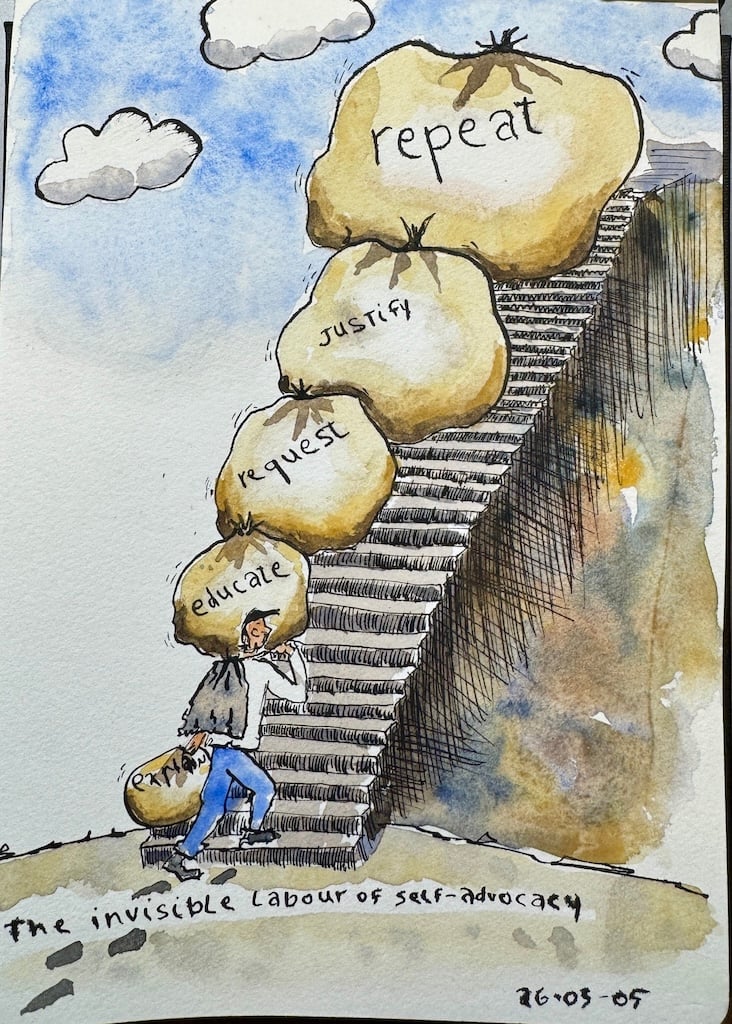
This edition started from the idea of the sketch I included with the main piece. It took me a bit to do the sketch. Then to write the words of the article. But I'm happy with both sketch and words. Let me know how you feel about it!
In this newsletter
- The invisible labour of self-advocacy
- From the podcast: You won't fix it later
- From the old blog: Ableism has a massive impact
- Serial lawsuits? Fix your site and you're good
- Wrapping up
The invisible labor of self-advocacy
Non-disabled people accept a dinner invitation and think about what to wear. Wheelchair users ask themselves different questions. Is there a step at the entrance? Are the bathrooms accessible? Is the accessible stall being used for storage? Will I need to call ahead and explain accessibility basics?
Non-disabled people register for a webinar and just click the registration link. Deaf people face different questions. Will there be captions? Live human-generated captions (CART) or auto-generated garbage (Craptions)? Do I need to request an interpreter? How many days in advance?
This is invisible labor. Disabled people perform constant work just to participate.
We explain. We educate. We request. We justify. We repeat the whole process. Over and over. Because we have to. It burns us out.
Every restaurant becomes a research project
A simple social invitation becomes exhausting detective work. Most restaurants don't provide accurate accessibility information. That's if they provide accessibility information at all. You call ahead and you might hear "Oh yes, we're accessible!" Then you arrive to find three steps at the front door. Or they tell you "We have a ramp at the back by the kitchen". And you know full well that right next to the kitchen are the big smelly dumpsters.
Even restaurants with accessible bathrooms often fail. You arrive to find the accessible stall filled with cleaning supplies or broken equipment. Staff assume no one needs it. Now you face more labor. Find a staff member. Ask them to clear it out. Or take a risk and go without, praying you'll make it home before an accident happens.
Then you ask yourself if you should tell your friends about these barriers? Or if you should suggest a different restaurant and risk seeming difficult? Do I decline the invitation? Every social interaction carries this invisible tax.
Digital spaces demand the same exhausting advocacy
A blind person tries to complete an online form. No labels. Error messages don't announce in their screen reader. The submit button says "click here." They can't complete the task.
Now they face a choice. Give up. Or find contact information. Explain the barriers. Educate the company about proper form labels. Request fixes. Justify why this matters. Wait. Often nothing changes. Repeat with the next form. The next website.
I've noted this in usability testing countless times. Blind users hit barriers on sites claiming to be accessible. Sites that passed automated testing. Sites with accessibility statements.
The labor isn't just navigating broken websites. It's deciding whether to report each barrier. Knowing that reporting means explaining basic accessibility to people who should already know.
Traumatic Brain Injury (TBI) survivors face similar exhaustion with different barriers. Websites with autoplay videos trigger headaches or cognitive overload. Navigation structures require holding multiple steps in working memory. Walls of text with no visual breaks.
Processing these sites takes enormous cognitive energy. Then comes advocacy labor. Explain that autoplay videos aren't just annoying. They're barriers. Educate developers about cognitive accessibility. Request changes. Justify the accommodation. Repeat when updates break everything.
One TBI survivor told me she stopped reporting accessibility issues. Too exhausting. Too little change. She avoids websites that hurt to use. That means avoiding job applications. Online shopping. Government services.
Deaf people encounter the same pattern with video content. A company posts a critical announcement as a video. No captions. The Deaf employee must now request captions. Explain why auto-generated captions aren't sufficient. Educate colleagues about caption quality. Justify the time needed. Repeat for the next video.
Every online meeting without captions becomes another advocacy moment. Request accommodations. Explain that lipreading isn't a solution at the best of time, much less over video. Some meetings get captions. Others don't. You never know which until you join.
Neurodivergent people face the same exhaustion
Imagine explaining before every meeting that you need the agenda in advance. That you process information better with written follow-up. That unexpected changes cause distress. Now imagine making these requests to every new colleague. Every manager. Every team. And justifying them each time.
"Can't you just be more flexible?" No. That's not how ADHD works.
"Everyone finds open offices distracting." Yes. But not everyone experiences auditory processing issues that make noise physically painful.
"Just set a reminder on your phone." Executive dysfunction means that strategy doesn't work the same way for everyone.
The labor is constantly educating people about invisible disabilities. Managing skepticism. Defending credibility. Deciding moment by moment whether to disclose or mask. Masking itself is labor. The exhausting performance of appearing neurotypical to avoid judgment.
Burnout gets blamed on the wrong people
Carry this load day after day. Year after year. Explain the same barriers. Educate the same people. Request the same accommodations. Justify the same needs. Repeat endlessly. You burn out. Then people blame you.
"If you need accommodations, just ask!"
"Why didn't you speak up?"
"We can't read your mind!"
These statements shift burden onto disabled people. They frame advocacy as simple. Just ask! But asking means risking your job. Your relationships. Your dignity. It means reliving rejections and gearing up for conflict. It means explaining and educating and justifying over and over.
When someone finally stops asking, they get labeled as not trying hard enough. Burnout gets reframed as individual failure rather than systemic failure.
We put the burden in the wrong place
We've structured our world to place accessibility burden on people who already carry disability burden. We made it disabled people's job to identify barriers. Request accommodations. Educate others. Follow up. Explain again when staff changes. Justify again when policies update. Repeat endlessly.
We turned access into something you earn through constant advocacy. Not something provided as baseline. This is backwards.
Restaurants should proactively ensure accessibility. Train staff to maintain it. Keep accessible bathrooms clear because that's basic operations. Not because someone complained.
Websites should be built accessible from the start. Developers should test with screen readers before launch. Companies should caption all videos before posting. Not after employees request it.
Workplaces should build flexibility into standard processes. Not require each person to separately negotiate accommodations. Meeting organizers should provide agendas in advance to everyone.
The current system treats accessibility as an exception requiring individual justification. Every disabled person becomes their own accessibility consultant. Building surveyor. Civil rights lawyer.
What actual change looks like
Shifting this burden requires systemic change. Design for accessibility from the start. Train staff to maintain accessibility features. Build cultures where accommodations are normalized.
Build websites with proper form labels. Caption videos before publishing. Structure content with clear headings. Test with assistive technologies during development.
Recognize that "just ask" is not a solution. It's an abdication of your responsibility. When we put the burden on disabled people to identify and request every accommodation, many won't ask. We're exhausted from explaining. Tired of educating. Burned out from requesting. Worn down from justifying.
The invisible labor will only become visible when we count the cost. Social invitations declined. Jobs not applied for. Websites abandoned. Meetings skipped. Potential unrealized because the energy required exceeded what people had to give.
Until then, disabled people will continue doing exhausting, invisible work. Trying to exist in spaces not designed for them. And burning out.
From the podcast - You won't fix it later
One of my guests on the podcast, Damien Senger, said something that is so true. He said:
Later does not exist in our industry. Don’t push something without accessibility now. Because you will NOT go back and fix it later.
We move fast and break things. One of the things we break is accessibility. We don't go back to fix it after the fact. Or if we do, it's years later, because we have to. And suddenly it becomes this huge expensive behemoth of work that has to be done.
We should have fixed it with accessibility built in.
You can listen to the whole episode on the podcast website. Or if you prefer, you can read the whole interview with the (human edited) transcript, on the same page.
Ableism is everywhere, including the workplace
Ableism is discrimination and social prejudice against disabled people. It shows up everywhere, including in the workplace.
Some ableism is obvious. Inaccessible hiring practices. Systems that screen reader users can't access. Social events in places wheelchair users can't reach.
Other ableism is subtle. Complimenting wheelchair users for doing grocery shopping implies low expectations. Asking people to stand up excludes those who can't. Using euphemisms like "special" or "challenged" instead of saying disabled suggests disability is shameful.
Micro-aggressions accumulate. One well-meaning comment might seem small. But disabled employees face these constantly. The impact builds. Intentions don't matter. Impact matters. When someone says "I didn't mean it that way," they're missing the point. Words have power.
Companies need to provide training. Individuals need to learn ableist language and stop using it. The outcome is a more diverse, productive, happier workforce.
Reducing ableism benefits everyone.
I wrote more about this with examples and screenshots in this older post: Ableism has a massive impact
The Best Defense Against Accessibility Lawsuits
I hear these complaints quite often: "Attorneys are scanning websites looking for accessibility violations". Or "Some disabled people file serial lawsuits". Or "It's all just a money grab".
And yes, some law firms do scan for violations. Some disabled people are serial plaintiffs. That's true.
Here's what the best defense is: Don't have an inaccessible website.
The real problem isn't the lawsuits
When we complain about accessibility lawsuits, we're focusing on the wrong problem. The real problem is that disabled people can't use our sites.
Someone can't complete a purchase. Someone can't apply for a job. Someone can't access healthcare information. That's the problem our sites created.
The lawsuit is just the consequence. Fix the actual problem and the lawsuits disappear.
Our sites are public accommodations
In the United States, websites are increasingly treated as places of public accommodation. The ADA requires equal access. Other countries have similar laws.
When our sites exclude disabled users, we're violating the law. Whether someone points that out politely or through a lawsuit doesn't change the violation. And as I've said earlier, pointing things out politely leads to invisible labor that all too often leads to burnout.
Serial plaintiffs deserve access too
Some disabled people file multiple lawsuits. This bothers organizations. But here's the thing: serial plaintiffs encounter barriers on multiple sites. That's not suspicious. That's reality.
Disabled people face accessibility barriers constantly. If someone finds ten inaccessible sites, they have ten legitimate complaints. The pattern isn't the plaintiff. The pattern is inaccessible design.
The solution is simple
Build accessible websites from the start. Test with disabled users. Fix barriers when we find them.
This isn't complicated. WCAG (Web Content Accessibility Guidelines) exist. Automated testing tools exist. Disabled consultants exist. Screen readers are free to download and use for testing.
We have the resources. We just need to use them.
Focus on the real victims
Organizations that get sued for accessibility violations often claim they're victims. They're not. Disabled users who can't access our sites are the victims.
Our embarrassment about a lawsuit doesn't compare to someone's inability to access basic services. Our legal fees don't compare to the discrimination disabled people face daily.
Moving forward
If we're worried about lawsuits, we should channel that energy into accessibility work. Conduct an audit. Test with disabled users. Make a remediation plan. Fix all the things.
Legal compliance follows naturally from building accessible products. We can't get sued for violations that don't exist.
The best defense against accessibility lawsuits is the same as the best approach to accessibility. Build products that work for disabled people. Everything else follows from that.
Wrapping up
That's it for now! I hope you enjoyed the newsletter. I'd love to get feedback - What was good? What could be improved? What topic would you like me to talk about? I'm not making any promise, but if a topic you suggest catches my fancy, I'll share my opinion on it. Just hit reply to this email, or send an email at info@nicolas-steenhout.com. I read every response. And a reminder that my content is Human Generated Content #HumanGeneratedContent