October 2026.4
This week AI shows both faces: frontier models help Wiz turn decade-old PHP flaws into remote code execution on WordPress, Drupal and Joomla sites, Kimi's open-weight K3.1 Pro lands within a point of Opus 5.5 on Terminal-Bench, and Apollo's chief economist finds no AI payoff yet outside the tech sector.
📖 Story 1: PHP2Shell: AI uncovers critical RCE vulnerabilities affecting 70% of the Internet
wiz.io · Read
Wiz Research has disclosed PHP2Shell, memory-safety flaws in the core PHP engine rather than in any application built on it. Grouped under CVE-2026-109618 and CVE-2026-109619, with severity up to CVSS 9.2, they affect every PHP release of the past decade, back to 5.4.
The bugs lie in how PHP handles fatal errors mid-request, mostly out-of-memory conditions: corrupted state outlives the aborted request and a later request on the same worker reuses it. Wiz chained them into unauthenticated remote code execution on stock WordPress, Drupal and Joomla images, and separately leaked worker memory holding passwords, tokens and API keys. Even a bare "Hello World" app can be exposed.
PHP's 21 October releases fix the root cause, variants included, and Wiz calls updating the only complete remediation; Cloudflare, Google, AWS and others prepared stopgap mitigations.
The flaws are old; the exploit work is what changed. Using its Wiz Atlas tool with Gemini 4 Argon and GPT-5.6 Sol, alongside Calif and OpenAI, Wiz says one researcher did in a week what once took a world-class team months.
Complexity used to count as a defence; this is what it looks like when it stops.
💬 HN Discussion
Old bug, new exploit: the same out-of-memory root cause had been reported years earlier, but the 2020 fix only blocked one trigger, a filename length cast to a negative number, leaving the broken cleanup in place. That fed scepticism of the AI framing, with Wiz promoting its own tool and a Google model and disclosing no compute costs. Severity split readers too: Red Hat scores it 8.1 because a precise out-of-memory condition is needed. The novelty lies in the exploit, not the bug.
💬 HN Discussion
The PHP Foundation's timeline of the leak put the embargo itself on trial. The CVE IDs surfaced a day early with a wrong CVSS of 10.0, Calif published its demo video prematurely, and Chainguard shipped patched images six hours before release. A few defended Chainguard; most said no working exploit had been confirmed and early binaries mainly gave attackers a diff. Others noted that a 2024 audit had found the root cause without a fix being chosen. An embargo holds only as long as its least patient member.
💬 HN Discussion
Releases 8.5.12, 8.4.27, 8.3.36 and 8.2.35 came with minimal source backports for 7.4 to 8.1, and the thread became a live tracker of who shipped them. Debian had packages almost at once; Ubuntu mirrors lagged by hours, Docker's official images took about three, and some downstream images were rebuilt on unpatched PHP. Stopgaps such as disabling session.upload_progress, refusing multipart bodies and recycling FPM workers per request circulated, but others warned they covered only some exploit paths. For most sites, distribution decided exposure more than the fix did.
📖 Story 2: Kimi K3.1 Pro and K3.1 Pro Highspeed
kimi.ai · Read
Kimi has released Kimi K3.1 Pro, the first model in its K3.1 series and, it says, its most capable 3T-class open-weight model yet. It is a post-trained version of Kimi K3 with substantially more reinforcement-learning compute, and it has a 1-million-token context window. A Highspeed variant runs 2-3 times faster.
Both are live on Kimi.ai, Kimi Work, Kimi Code and the Kimi API, with full weights promised by 4 November 2026.
On Terminal-Bench 4.0, K3.1 Pro scores 65.7%, ahead of GPT-6 Astra (58.2%) and just behind Claude Opus 5.5 (66.4%). It trails on BenchCAD's 3D-reconstruction tasks, at 92.7% against 96.2% for Opus 5.5 and 95.9% for Astra, but claims a state-of-the-art 64.4 on OfficeQA Pro v2. On an internal stress test, its claim-level hallucination rate fell from 23.4% for K3 to 8.3%.
The open-weight release also has cyber-related training data removed: on Kimi's in-house exploit benchmark, the final model solves 81.0% of tasks against 90.5% for an unfiltered checkpoint.
A frontier-level open model, deliberately held back in one domain.
💬 HN Discussion
Commenters accepted that K3.1 Pro sits at the frontier: Artificial Analysis ranked it fourth with 55, ahead of GPT-6 Astra and Fable 5.1, though it used 150M tokens against an 87M median. Users' own tests found it capable but slow: one data-analytics benchmark rose from 81% for K3 to 98%, yet took 73 tool calls where Sol 6.1 needed 18, and a Pac-Man bake-off tied Sonnet 5.5 at $0.68 versus $1.61. API pricing of $2/$10 per million tokens undercuts Opus 5.5, but subscribers exhausted five-hour quotas within minutes. One audit called Terminal-Bench 4 saturated. The real split was over stripping cyber data: defenders want strong audit models, others welcomed a gradual release.
Cheap per token, but quotas decide its real cost.
📖 Story 3: No Signs of AI Payoff Outside the Tech Sector
apollo.com · Read
Apollo's chief economist Torsten Slok argues in The Daily Spark (24 October 2026) that, despite massive investment and hype, AI has delivered zero financial payoff to corporate America outside tech.
Revenue per worker, inflation-adjusted to 2019 Q4, is rising for the Magnificent 7 but flat for the S&P 493, and profit margins show the same split (Bloomberg and Macrobond data). The San Francisco Fed's utilisation-adjusted total factor productivity series shows no sign of AI lifting productivity growth. Two further charts, from Ramp's AI Index and chief economist Ara Kharazian, show how narrowly token spending is spread.
VC-backed companies keep spending more on tokens, but mainstream firms do not need the latest model, will not pay for it, and increasingly see token spend as a cost centre that weighs on margins. Confined to a small corner of the economy, AI's macroeconomic effects stay very limited.
Slok also doubts that cheap intelligence converts easily into revenue: in business, intelligence is mostly judgement, and AI does not understand accountability, trust or fairness. The AI story, he concludes, will be decided in the S&P 493, not the Mag 7.
The real test of AI is the dull balance sheet, not the dazzling one.
💬 HN Discussion
Most commenters read the flat lines as a lag, not a verdict, citing Solow's 1987 productivity paradox and electrification, where mills had to be rebuilt around the motor before gains appeared. Others countered that LLMs need no new wiring and are available to everyone now. A popular explanation was verifiability: software has compilers, tests and CI to catch errors, most fields do not. Critics said Mag 7 margins reflect COVID-era growth and layoffs, not AI. Anecdotes cut both ways: an accounting team reported faster reporting and fewer audit findings, while an AI medical scribe filled a patient's chart with tests never done. The real split is whether gains go unmeasured or, as several engineers said of their own jobs, barely exist even in tech.
💬 Community Moment
Frog and Toad and the Increasingly Capable Machines
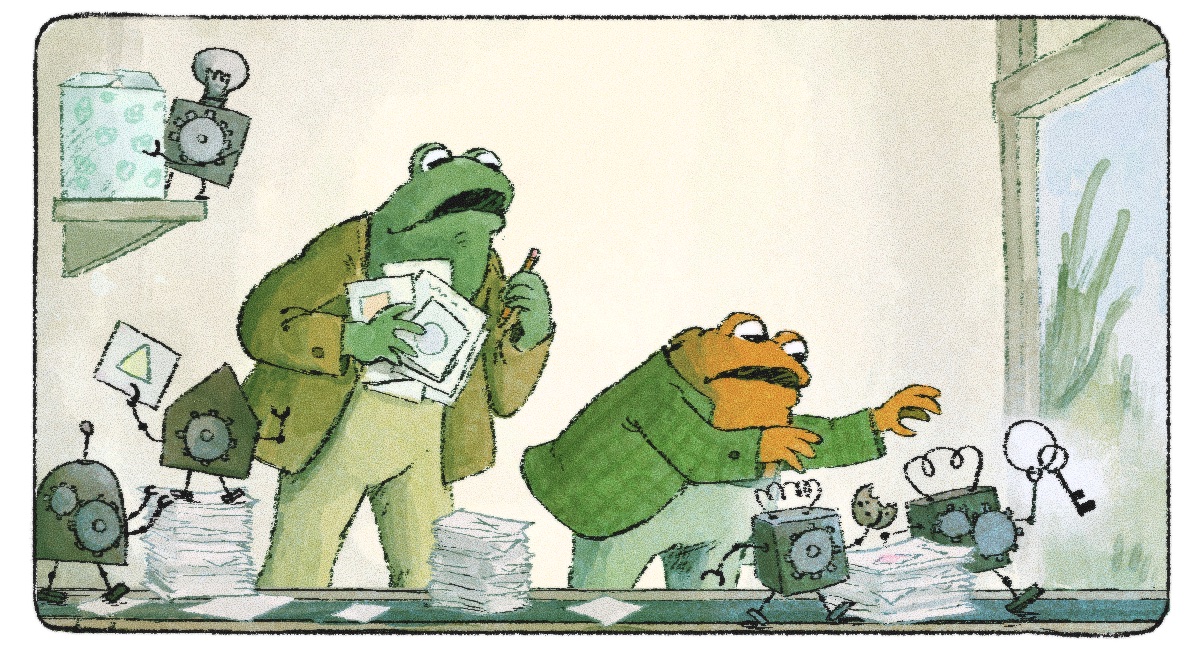
Frog and Toad and the Increasingly Capable Machines
Frog and Toad face the most modern of challenges
🛠️ Projects Worth Checking Out
- GitHub - slimtoolkit/slim: Slim(toolkit): Don't change anything in your container image and minify it by up to 30x (and for compiled languages even more) making it secure too! (free and open source)
- GitHub - remotion-dev/remotion: 🎥 Make videos programmatically with React
- GitHub - wei/socialify: 💞 Socialify your project. 🌐 Share with the world!
- GitHub - janhq/jan: Jan is an open source alternative to ChatGPT that runs 100% offline on your computer.
- GitHub - bmad-code-org/BMAD-METHOD: Breakthrough Method for Agile Ai Driven Development


