
Returnal and the Best Gaming Experience I've Ever Had
In honor of the release of Saros, a look back at its predecessor Returnal and my love for it
Last week I wrote about The Mortuary Assistant, a truly awful film who’s very existence baffled my mind. To make up for what was essentially an excuse to gawk at a shitty movie, this week I thought I would go off in the other direction and gush about something I truly love.
So let me tell you about Returnal and the greatest gaming experience I have ever had.
Returnal is a PlayStation 5 exclusive (later released on PC) developed by Housemarque, and it is my favorite game. It’s a rouguelike set on the alien world Atropos where every death sends you back to the site of your crash landing, but with your character Selene maintaining memories of each attempt. Well, maintains memories of some of them at least. During runs you will come across the corpses of other versions of Selene she does not seem to have memories of, finding scout logs detailing previous failed attempts. Returnal combines incredibly tight and satisfying combat with a visually captivating world and a story about trauma, grief, and guilt that gives as much as you are willing to put in.
It’s also criminally underrated. I think some of the reasons it hasn’t gotten as much love as I feel it deserves are the same reasons I enjoy it so much. It is a challenge. There is a steep difficulty curve. The combat is fair but intentionally punishing, meaning you will frequently need to start all over again with the majority of items acquired lost. And while they have since added a way to save your progress while in the middle of a run, at launch this was not available. This meant that not only did you need to worry about death resetting your progress but also the limitations of your own time. There were plenty of nights I blew past when I wanted to go to bed because I was in the middle of a run and did not want to leave my progress at the mercy of suspending the console and hoping that an update or any other mishap did not close the program.
The difficulty also does not end with the combat; the game’s narrative is opaque, operating on symbolism and abstraction. While it is possible to get some sort of surface level plot from simply going through the game and cutscenes, understanding the game requires combing through not just item descriptions but ship logs, personal scout logs, alien artifacts and cyphers, and entries detailing the various enemies you will fight. Of course, you will need to defeat an enemy numerous times in order to unlock all the info about them as well. But if you are willing to do the work all the abstraction begins to come together into a surreal and haunting portrait on cycles of abuse, the ways we attempt to escape and/or justify them, and the guilt and loss that can come from those attempts.
But I think Returnal being overlooked goes beyond simply its difficulty, and also has to do with the type of game that it is. After all, a lot of what I described in the previous paragraph could also apply to FromSoft games. Dark Souls and Bloodborne and Elden Ring are also notorious for their difficulty, and have a similar approach to storytelling where it is up to the player to dig through item descriptions and the visual details of their respective worlds to piece together the story. Yet those have achieved a critical and cultural consensus as masterpieces, all Game of the Year contenders and winners. To a degree I think that is because they are the “right” kind of game. RPGs hold a special place within the world of video games, and even if you don’t get very far, even if you don’t fully understand what is going on, for a lot of people they just chalk it up to “being an RPG” and will still view it as a good game because of the overall reputation of the genre.
Returnal on the other hand is a shooter. A third person bullet hell to be precise. And while it has the trappings of a rougelike it still looks unmistakably like a shooter at first glance. So when people bounce of Returnal’s difficulty I think there is an assumption that its “just a shooter” and there isn’t the same feeling to push through the way one might with an RPG. There isn’t the same assumption of substance that will make it worthwhile.
This is a shame, because Returnal has so much to offer if you are willing to dig into it. And there is no better example than my experience getting to the midpoint of the game.
I will warn you now; there is a massive spoiler for Returnal that is unavoidable to divulge in order to tell this story. If you think you would ever give Returnal a try, you may want to sit the rest of this piece out. Ok, here we go.
.
As mentioned before, dying in Returnal sends you back to the beginning of the game to start the run over. This happened to me a lot as I tried to get past the third biome and its boss, Nemesis. By many accounts, Nemesis is the hardest boss in the game (I slightly disagree and would put second boss Ixion as the hardest, but Nemesis is no joke) and they were very much kicking my ass. The fight takes place in a sort of dreamscape, with you firing at the hulking figure of Nemesis from floating platforms that begin to break up as the fight goes on, forcing you to navigate from platform to platform and even float in the air all while dodging Nemesis’ attacks and trying to land your own. And every time they killed me, back I went to the crash site at the beginning of the first biome once again.
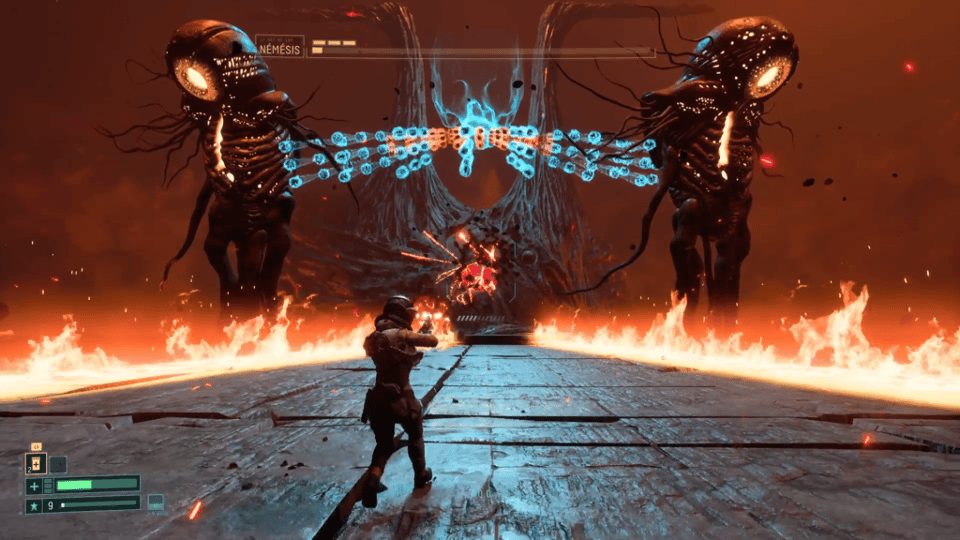
But then finally I had a good run going. I took my time making my way through the earlier biomes and forewent using the shortcuts to instead scour every nook and cranny to build up my suit’s integrity/health and find upgrades. By the time I got back to Nemesis I was in as good a shape as I could be in, and was wielding my favorite weapon. It was go time, and a few minutes of pure anxiety later I had done it. I had defeated Nemesis. The endorphins flowed.
That’s when a cutscene kicked in. You get a distress signal sent out, get rescued, and make it back to Earth and greeted as a hero. Snippets of your life play, you get older, and eventually die of natural causes. And then.
And then you wake up at the crash site on Atropos. Escaping the planet did not end the cycle. Death, regardless of where it occurs, sends you right back. There is no escape.
It’s an insane reveal, and it is handled so well and provides such a shock that it took me a moment to clock the other major change; the biome where your shipped crashed has changed. Your time away from Atropos equated to a change of time on the planet.1 The good news is this break allows for a new starting point when you die. The bad news is everything has changed and you need to learn what new dangers await.
My adrenaline was in high gear. I was in uncharted territory and still reeling from the mid game reveal. And it was past my bedtime. But what choice did I have? The only thing to do was to keep going.
I pushed through this new biome, an echo of the first, and learned how to deal with the new enemies. Possibly due to the rush I was still in the midst of, I kept the run going, clearing room after room of hostile creatures not only without dying but somehow further increasing my suit integrity. Eventually I made it to the same vault that previously held the first biome’s boss, only it was no longer collapsed and still retaining structures allowing me to ascend.2 A strange calliope music was wafting down that became louder as I climbed up the available platforms and pillars. Selene even comments on the music’s haunting nature and familiarity, and her need to silence it, further lending it mystique and dread. That there were no enemies in this room to prevent my ascent further cemented what my gut had already figured out; it’s time for another boss. Goddamnit oh shit. Reaching the top the music became the focus, until I could see a clearing on the top of the architecture I could jump down into. And then.
And then organ pipes blare as Hyperion pounds on the keys of an organic organ seemingly built up from the ground itself, and my favorite boss fight of the game begins.
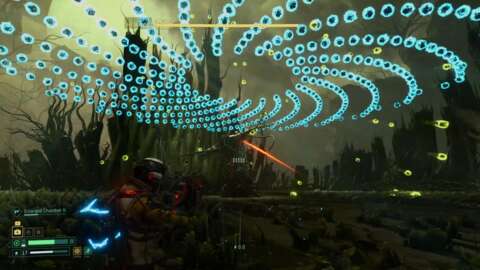
It’s a truly wonderful combination of sight and sound. The track scoring this fight is the most unique and distinct in the game, a riff of Blue Oyster Cult’s “Don’t Fear the Reaper” set to a mix of organ and electronic beats. All the while Hyperion’s playing of the organ keys creates colorful projectiles that cover the screen in intoxicating patterns that must be dodged, until by the final phase of the fight he has fully torn himself away from the organ and the encounter reaches a crescendo that is almost (but only almost) too much to keep track of.
I was in a trance. The panache of the fight’s presentation combined with the knowledge that I was still on the same run blocked out everything that was not Hyperion from my mind. Its the closest I have come to feeling like I was on drugs while being cold sober; the fight itself could not have lasted more than five minutes, but at the time and in my memory it felt like I spent all night there. Every second stretched out as I focused so intently on the spectacle of light and sound and space.
And then I defeated him. Adding onto the run that ended Nemesis I felled Hyperion on my first go. And I felt like a god.
It was exhilarating in a way that is difficult to describe. The sense of relief and triumph and awe that washed over me was without equal. Even Bloodborne, another game I love with its own number of intense boss encounters, never brought this level of elation. The Hyperion fight was the culmination of such a specific set of circumstances that could never be repeated, and it is unlikely I will I experience anything quite like it again. Even with Housemarque’s upcoming Saros, very much a spiritual successor that I am very very much looking forward to, I doubt there will be a high that quite reaches the bar my first Hyperion fight set.
And that’s ok. The fact that it was a singular, fleeting moment is part of what makes it, and Returnal as a whole, so special to me. And maybe it can be special to you as well.
The obvious assumption is that time has moved forward in your absence. This is what most people believe, even those who have done in depth analysis and video essays on the game. But this is incorrect. The second half of the game actually takes place in the past, an unspecified though presumably large span of time prior to the previous biomes. The game explicitly tells you this too; not only does Selene end up shooting down her own ship and causing her own crash in the later half of the game (something that could be waved away by time paradox shenanigans in either direction) but many of the enemies in the second set of biomes are variations of enemies you fought in the first set. And the log entries for those in the second set of biomes all have a prefix of “proto-”, making them the ancestors of the versions you fought previously.
This is actually an important distinction. That Selene ends up in the past emphasizes the cyclical nature of the game’s themes, that you cannot move forward without being willing to first look back. That our actions and motives are forever entangled with and effected by those that came before. It’s a detail that is so often missed but adds an incredible layer to the story the game is telling. ↩
Another indication that we are in fact seeing a version of Atropos that predates the initial crash. ↩
