
How to Have Tough Conversations, a mini linkdump, and some good in the world for a change
Hi and congrats again on persisting another week in this iteration of apocalypse 💪 I’m out of town training this weekend, so we’ll keep this short and sweet: in this week’s newsletter you’ll find:
An excerpt from my new essay this week, “How to Have Tough Conversations”
Links to some reads/listens from this week
Some good things for a change??? There are still a few, and you deserve a little treat for reading all the way to the end 😅
Thanks for being here 🖤
New essay this week: “How to have tough conversations”
I put out a new essay this week with some things I’ve been sitting with following Charlie Kirk’s assassination. In particular, after witnessing so many fruitless, inflammatory internet battles and irl conversations that devolved into platitudes in the aftermath, I wanted to offer some thoughts about what makes having tough conversations possible, and what we’re missing if we want to do this well. Check out the excerpt below ⤵️ and read the whole thing on the website. Then let me know what you think! You can reply directly here or find the ig post about the essay.
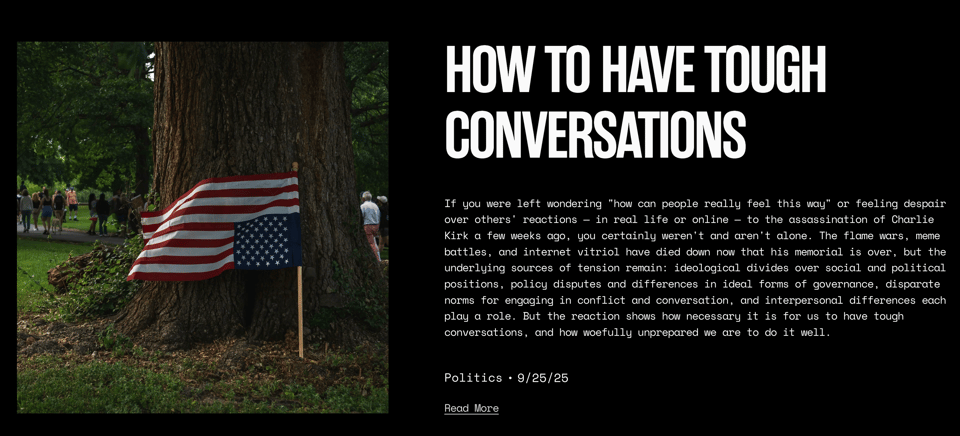
Excerpt: How to Have Tough Conversations
If you were left wondering "how can people really feel this way" or feeling despair over others' reactions — in real life or online — to the assassination of Charlie Kirk a few weeks ago, you certainly weren't and aren't alone. The flame wars, meme battles, and internet vitriol have died down now that his memorial is over, but the underlying sources of tension remain: ideological divides over social and political positions, policy disputes and differences in ideal forms of governance, disparate norms for engaging in conflict and conversation, and interpersonal differences each play a role.
To be very clear before I start, Charlie Kirk was a vile human being. He was a white supremacist Christian nationalist, an antagonist to trans people and queer people, and a propagator of misinformation and hatred, not a champion of "free speech" or "open debate," and not a hero or someone to admire. If you support free speech and open debate (which I do), that is something you can do without white-washing his legacy or investing in his symbolic presence in any way. This isn't an essay about how to carry forward his supposed legacy and get into "debates" with false premises that are unproductively polemical. This is an essay about how reactions to his death demonstrated just how ill-prepared we are to have tough political conversations.
This post isn't for folks who are going to throw themselves into hero worship or fandom about his persona or anything he represents; it's for people who witnessed what happened and were shocked by how the conversation around his life and work unfolded, and perhaps were dismayed to discover that not just random internet people, but people in their communities and close to them, were enthralled with his presence.
How do I talk to people who think Charlie Kirk was a hero?
I intentionally waited to weigh in here because of what I'm about to say: conversations about politically volatile subjects are not best had in a reactive state or from a reactive posture. So in short, I want to offer a first quick piece of advice in an overall framework for engaging in these kinds of tough conversations: don't. I'm not telling you to never talk about these types of people, or discuss issues with others who don't agree with you, but I am telling you that your best baseline response is probably going to be to take a beat. Here's why:
Your goals for tough conversations matter
If you were jump-scared by a friend or family member appearing on your social media timeline to eulogize Charlie Kirk at length, or were taken aback by major news media sanitizing his legacy rather than representing him with his own words, you might (understandably) have felt the urge to leap into action.
Surely your friend/family member/favorite journalist is mistaken. Surely you can offer a quick correction, perhaps even citing a source or a quote. Perhaps you see a cascade of misunderstandings, misrepresentations, or falsehoods, and feel called to address each point, line by line, with refutation.
It makes sense that you want to rectify the situation and have the urge to engage, but this is the moment where pausing to check in with yourself might matter most. What are your goals for this conversation, whether it's with a member of your community or an internet stranger? And, behind those goals, what are your covert hopes for how the conversation will go?
Consider that the person making those statements has already put their position out into the world — they either shared their take from an emotionally volatile place, or they had a long-considered position that is emerging in this seemingly opportune moment. In either case, your swift take-down or lengthy refutation isn't likely to land on fertile soil. That doesn't mean you shouldn't still post or engage, but it does mean that if you were hanging your hopes on quickly convincing someone to share your point of view, you should think again.
If, on the other hand, your goal is about signaling to others or yourself, it might still make sense to proceed. These goals can include things like, registering your disagreement or disapproval to let this person (or the general "audience" of your community) know that it's not a universally held belief. Or perhaps what you mainly need is to speak into the world your sense of reality, to see it in print or to hear it come from your own mouth, to reassure yourself of its veracity. Importantly, though, these types of goals are much more circumscribed: you achieve them mainly by speaking your truth or sharing your position, rather than relying on the other person's reaction.
Avoiding altercations or disappointment don't need to be the litmus test for whether you choose to dive into a tough conversation or a political topic, but learning how to have these conversations sustainably and handle them well in part hinges on your clarity and objectives going into the conversations. Repeatedly jumping in without considering what you hope to accomplish serves more to burn you out than it does to enact any social or political change.
Reacting is not the same as meaningful conversation
In a related vein, being reactive is not an end unto itself when we have broader political work in mind. I'm not necessarily telling you to swallow your emotional reactions and "take the high road." It might feel cathartic to chew someone out, shitpost at length, or block someone on a social media platform — and perhaps you have a real emotional need for catharsis in the moment. Just don't mistake catharsis for accomplishing political aims.
When we jump in to react and refute someone else's out-of-pocket commentary to to laboriously critique their overwrought political diatribes, we're accepting their framing and their position as the one that sets the terms of discussion. How they contextualize the issue, how they understand the issue, how they feel about the issue—those are what's at the center, and you, in reacting, are at the periphery.
Sometimes we don't get to choose the best staging for our battles. It's important to interrupt actively harmful claims and inflammatory statements in the moment, too. If someone is threatening harm, using slurs, or being actively detrimental in their rhetoric, demonstrating disagreement is one way to poke a hole in the veneer of their totalizing narrative. HOWEVER: engaging in deeper conversation with a goal of understanding, education, or growth is a different activity than directly interrupting harm. Again, being clear about the goals of a conversation is the first step. This deeper type of work can be done in contexts more amenable to exchange, where everyone is more open to learning and growing; it shouldn't be an expected consequence of more urgent moments of intervention.
There are several reasons it's so easy to get drawn in to reacting to others' rhetoric and vitriol:
These issues matter. Many of us have heartfelt, deep-seated values and beliefs that relate to issues that Charlie Kirk (in life or death) brought up: gun violence, racial disparities, sex-based discrimination, faith and politics. It makes sense that hearing or seeing others wade in on these issues in ways you might vehemently disagree with brings up emotions and stirs a sense of urgency.
Bringing up controversial, heavy, or political topics is hard. It violates social norms. It puts the onus on the initiator to frame the discussion and opens them to unknown or uncertain pushback and reactions. Fear of "rocking the boat" or upsetting social niceties inhibits socially conscious and responsible people from bringing up topics that deeply matter, that are values-based, and that have political consequences. But those topics, as in the previous point, still matter, so we may want to jump in to conversation about them now that the moment has arrived. Getting comfortable with initiating these kinds of conversations is one antidote to always being on the reactive and receiving end.
Our vision of politics is (incorrectly) only about winning and losing. For many people who are steeped in a culture of electoral politics, it's common to expect that any political debate or political contest will have a winner or a loser. Given how much these political and social issues matter, then, you certainly don't want to lose! Even if a "debate" isn't literally happening, and is just implicit in people putting their thoughts and words out for public consumption, it's easy to feel like leaving odious points uncontested means that that "side" or mindset "wins." This framing suggests an imperative, a responsibility, to weigh in on tough topics and controversial issues.
All of these are understandable impetuses to engage, but they don't change the fact that merely approaching from a reactive posture or operating only from quick retorts is not (probably) a real mechanism of political change.*
Don't misunderstand: I am not at all saying that we need to "reach across the aisle" and "befriend our enemies," or some other bucolic vision of defusing political disputes that resolves in us holding hands and singing kumbaya at the end. I actually think this idea is profoundly harmful unto itself, but that's a subject matter for another day and a different essay. What I am saying is, if part of the goal is developing an understanding of each other and raising political consciousness, doing political education, or calling in/out people in our communities, those aren't activities that can be accomplished well in a single conversation, and they especially are not best approached from a reactive position.
Rather, we need better tools and more practice for having hard conversations on terms that are thoughtful and lead from our values. Not getting sucked into someone else's emotional vortex or political cesspool plays one part in that.
Some reads and listens from this week
Katelyn Burns on what it feels like to be trans in the wake of mass shootings in the US
Transgressions of gender are systematically punished, and trans people under threat, in the US as a whole, not just after mass shootings. But one particularly valuable thing Katelyn highlights here is how milquetoast calls for us all live in “harmony,” strive for “kindness,” or find sources of “unity” completely ignores transantagonistic (and often, frankly, genocidal) things said about transness in media and popular discourse after acts of violence. Asking trans people to “tolerate” our oppression isn’t kind or reasonable, actually.
This Bluesky mini-thread-in-thread + the attached Reuters article about the EO attempting to designate antifa as a “terrorist” organization. The EO in question, and a longer interview analyzing its potential implications.
I really wish folks would be slightly more hesitant to assume anything written in an EO is law or directly actionable. Mostly you’re outlaying a lot of energy and anxiety over someone’s statement in plain words about things that were already empirically true, or signals about plans that we already could tell were in the works. In this particular case, folks who have been following the RICO cases against Stop Cop City activists have seen this coming and sounding the alarm bells for years. The EO targeting “antifa” is not actually going to sweep up a lot of anarchists or people who operate in underground networks and organizations — what it likely will do is create a chilling effect for much more surface-level, NGO supported above-ground organizing that facilitates more perilous direct action work. That’s obviously concerning, and is a reason that we need even more people involved at whatever level of depth fits their risk appetite, and doing so cautiously and conscientiously.
For those still playing catch-up on the far right popular ecosystem post-Charlie Kirk, this explainer on the mainstreaming of Nick Fuentes and this podcast episode giving more of a background on him.
Did you know that CBP has been collecting US citizens’ DNA for years?
Some good things?
Because you deserve a treat, which is to say, seeing some things that are good from the world…
This classy video and offering from Crimethinc
We’ll take the wins where we can, even if laws and institutions are fake
Some love from Schickeria München
A little history snippet on gun regulations in the US
Microsoft blocked Israel from using its cloud services to surveil Palestinians, Italian workers staged a strike in solidarity with Gaza, and Spain and Italy sent naval ships to accompany the flotilla carrying aid to Gaza
Baby Corn has my whole heart (and is carrying the weight of my entire mental health, thx buddy)
Questions? Feedback? Reply Directly…
As a subscriber, know that you can always reply directly to these emails to reach me if you have questions, want clarification on something that came out on the site, or have requests for future education and resources.
You’ll always have access to the main resources and updates for free, but I’m also exploring the options for a pay-what-you-want tier that may include some special BTS work and more personal content. Let me know if there are things you’d like to see, or if you already know that you’d like to support my written work more, you can do that here:
Thanks so much again for being here, and congrats on reading to the end 🎉 Wishing you the support and steadfastness you need today, until next time.
In solidarity,
Sirus

