DOE Diesel Sheds 9.1 Cents to $5.257/Gal
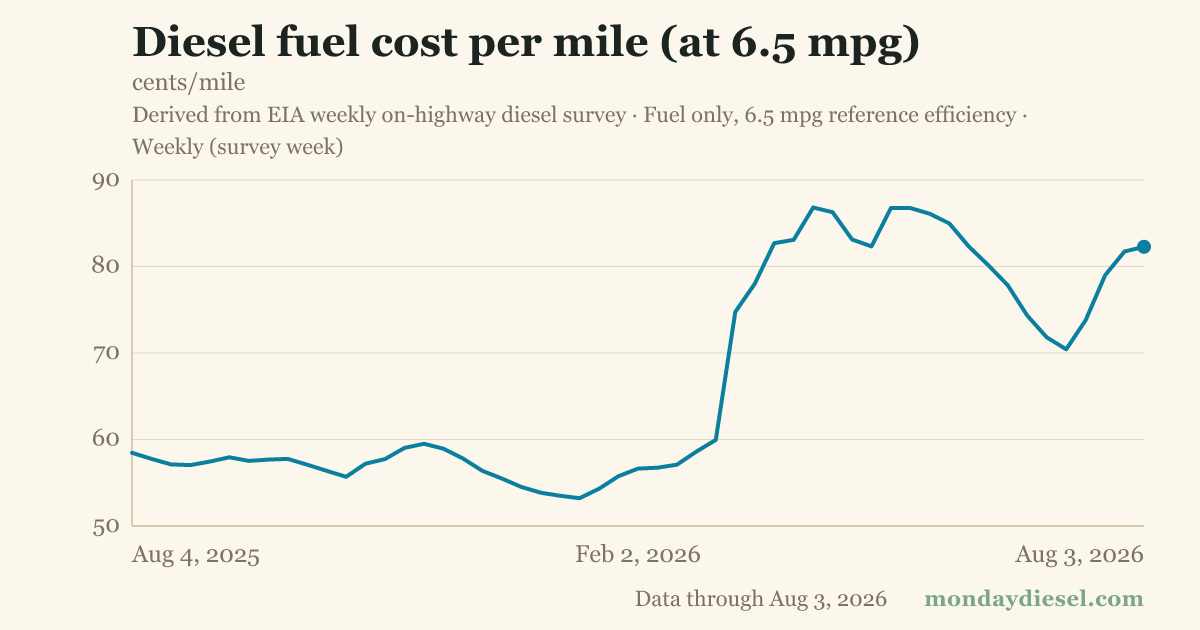
The EIA weekly on-highway diesel survey puts the DOE number at $5.257/gal for the week of August 10, down 9.1 cents from the prior week and 40% above the 5-year median for this calendar week. At the stated 6.5 mpg reference, that is 80.9 cents a mile of fuel. The week's move trims about $7.00 from the fuel cost of a 500-mile haul.
- Gulf Coast (PADD 3): $5.044/gal, down 2% week over week from the prior Monday EIA survey reading, and 48% above the 5-year median for this calendar week, the widest above-median gap in the survey.
- Lower Atlantic (PADD 1C): $5.034/gal, down 3% week over week, the largest weekly percentage drop of any region in the EIA survey.
- Rocky Mountain (PADD 4): $5.271/gal, essentially flat on the week (rounded to zero change), 40% above the 5-year median.
- West Coast (PADD 5): $6.033/gal, down 2% week over week and 34% above the 5-year median, paying 98.9 cents/gal over the Gulf Coast (PADD 3) at $5.044/gal.
- California: $6.618/gal, down 1% week over week and 35% above the 5-year median, the highest pump price in the EIA survey.
At the wholesale layer, EIA's daily ULSD spot series shows New York Harbor at $3.898/gal and the Gulf Coast hub at $3.868/gal, both dated August 3. Those are untaxed bulk cargo prices. The gap between those hub reads and Monday's retail print carries taxes and the full retail layer on top. EIA's daily crude benchmarks for the same date show WTI (Cushing) at $81.96/bbl and Brent at $88.90/bbl. Crude is roughly half the cost of a gallon at the pump, reaching retail with a lag of days to weeks.
Spot and crude data in this issue are as of August 3, one week behind the Monday retail number.
Monday Diesel reports public data from the US Energy Information Administration (the weekly on-highway diesel price survey and the daily ULSD spot price series). It contextualizes market conditions; it is not investment, hedging, purchasing or rate-setting advice, and it never tells a reader when or where to buy fuel or what fuel surcharge to set. Per-mile and per-haul figures use a stated 6.5 mpg reference efficiency and are illustrations of the index, not billing math.