
Towards Democratic Infrastructure: or A Humanities Professor Teaches Himself to Build a Tech-Stack to Maintain Free Inquiry in Dark Times
I had been drafting an email arguing for optimism about how clear the path beyond the current administration was becoming. Still, in light of the events of the last week, that post is probably quite tone deaf to what we are all feeling, so I’ve adjusted my focus.
I had, in that draft, anticipated that the rapidly diminishing legitimacy and power of the administration to enact its political will would result in dangerous and desperate escalations, which would feel scary but should be understood as signs that they are in a political corner. I still think that’s true, but I hadn’t remotely anticipated the lawlessness we’ve seen and the dangerous standoff between local officials and occupying federal enforcement agencies that is developing in Minnesota. This is probably the most dangerous political moment in the U.S. in my lifetime, and I’m not going to paper over the real risks we face. I also have nothing to contribute more insightful or powerful than what people in Minneapolis and all over the country are already doing. This is an existential crisis for the regime, and they know it, which makes them dangerous, but also means it’s either the beginning of the end or the end of the beginning. I’m hopeful it’s the former. And while I resist analysis that hinges on either/or turning points, it certainly feels like it is one of those moments. We will only know in retrospect, and I’m praying for everyone’s safety, for democracy, and the rule of law.
So what do we do with ourselves in a crisis? We keep working. I have more faith than ever that cultivated spaces of free inquiry in my classrooms matter, no matter the "use” the institution makes out of its educational function as a mask for investments and debt extraction. We are all together in a class, we have to make the most of it, and live the values we want to see. We have to keep practicing democracy and the pursuit of truth.
In the last week, I finally accomplished a major milestone on the road to a better classroom space I’ve been meaning to do for a long time. I have long disliked ed tech, and particularly the LMS (Learning Management Software) that huge numbers of universities use. The era of data capitalism has become the era of surveillance capitalism, and ed tech reflects this thoroughly. For ed tech platforms, every pedagogical and assessment problem is primarily a surveillance problem. How can teachers and administration collect more data on what students are doing, and how can that data be used to assign grades and credentials at scale? Are students plagiarizing? Here’s a database of student papers that a company keeps collecting data without paying the students who are forced to submit their papers to be scanned and incorporated into the database. Are students cheating on take-home exams? Here’s Proctero to watch them and turn their test-taking behavior into analyzable data sets that will get matched against databases of patterns of student behavior to flag cheating.
This is terrible pedagogy. It’s a betrayal of trust in the classroom. It’s treating students not as learners but as risks to be managed so we don’t accidentally pass a cheater and degrade the standard (and value) of the credential. It’s simply deeply unethical. It should be a scandal, but we keep vilifying students to justify the growing surveillance regimes. And I’ve long tried to minimize footprints on LMS and never ever use anti-cheating surveillance. But experiments with breaking with the LMS entirely have never worked because it really does “manage” the bureaucratic workload of teaching well, and when I have 80 students in a semester, as I do in this coming one, doing without its tools entirely feels impossible. Those teaching loads increased on the back of the tool implementation, and the student attitude towards work and grading as a contractual task checking has only grown. Without a “neutral” environment, you lose assessment capacity and authority.
Perhaps it is a bit shameful that it took the LMS being turned directly against teachers as well for me to finally act. But I had been acting in many ways before this, from requiring printed papers (which students hate) to trying to build WordPress sites alternatives through the open-source platform Humanities Commons (Unfortunately WordPress is too dated a platform to be operable these days; those websites didn’t have the needed functionality). Regardless, understanding a bit of news helped push me to make a major change.
Instructure (which owns Canvas) was acquired by Private Equity in 2024 (KKR). Private equity was specifically interested in an Ed Tech company because they saw all those course modules, all that student surveillance data, as an “underutilized asset.” What this means, practically, is that they are using the data as source inputs for companies building AI agents that can teach courses and monitor students. 1) they can market these products back to universities as workforce reduction tools. I think the likely scenario here is not “no” humans, but far fewer for far more students aided by agentic AI whose primary purpose is bureaucratic management and student surveillance. And 2) the private equity fund also has investments in for-profit universities. It can take course data from high credential schools that use Canvas and repurpose it, avoiding copy write law through scale and obfuscation, and use it in the for-profit context.
In both of these instance labor is being stolen to immiserate the people doing the labor, whether teachers or students. I have no faith that my institution would ever do the right thing and cancel the contract with Instructure (the board are all Private Equity managers themselves, after all) so it is urgent that teachers leave by choice. But that is hard to do. Alternatives are hard to find, and the moats are high once the institution buys in and hosts all the student data on the LMS. And we need more technical know how in the profession. We need solidarity and a plan.
In dark times, the only thing to do is keep building. If the crisis in Minnesota represents the dangerous escalation of centralized power, then our task in the classroom is to build spaces that are decentralized, human-scale, and private. Reclaiming our tools is not a distraction from the political moment; it is a refusal to let the logic of the regime—surveillance, extraction, and management—dictate how we think and learn together.
I took initiative and built my own open source static state walled garden learning environment. I will link it here. Its a static website with no student data, just course information and links to opensource resources, so I am free to share it publicly. I’m rather proud of this project, so pardon me while I show it off.
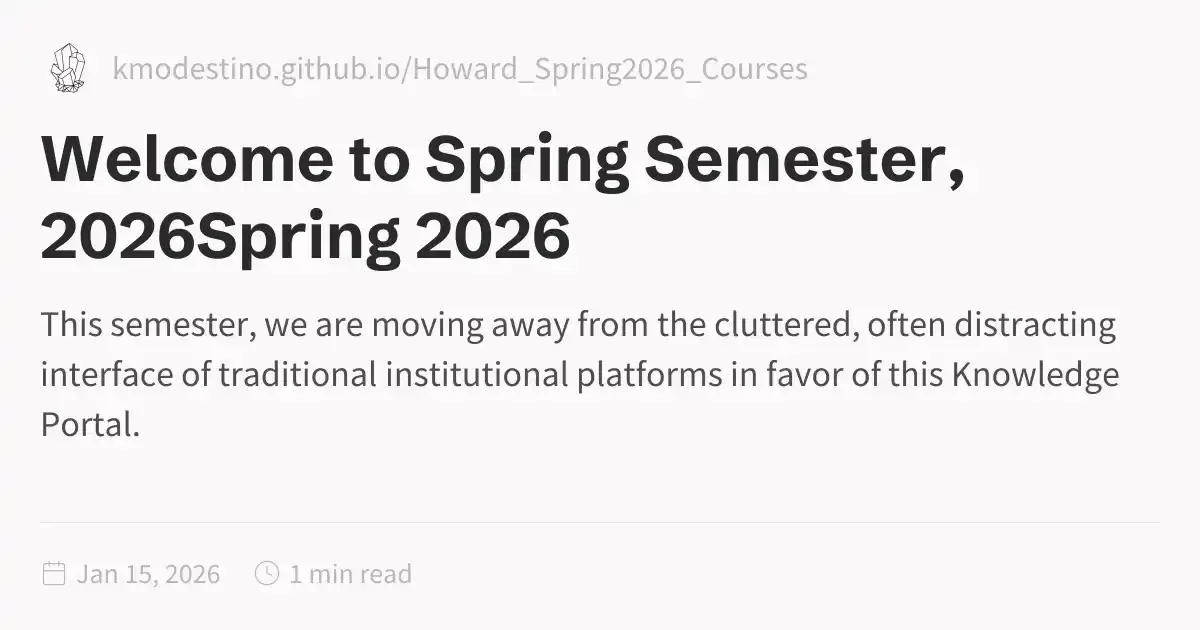
Welcome to Spring Semester, 2026Spring 2026
This semester, we are moving away from the cluttered, often distracting interface of traditional institutional platforms in favor of this Knowledge Portal.
This paragraph is a technical explanation of how I built it. If you find your eyes glazing over, feel free to skip down to my explanation in the next paragraph of what this work achieved. I did not have any coding skills, so I spent an intensive week using a chatbot (yes I used Gemini, I’m not anti-tech, I’m anti-extraction) to learn enough about GitHub, Obsidian, and markdown to build my own site. I used an open source site generator tool called Quartz that automates the building of the website from the file structure you maintain in Obsidian when you execute Git commands in your terminal. I also had to learn about editing JSON files (a variety of JavaScript) in an IDE (coding-editor) to adjust the organization structure and appearance of the website. Finally, I used the privacy walled MS365 and OneDrive access provided by my institutions to create a back end for student work submission, grade tracking in excel, and automating student access to their grade information. I made sure everything remained FERPA compliant, and I did my best to follow WCAG accessibility guidelines and checked the website against bot checker for accessibility (this involves looking at text size, color contrasts, link navigation).
Okay, now let me explain what this accomplished, substantively.
1) It is a “Static Site:” basically a bulletin board with a coherent information architecture that I can easily edit using markdown files and file/folder trees on the back end. In tech industry terms, this is called Continuous Integration and Continuous Deployment/Delivery (otherwise known as CI/CD.) In this, it is far more robust a content delivery system than Canvas or other LMS because its much more adaptable and editable once you’ve gotten over the technical hurdles. There’s no “types of content” or function limitations, although I can’t host private chats or discussion boards without introducing third party trackers. I have never found these pedagogically useful, anyway, and if we really need a private discussion space there are options, including shared university hosted OneDrive documents, a Signal chat, or some encrypted alternatives to Slack.
2) The website itself collects no data from users. I have access to the back-end and have verified there are no click or scroll trackers and no data repositories. The site is driven by values of data and user privacy. While there is no way to stop metadata collection by browsers or the hosting platform (GitHub), there is no pedagogical tracking—reading habits, engagement, and time-on-task are not monitored or recorded by me or this site.
3) For assessment purposes (where I am collecting data on students) there is full transparency on what is being collected. I use MS form integration for assignment submission and attendance tracking, and while Microsoft is no exemption from surveillance capitalism, the protect it provides to university clients is a walled so to ensure FERPA protections. On Canvas, there are particular places to put grade data, and that data is “de-identified” when used to comply with law (how effectively is open to debate), even as the assignment submissions, clicks, user behavior are tracked. MS365 for Universities has to provide more data privacy because universities need to be able to use Excel, Word, Forms, etc… to track and communicate all sorts of information that might be confidential otherwise the product would be useless. So I know that the forms I am using are generating excel spreadsheets and files in my OneDrive that are for my eyes only, and only collecting the student name, the time of submission, and the inputs the students themselves provide.
There’s some nuance here. Microsoft does collect some technical data, but not the same level of user data tracking as Canvas. And hypothetically, there’s potential for admin override access to my files, but that would require an institutional process and justification (like I got fired mid-semester) and would be manual not automated. Finally, none of this is stable. Ultimately my OneDrive file is not “mine” and both my employer and Microsoft could continue to blur the lines and cross over into more automated surveillance, pressing against legal restraints. I have to remain vigilant and not just assume because this is the case NOW, it will always be the case But for now its a vast improvement over Canvas.
4) This includes attendance tracking. I will not be “taking” attendance and recording things about students they don’t know about. I will use MS Forms to generate a QR code that I will project at the start of class, students will sign-in with their email addresses, and I will get an Excel sheet with their attendance, the time and the name of the user submitting the sign-in (I’ve told my students it collects this as well as the input). I then have some automation set up to collate that to a master attendance and grades sheet. This way students are in charge of their class inputs at every level. There’s potential for students to game this system, but there are strategies, like time-locking and words of the day, if this becomes a problem."For me, this attendance system is a data sovereignty principle in action. It moves the act of recording from a passive 'surveillance' by the instructor to an active 'assertion of presence' by the student. In this model, they own the initiation of their attendance data, and I act as a steward of that record within our protected university infrastructure.
5) The final challenge in this model is balancing data access with transparency. It’s one thing for students to own the data submission, but it’s another for them to have meaningful access to their records. Since Quartz is a static site, I have no way to post student information that remains private and FERPA-compliant—everyone can see everything. My master grade sheets stay in my personal university files because I’m the only one who can see the aggregate data.
So I have to be able to respond to student requests for grade information, which could easily become overwhelming. To solve this without overwhelming myself with manual emails, I use Power Automate: a tool in MS365 that can trigger the private delivery of information to individual email addresses at the click of a button. Beyond just sending a row of numbers, I can build these tools to translate raw data into plain language—turning spreadsheet data into a clear message about a specific grade or attendance date. It isn’t permanently on a dashboard like Canvas, but it allows me to process requests quickly and give students back their data in a format they can actually read. This is the best solution I’ve found that maintains data privacy while ensuring students aren't locked out of their own records.
I’m genuinely very proud of building these tools, and I hope after a semester of working with them and doing trial and error, I may be able to run workshops for colleagues to help empower them to build their own tools away from an extractive ed tech industry. It has been very rewarding engineering solutions (even if I was aided by a chatbot), and now having the tools I actually want, that I have ownership over, that enact my values and pedagogy, and not having to accept the corrupt systems that have been shoved down our throat by monopoly capitalism. I hope I can empower more teachers to make this leap. Its work, but its some of the most valuable work I’ve ever done as a teacher to rethink the systems and structure of learning.
As an addendum, it aligns really well with the writing course I’ve designed that focuses on critical algorithmic information literacy and chatbots as an object of inquiry and critique, produced and embedded in political economy. Below is the link to this specific course information. I’m really proud of the course structure of using the major LLM models and the ways they are transforming the information architectures and aesthetics of the web as critical case studies. The only thing to do in dark times is to keep building the futures you want to see.
https://kmodestino.github.io/Howard_Spring2026_Courses/Courses/Writing,-Literacy,-and-Discourse/