
College Without Jobs
An ongoing problem I have to face is how to adapt to the deployment of Chatbots in my teaching. Like many, I have a deep aversion and distrust of big tech. I’m enough of a historical materialist to recognize, even if Sam Altman, Mark Zuckerberg, Elon Musk, and Jeff Bezos were not a rogue’s gallery of almost comically hateful villains, new economy-transforming technologies are inevitably horribly disruptive of the lives and well-being of working people. And let’s face it, working (and middle-class people are already in pretty dire straits given the compounding inflation, debt, affordability, housing, wage, and job crisis.
There has been a general, top-down, heavy-handed message in higher ed that “employers want AI-competent workers, we need to incorporate AI in all our classes.” There is a desperation here, relating to the real economic crises in higher education and its ongoing identity crisis. But it is not clear what employers even want from new graduates in terms of AI competencies, or whether they want new graduates at all. There are countless articles about the collapse of entry-level work. Anyone who has been on the job market in any capacity recently knows that it’s bad out there, and getting hired increasingly depends on elaborate, cultivated online branding through LinkedIn, digital portfolios, podcast appearances, a newsletter, and a whole host of other, usually unpaid, performances of the labor you would be hired to do. A degree and/or work experience alone are deeply inadequate, even if they remain baseline requirements. What used to be required simply for high-level management and C-suite roles are now required up and down the career ladder (which barely exists anymore since there’s almost no internal promotion).
Malcolm Harris’s book about millennials, “Kids These Days,” remains a must-read about the front lines of this transformation during my generation’s coming of age. But I can attest that the situation, and the stress of the problem, is far more extreme for my students today than it ever was during my time in college. I started to feel it in graduate school. The 2008 economic collapse happened as I was beginning my program. There was an immediate, significant hiring slowdown in the professoriate, but we were assured it was temporary and, like there was after the dotcom bubble burst, there would be a recovery by the time my cohort finished graduate school six years later. It never happened. Adjunctification simply sped up to cover the teaching gap, and lower interest rates (the free money era), as well as changes to the management of student debt, led universities to go on a building spree as the economy recovered. This article about the University of Chicago offers the most comprehensive understanding of the extremely precarious financial position of universities today. Essentially, when the Obama administration bought student loans from the failing lenders and housed them within the federal government, it enticed universities (public and private) to treat tuition dollars as an infinitely expandable resource. The government was happy to keep lending more and more money to students without restriction on university tuition increases because, for a time, servicing the debt was profitable for the government, and there was no threat of default. Student loans are inescapable through bankruptcy, and the government has the authority to garnish wages upon non-payment.
With the promise of infinite potential tuition growth via government-held student debt and access to extremely low-interest-rate loans, universities spent the next decade building extensive new facilities: student centers, high-tech digital repositories, athletic facilities, stadiums, and fancy conference centers. In many cases, they leveraged the money they borrowed to pursue capital projects against future tuition increases. It was an arms race: universities were looking at a long-predicted demographic cliff (a drop in overall enrollments due to slowing birth rates), and they were trying to outcompete each other to attract from the diminished student pool by offering campus experiences (as well as attract corporate presences and recruitment on campus to ensure their degrees remain valuable). But as the above-linked article about Chicago points out, they were competing for the same architect firms and paying exorbitantly to build as much as possible as fast as possible.
What Universities did not do in that decade and a half was develop their workforce. They came to rely on extreme workforce flexibility in the form of adjunct and contingent faculty who could be hired and fired on a yearly or class-by-class basis, and growing outsourcing of core functions to contracting firms like student housing, IT, database maintenance, food services, HR training, diversity consulting, etc. Long-term commitments to hired employees for career development became a special privilege of an elite class: mostly administration, but with some space available for superstar researchers to keep up appearances.
By the time I was on the market looking for a professor job in 2014, it was clear that the only way to get a tenure-track job (and hence any possibility of secure employment) was to already be a research star with multiple high-placed publications and a book deal. My program took a destructive approach to the crisis, misread the room, and encouraged us to finish our degrees ASAP and get on the market (out of fear our funding would get cut before we could finish). But it is rare for a person to achieve a Ph.D. and all it entails, as well as develop the publishing profile of a successful early-career scholar, all within six years. Without that, you got funneled into a low-paid no-security contingency, if you could get a job at all.
And once you’ve been sorted, getting out is almost impossible. Trust me, I did everything possible. I published in a couple of big journals, pursued and was awarded prestigious institute fellowships with NEH and in Germany, and got a book contract with a major press within a few years—all despite working a research unfriendly 4-4 course load. But by the time I got there, my Ph.D. was “old” (4-5 years out), and I had fallen out of meaningful competition in job searches in favor of fresh Ivy League grads who had all that by the time they finished their Ph.D. because top programs had somewhat adjusted to the new demands. You simply have to be a superstar before you even start working to have any hope of a long-term, semi-stable career path. I did eventually get tentatively offered a tenure-track job by my own department after years of service on the promise of that book contract and after a nationally competitive search, but the provost’s office spiked the offer because I already worked there. More fool me, I agreed to teach the American Literature classes anyway without a raise or any more job stability and years later they’ve never bothered to hire anyone into the tenure track for this role.
I relate this story about higher ed because it lays out, in one industry I know well, what has happened everywhere. For a while, instead of hiring entry-level workers into a career path, the economy was coming to rely on an equivalent to adjuncts: piecework contracting. This is very common now and a feature of much of the part-time work I’ve picked up to supplement my below-cost-of-living salary. You get put on the rolls as a contractor, and if work comes in, you get paid by the hour to do it. But there’s no guarantee of any hours; you are competing with anyone else who signs up to snag the work before they do, and you can go weeks or months with no work. And, more importantly, there’s no career path: you are not being developed or trained in any way, and you either do it up to standard or an automated system stops offering you work.
While these roles exist and continue to exist, so much is being shifted to automation that there’s not much place for new workers, as I’ve heard Hank Green put it, to get paid to be bad at something for a while so they can get good at it. Everyone is expected to already be mid-career with mid-career work portfolios.
What exactly is the value-added to young college grads looking for jobs of having learned some ways, in freshman writing, to brainstorm with a chatbot or use one to edit a paper? Students have so much more to do, to build on there resume before graduation, that merely getting passing grades in courses is low on the agenda. The completely reasonable approach of most students facing this pressure is to game the system and try to get through the grading hoop with as little work as possible so they can work on things that may actually get them a job. For students, chatbot-assisted writing is about automating part of their development of human capital, not learning. And this is getting more and more extreme as tuition debt loads grow and access to jobs out of college that would allow recent grads to service that debt shrinks and grows more competitive. What I saw in higher education since 2008 has now become universal. At least I didn’t take on debt to get my Ph.D.
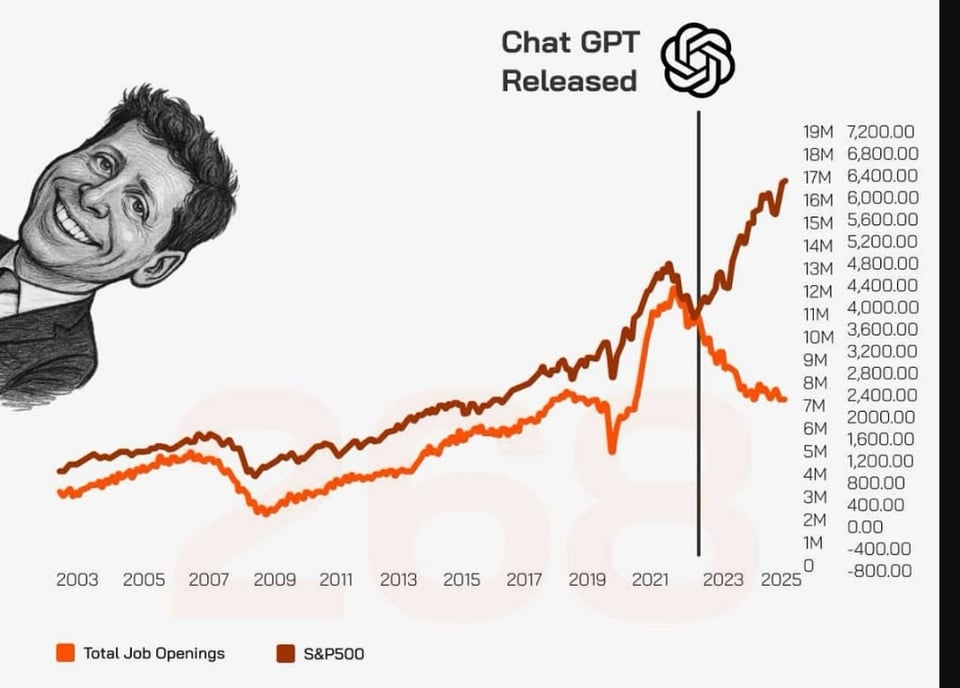
There is a great divergence in our economy. As this fairly infamous chart has shown, there is a divide in the economy right now between absolutely astronomical economic growth on the back of AI investment, with NVIDIA at the core (5 trillion valuation for Q3 2025 posted just four days ago as I write, completely bonkers numbers), and absolute stagnation of job growth and wages. Some have pointed out that the reason for this job stagnation is not really AI replacing jobs, and that’s true so far as it goes. Most roles are not automated; AI’s promised efficiency gains (and labor cost reductions) have yet to arrive. But focusing on that misses the point that, in a historically unprecedented way, enormous economic investments in a new technology are not resulting in any build-out of a workforce. Companies are preparing for a future in which they need far fewer workers, not one where they need workers trained in AI. The specific reasons for this are a bit more complicated than just a bet on automation, and have origins in the last decade of labor casualization and investments in cloud capital. Whatever you think of the overall new-feudalism thesis, I think Yanis Varoufakis offers the easiest to follow narrative of economic transformations since 2008 in Technofeudalism.
So this brings me to the starting question I have: What is the purpose of AI in my classroom? The message we have from the top is that it is what the employers of the future will want from our students. But it seems increasingly clear that is not what the employers of the future are planning on, despite what they are saying.
So universities have a real crisis brewing. 1) They are dependent on tuition increases to service debt from the shortsighted building boom of the 2010s. 2) While college degrees absolutely remain a minimal requirement for middle-class employment, the entry-level postgrad job is collapsing. 3) It was already the case before the disasters of the Trump administration that the financing of student debt had ceased to be profitable for the federal government and started to become a significant cost, and no one seems to have a solution. Even if Trump had not radically restricted federal funding to higher ed, it was clear that political winds were turning against an industry that had made itself an unsustainable burden on the public purse. Universities remain major employers, despite their own shortsighted attitudes towards workforce development, so politicians are probably not ready to ditch them quite yet. But clearly, the limitless payouts from the feds were going to be reassessed sooner or later.
As a lowly contingent professor, the AI imperative can feel like a last desperate attempt by university admins to secure a degree value that is increasingly in question. But there’s just no “in-classroom fix” or “branding fix.” Degrees have to get students jobs, and college tuition has to be reined in, or the system will collapse. The cuts keep getting put on academic departments and teaching jobs. But we are already at skeleton crew levels. There’s not much left to give here, even if they closed several academic departments in the humanities. We are not exactly costly. Maybe philanthropy will keep bailing us out, but I wouldn’t bet on it.
At this point, you might be noticing how little I’ve talked about the public goods of the university, like helping produce an informed and cultured citizenry or the social value of public research. That is perhaps a reflection of how little these things are talked about within higher education at this point. But ultimately, if anything saves the university it’s going to be the choice to invest in these things because they are valuable, and the choice to invest in early-career workers because mass unemployment of high-debt college grads is bad for everyone. Universities, perhaps, are the space where this can happen; a potential early career employer where people can be paid a living wage (or at least provided a low-cost living situation) to develop human capital previous to industry employment, while helping pursue education and public knowledge. Instead of debt financing, we fund the public goods of early-career employment and education. All this is a pipedream, but we are on a trajectory that is not going to serve many people very well. Some of that absurd value funding the development of AIs and cloud capital may need to be put back into human intelligence and human capital. Otherwise, I think we are well and truly fucked. And AI in the classroom won’t save us.