Team Update: Engineering from the Global South - What AIEng4D Is Doing
This edition of the our AIEng4D newsletter comes directly from members of our AIEng4D team working to expand access to practical AI engineering education around the world. Marcelo Rovai, Marco Zennaro, and Diego Mendez share their perspectives from their work with educators, students, and communities across our growing global network.
Their reflections highlight why building AI engineering capacity globally—and ensuring that educators and learners everywhere can participate—is central to the mission of AIEng4D.
People talk about the “Global South” as if it were a place you could find on a map. It isn’t. There’s no border you cross, no checkpoint.
The term is shorthand for most of Latin America, Africa, and large parts of Asia and Oceania—regions that, for historical reasons tied to colonialism and uneven industrialization, ended up on the consuming end of technology instead of the producing end.
It’s an imperfect label, and people argue about it for good reason. A startup in São Paulo or Bogotá and a rural clinic in Malawi don’t have much in common on paper. What they do share is a relationship to where the tools get built: usually somewhere else, by someone else, for someone else’s problems.
That gap is the whole reason our group exists.

What Is AIEng4D?
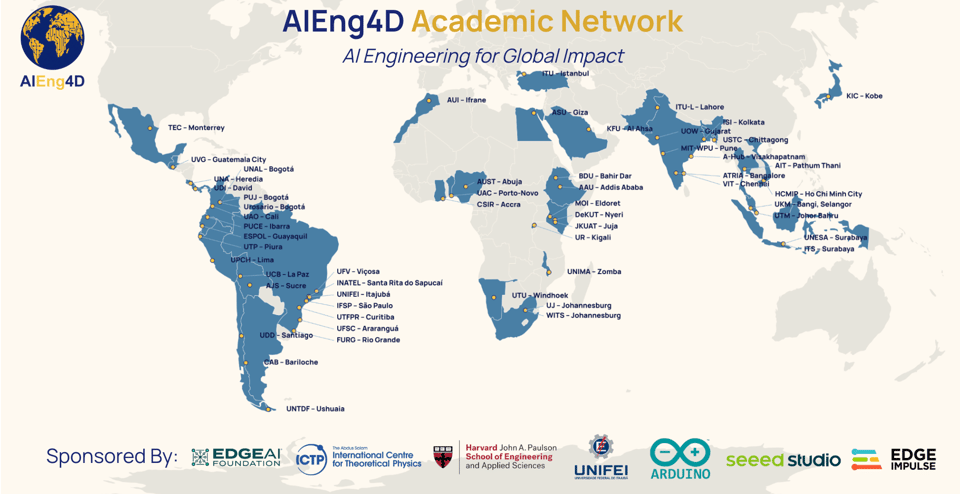
AIEng4D—AI Engineering for Global Impact—is a network of educators and researchers whose mission is to empower a global community of learners and institutions to design, deploy, and teach open, practical Edge AI for meaningful impact across the Global South.
We’re not visitors flying in with a solution; we mostly teach where we live.
The network began as TinyML4D, built around tiny machine learning: models small enough to run on a bare microcontroller. That work remains important, but the field has evolved quickly. Edge AI now spans a wider ecosystem of hardware, software, and deployment approaches.
We renamed ourselves around the part that matters most in the long term—AI engineering—because our goal is not to train people on a single technology, but to help build lasting local expertise that can evolve alongside the technology itself.
A New Home for AIEng4D
As the community has grown, we’ve also been building a new home for this work. We’re excited to introduce the new and evolving AIEng4D website, bringing together many of the resources and opportunities described here in one place.
You can explore open learning materials and hands-on labs, find hardware and kit resources, learn about upcoming workshops, sign up to participate in our monthly Student Show & Tell, or connect with the broader AIEng4D community. We’d love for you to explore it and let us know what would be most useful.
Building Practical Engineering Skills
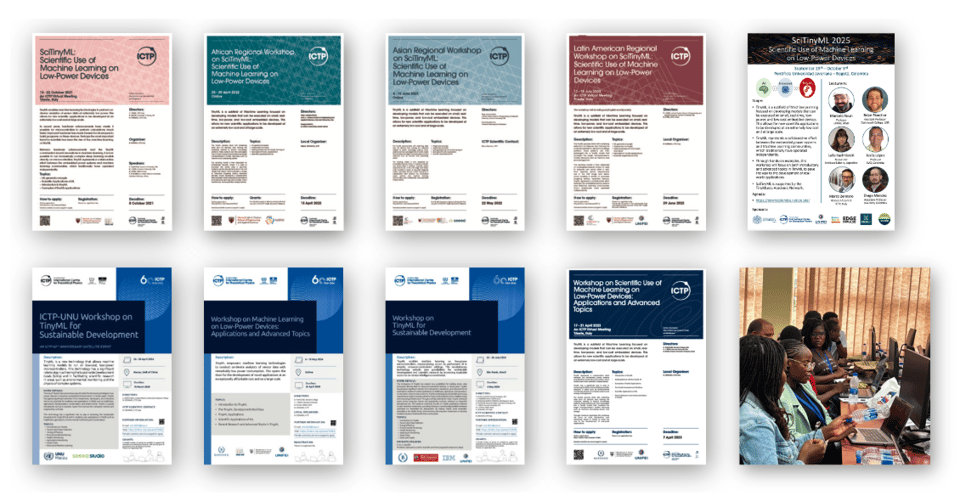
We run hands-on workshops, often with support from the Edge AI Foundation, from the Workshop on TinyML for Sustainable Development in Malawi to the AI Engineering track at WALC across Latin America and the Caribbean.
These programs are designed not only to introduce tools, but to help students and educators develop the practical engineering skills needed to adapt AI systems to local realities and constraints.
Getting Hardware Into the Right Hands
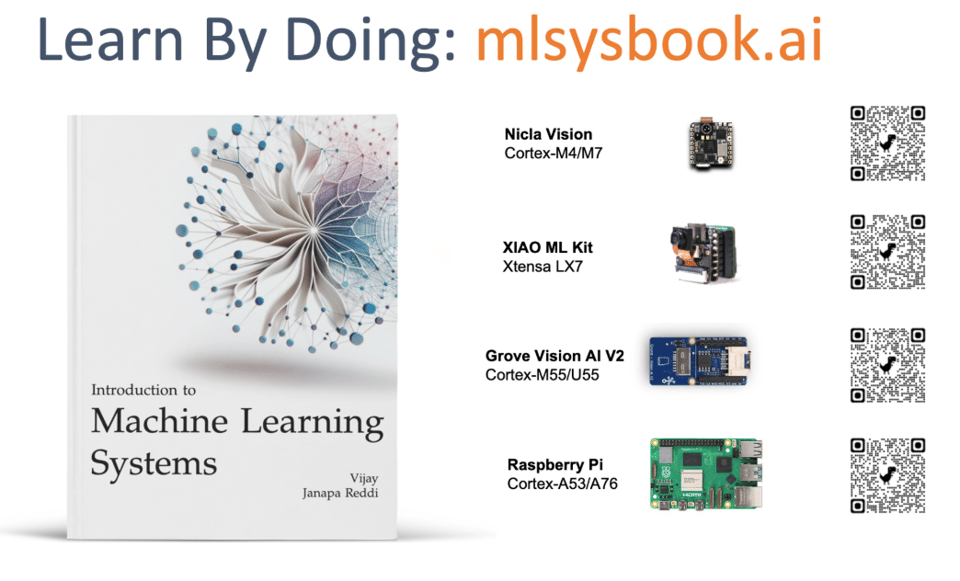
We get hardware into the right hands through kit donations and hardware access programs, with support from partners like the Edge AI Foundation. This year, hardware was awarded to universities across the Global South through an application process.
The hardware kits we teach only cost a few dollars to a few tens of dollars:
- Arduino Nicla Vision
- Seeed XIAO ESP32S3
- Grove Vision AI V2
- Raspberry Pi
- Arduino UNO-Q
The goal is not simply to distribute devices. It is to give universities and local teaching communities the resources needed to build sustainable AI education ecosystems of their own.
Why the Edge Instead of the Cloud?
Because the cloud assumes things much of the world can’t count on:
- Reliable connectivity
- Cheap bandwidth
- Money for API calls
- A willingness to send your data to a server you don’t control
A model that runs on a $10 microcontroller in a field with no signal is not a worse version of ChatGPT. It’s a different tool for a different reality.
We’ve used exactly this approach to detect mosquitoes for dengue control and other crop diseases, and to monitor machines and the environment in places where a data center is not an option.
This Is Not Charity
We want to be clear about one thing: this isn’t charity, and it isn’t catching up.
The people in this network are solving problems that the people who designed these tools never had to think about. That perspective matters.
The goal is not only to use AI systems built elsewhere, but to give Global South communities the capacity to adapt, shape, and ultimately create technologies that reflect their own realities and priorities.
Come Build With Us
If you want to see what this looks like in practice, the materials are open—and the community is open, too.
Visit AIEng4D's Website to start learning, explore our labs and hardware resources, join a Student Show & Tell, request information about kits and workshops, or find ways to participate in the AIEng4D community.
We’re building this network together, and there are many ways to take part.
Written by members of the AIEng4D Team: Marcelo Rovai Diego Mendez Marco Zennaro
