
Team Newsletter: Bringing AI to the Edge of the World
Training Activities of the TinyML4D Network
From a Simple Idea to a Global Movement…
Tiny Machine Learning — the ability to run machine learning models on low-cost, low-power microcontrollers — holds extraordinary promise for developing countries. These devices cost as little as ten dollars, consume minimal energy, process data locally without cloud connectivity, and give students and researchers a real sense of ownership over the technology. Recognizing this potential, we launched the TinyML4D network in 2021, an initiative initially co-hosted by ICTP and Harvard University, to build a global community of educators, researchers, and practitioners dedicated to making embedded ML education accessible across the Global South.
Our training journey began online during the COVID-19 pandemic. In October 2021, ICTP organized the first SciTinyML workshop — Scientific Use of Machine Learning on Low-Power Devices — which attracted 200 participants from 20 universities worldwide [1]. Through hands-on labs and lectures delivered remotely, attendees learned to build keyword-spotting systems and image classifiers on Arduino boards, all from their home institutions. The response was enthusiastic: participants were not just learning — they were already imagining how to apply TinyML to local challenges, from detecting plant diseases in Benin to monitoring respiratory conditions in Rwanda.
From 200 Learners to a Growing Global Network
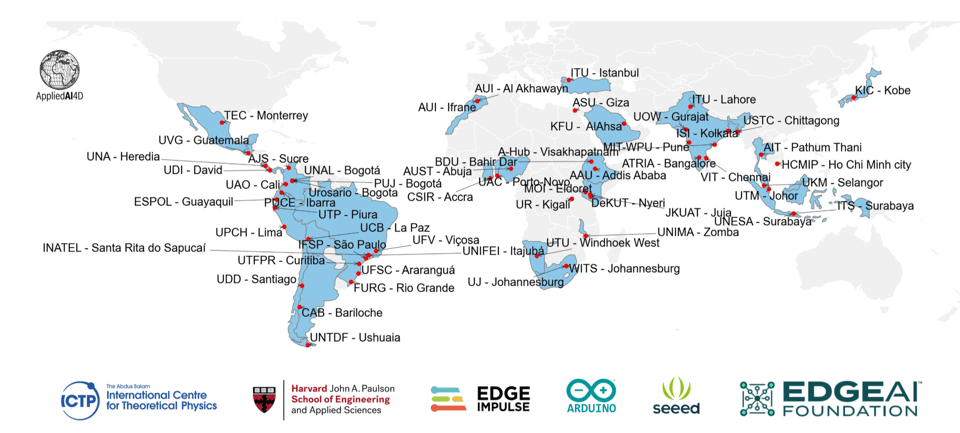
In 2022, we scaled up by running SciTinyML as three separate regional workshops, tailored to Africa (187 participants from 29 countries), Asia (100 from 8 countries), and Latin America (200 from 17 countries) [2]. This regional approach allowed us to address locally relevant applications. Alongside these workshops, the academic network itself was growing rapidly: a first cohort of 20 universities joined in 2021, followed by another 20 in 2022. With support from industry partners like Arduino, Seeed Studio, and Edge Impulse, each member institution received TinyML hardware kits free of charge, removing one of the most significant barriers to adoption. By 2023, the third edition of SciTinyML drew 418 participants from 76 countries.
Throughout this period we maintained weekly online meetings — over 100 Zoom sessions and counting — that kept the community connected, fostered collaboration, and allowed members to share teaching experiences. We also launched a monthly "Show and Tell" series, a deliberately informal format where students and early-career researchers could present works in progress and receive feedback from the broader community.
From Online to In-Person: Expanding Global Impact
In July 2023 we finally met face-to-face, when we organized the EdgeMLUP workshop at ICTP in Trieste, bringing together 42 participants from 25 countries to establish best practices for teaching TinyML. The goal was explicit: share experiences, develop open-source curricula, and lay the groundwork for a white paper [3] on how to build TinyML university programs. This gathering formalized our "teach the teachers" philosophy — training educators who would then return to their institutions and launch their own courses. The multiplier effect has been remarkable: many current educators in the network were themselves first participants in our workshops, and several have independently built educational programs.
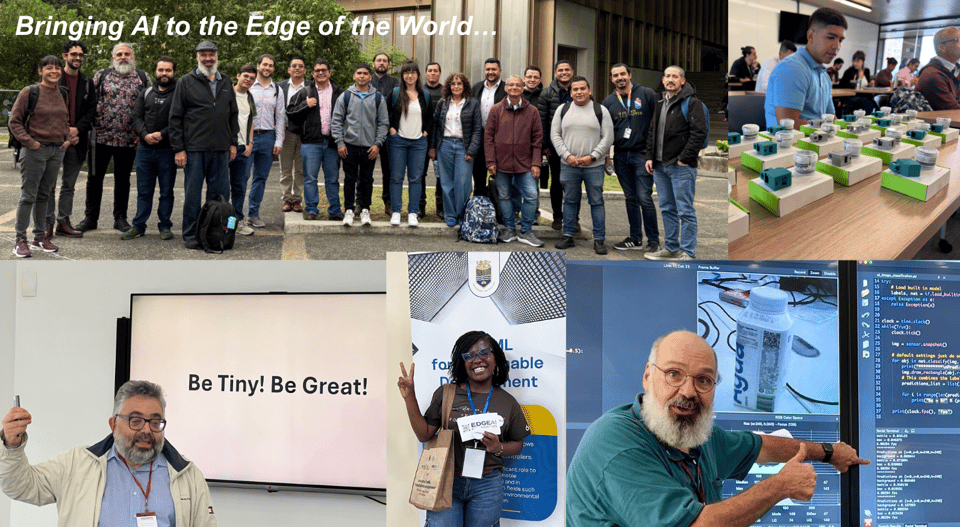
From 2024 onward, we shifted increasingly toward in-person events in developing countries. A major workshop on TinyML for Sustainable Development was held in São Paulo, Brazil, in July 2024, organized with IBM, Harvard, and UNIFEI, providing participants with intensive hands-on training using real hardware [4]. In March 2025, we brought the same format to Malawi, partnering with the University of Malawi, IRCAI, ITU, and the Edge AI Foundation [5]. A similar workshop was held at Pontificia Universidad Javeriana in Bogotá, Colombia, in October 2025, bringing together participants from across Latin America, with support from the Edge AI Foundation, Edge Impulse, Seeed Studio, UNIFEI, and ICTP [6]. These in-person events complement the regional workshops that network members have been organizing independently — at Addis Ababa University in Ethiopia, at Universiti Kebangsaan in Malaysia, at Al Akhawayn University in Morocco, and at the WALC Latin American conferences in Ecuador and beyond — often taught in local languages and focused on locally relevant applications.
Real-World Results and a Path to Scale
The research impact has been substantial as well. Network members have produced over 15 peer-reviewed publications on embedded ML, covering topics from mosquito species classification for malaria control to coffee disease detection, atrial fibrillation monitoring, and wildlife tracking of endangered tortoises in Argentina [7].
Today, with more than 60 universities across five continents, the TinyML4D network demonstrates that cutting-edge AI education need not be confined to well-resourced institutions in the Global North. By combining open-source materials, donated hardware, sustained online community building, and a deliberate train-the-trainer strategy, we have shown that it is possible to democratize access to embedded AI — one teacher, one classroom, one microcontroller at a time.
Written by Marco Zennaro & Diego Mendez
REFERENCES
[1] https://tinyml.seas.harvard.edu/SciTinyML-21/
[2] https://tinyml.seas.harvard.edu/SciTinyML-22/
[4] https://tinyml.seas.harvard.edu/SustainableDev-24/
[5] https://tinymlmalawi.notion.site/Agenda-TinyML-workshop-Malawi-1bd6dbff8adb800c9271db78657a8ad0
