
Musing on Mixed Media: A Review of Searches: Selfhood in the Digital Age by Vauhini Vara

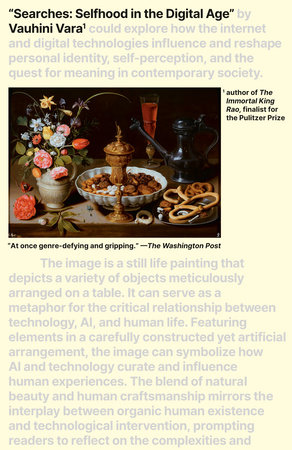
Usually for my last newsletter of the month, I try to match mixed media. Talk about how seemingly disparate words are entangled in my head. It’s very rarely that I find myself wanting to write about one singular corpus with fervor, but I suppose there is a first time for anything.
My friend Adam recommended this book to me. He pitched as an insightful piece of nonfiction that managed to show how utterly soulless ChatGPT was and the stark difference of human words versus large language models. He explained the format and the background, and I was curious enough to engage, trying to find another text to cling to as I wait out for AI Winter.
Spoilers ahead for a nonfiction book. Can you spoil nonfiction? Nevertheless, be warned: I talk a lot.
“Searches: Selfhood in the Digital Age” is a nonfiction story.
Part memoir, part timeline of technology and industry, part kitbashed archive, Searches is the type of work I endeavor to write. Multi-faceted, nuanced, a stream of consciousness that actively accrues ideas and concepts and effortlessly manages to get everything to sync.
Vara knows how to tell a story. She knows how to tell her story. We get a very thorough look at her childhood, her marquee moments, her sensibilities, her skills. She is very good at bouncing back and forth in timelines, focusing on the key elements that need to be discussed in the moment before pivoting to a different tangent.
As someone who lived through parallel experiences and interactions in the Digital Age, Vara’s recollections ring true and her thorough detailing of the history of the tech companies that scaffolded our developmental years is consumable.
It is tight. It is personable. It is focused. It well researched and constructed. It is a book that recognizes that it is uniquely positioned to be written at this exact time and not a minute, day, week, month, year later. And true to the advice I once received from a nonfiction writing mentor many years, it knows it has a very particular lens and does not shy away from acknowledging.
This is quite literally the type of work I imagine when I say “something only that person could do.”
“Searches: Selfhood in the Digital Age” is one of the most inventive pieces of experimental writing that I have ever read.
I took a short experimental writing workshop at the tail end of last year and it got me thinking about the “shape” of a writing. Most stories are linear. Some are cyclical.
Searches is best described as a series of nested dolls with internal mirror coating, constantly reflecting on its own scope and shape, waxing poetic on the confines of technology.
Or at least, that’s how I would describe the shape.
When Adam was telling me about the book, he explained it as such: Vara was writing a book about her use an early version of ChatGPT, but also about her experiences with technology as well.
Some chapters were Vara’s writing. Some chapters were Vara getting feedback from ChatGPT about the chapters. Some chapters were different archival delves: records of google searches and old Amazon reviews. One chapter was the entirety of her essay Ghosts, where she used ChatGPT to help process her sister’s death (something that the book goes into great detail long before the actual essay appears). One chapter was a meditation on translation, with two columns that ostensibly had the same meaning. One chapter was paired with GenAI images that were questionably applicable.
The final chapter of the book was a collation of survey responses from actual human beings. Answers of variable length, humor, and tact. A strange counterpoint to all of the manufactured, stochastic parroting (a term Vara does also mention, although to the extent that I hoped, but we’ll get there).
It was breathtaking, and I meant that in a way that is complementary and a way that terrifies me.
“Searches: Selfhood in the Digital Age” is a horror story.
At least from my perspective. There was a part of me that wanted to say that it felt like a Black Mirror episode, but Black Mirror at least has the decency to be a few steps removed from reality and not deeply embedded within the current to the framework where I can not opt, NO GMAIL I DO NOT WANT YOUR HELP WRITING AN EMAIL.
ahem.
I remember vividly the first time I saw a GenAI art bot. I typed several prompts. I shared it with folks. I thought it was cool. And then I found out the company was using it to mass produce NFTs. So I stopped. And then Midjourney came round, and I shared that with some friends, only to then discover that the entire foundation of Generative AI is built on stolen labor, unethical business practices, is actively doing harm to actual people because no one has put in safeguards, and is actively having a devastating socio-ecological impact everywhere between the drain and strain in puts on utility system and the sheer amount of lay offs companies are doing because of some perceived efficiency (that mind you, does not actually exist).
I hate this technology. I hate this technology with my whole chest. I hate this technology such that I am willingly breaking out of my introverted homebody tendencies to galvanize people to testifying against putting a data center, partly because of the environmental impact and mostly because I will not stand by and have a modern day snake oil factory tarnish the city that I love.
And the worst part is that I do in fact get it. I see what drew Vara to the technology. I understand the appeal of a thing that streamline the hard parts of writer’s block or making illustrations that I am not capable of. I understand wanting immediate feedback and the sheer curiosity of what the technology is capable of.
In the middle of the book, Vara does acknowledge that she did not have a full understanding of how the technology was created or the impact it has. At the end of the book, Vara admits that she has decided to keep using the tools because it makes things easier.
And I am reeling, trying to really understand how you do all of this and get to that conclusion.
“Searches: Selfhood in the Digital Age” is not the condemnation of Generative AI that I hoped it would be.
Last year, I read The AI Con by Emily M. Bender and Alex Henna, who do get a little nod in this book as Vara was discussing the aftermath of publishing Ghosts. The AI Con is a straight up condemnation of Generative AI and the businesses that created it. It is aligned with my personal beliefs and referenced several things that I had independently researched and it was nice to see that folks with PhDs agreed with me.
I read Searches hoping to have add another thing to my “please read this” list when it comes to Generative AI. I did not get that. To Adam’s credit, Vara did show how soulless and spineless ChatGPT was. Vara did contrast that soullessness with the spark and vividity of humanity.
It critiques tech companies fairly and brings up a lot of valid points about consumerism. I continue to face my own hypocrisy of still having an Amazon Prime account and other ways I participate in the capitalist framework.
But as I read the sentence “I haven’t stopped using ChatGPT” I got angry. I got frustrated. I bit my tongue to point where I almost thought I might have drawn blood.
I do not have Vara’s exact experience with the technology. I do have my own though. I have nearly three years of watching search engines become utterly useless. Three years of testing this variations of the technology only to find that it couldn’t do the simplest tasks. Three years of being told this was inevitable, this was the future. Three years of seeing the products not actually get substantial and in some cases get substantial worse. Three years of actual horror stories, of people fucking dying as a direct result of interacting with this tech.
I don’t think human life is worth the cost that I’m seeing. And I think a part of me wants to believe that Vara believes that to, but that’s not what I read at the end of the day.
“Searches: Selfhood in the Digital Age” is a book I read that I don’t know how to feel about.
Am I glad that Adam recommended me this book? Yes.
Am I now fuming that I have now written 1400+ words about it trying to process the fact that it is a book that does incredibly novel things with form and narrative and also runs deeply counter to my deep seated personal belief? Also yes.
Do I know friends/family who use these tools? Also, unfortunately, yes.
This book is a beautiful thing that Vauhini Vara crafted because of her unique position and her unique experiences, and it’s a book that could only ever exist right now because of the advent of large language models, and I’m glad it exists, but god.
I hope there’s never another book like this.


