
Hello! It’s been a while. I hope you’re doing well. One of my big goals for 2026 is to create more, and one of my favorite ways to create is to write. It’s March, so it feels like high time to get started. To reboot my newsletter, I’ll be sharing some thoughts, plus what I’m reading, watching, or listening to, in a short weekly letter, on Mondays (though if I’m late for that, I’ll probably publish mid-week anyway). Here’s the first edition of The Monday Letter. Enjoy!
Put yourself on the critical path
Early in your career, optimizing for learning matters more than optimizing for comfort (don’t take this too far, but still). Critical-path work tends to maximize learning because it sits closest to what really drives the business.
A handful of my friends are on the job market right now, and it’s had me reflecting on what I love about my current job and what I’ve, uh, loved less about past jobs. One of the defining characteristics of a great role for me is working on something that puts you on a company’s critical path. (Especially if you’re at the start of your career.)
If you’re working at a company that makes, say, phones (or at least, that’s their bread and butter), you will learn the most, be pushed the hardest, and be surrounded by some of the best folks in the industry if you’re working on the phone team. Most companies, especially large ones, have a symphony of products that all contribute to the bottom line in one way or another. But if you can find a way to work on the hot product that truly defines the brand, that’s special. The best cellphone people in the world are probably going to be on that team. Why not work with them?
(To make this concrete: when I was at Samsung, I worked on a niche B2B product for Samsung Knox. It was fine, but it wasn’t the phone or anything even close to that. It was a similar thing for me at Amazon; I was working on an extremely niche intake flow for supply chain vendors—that was fine, but it was a far cry from the experience my college friends had working on S3 on Amazon.com. These jobs were largely uninspiring, to the point I came out of them thinking industry was not for me. Working on performance at Notion has been a far cry from those experiences.)
An easy test to figure out what the critical path is at a company is to look at how they market themselves. What do their values center around? What products does that translate into? A harder-to-fake test is to ask what leadership reviews every week, and what would be most painful for the business if it broke.
I’m not a machine learning person. If I were, I’d be chomping at the bit to work at Anthropic or a neo-lab. I’m not a trader, but if I were, I think working at Jane Street would be a great time. The supporting cast is, of course, crucial; it really does take a village to make a great product. But for your sake, especially early on, try to find the steepest learning curve you can.
That’s why I particularly enjoy my role right now. One of the things that will define my company in the next few years is whether we can properly scale up to the demands of larger customers. What do I do? Help the product scale so that it can meet those demands.
If you’re on the job market, ask yourself what it is that you love to do. Software engineering is too broad. Do you like working on distributed systems, databases, machine learning, networking, programming languages, or something else? For that area, where are the best people working? And do they have a role on their team?
(If you haven’t found this yet, don’t fret. Bounce around to different teams and projects to explore your interests broadly. Read books and papers, maybe tinker on a side project or two. It’ll become clear quickly. I promise.)
There is an exception to this: I also think it would be a lot of fun to work on a “new bets” or special-projects kind of team. In this position, your goal is to become the driver of the bottom line. The only caveat for me is that at that point, why not go start your own thing? Or at least go to a smaller shop, where you can get a bit more skin in the game, i.e., equity?
When you’re looking at a company or picking your next role, sanity-check where the critical path really is by asking two questions: what work is currently blocking the company’s top priority, and where the strongest engineers seem to be concentrated. Go be a sponge among them.
To close out, here’s what I’ve been consuming of late.
- I finally got around to watching Bugonia (2025). Emma Stone and Jesse Plemons in this Yorgos Lanthimos film. It’s definitely Weird (—this is my first Yorgos movie, and apparently that’s to be expected), but it’s a super fun watch; there’s really never a dull moment in the film.
- The NHL is back in action, and I had a chance to catch my Edmonton Oilers take on the San Jose Sharks this weekend in an absolute barn burner at the SAP Center. Hockey has had a hell of a year: Heated Rivalry, an Olympics (to forget, for me), and stars old and young lighting up the league. Hockey was quite literally front and center on SNL this weekend, with the Hughes brothers making an appearance in the opening monologue. If you haven’t caught a game before, go! If you need some convincing, here are the highlights from the game I watched last Saturday.
- I nabbed tickets to Shaky Knees, a music festival in Atlanta with a ridiculous lineup this year. Gorillaz, Geese, LCD Soundsystem, The Prodigy, Fontaines D.C, Peach Pit, and a whole lot more. To that end, I’ve been really enjoying Gorillaz’s latest project *The Mountain.*
- This rebuttal ("Why I’m not worried about AI job loss") to the “Something Big is Happening” essay that’s been making the rounds on Twitter is excellent. A few quotes I liked:
If you had come to me ten years ago and told me about the leading AI models that we have today, that GPT 5.2 and Claude Opus 4.6 would be publicly available via a cheap API call, I would have thought that we’d be seeing something like mass unemployment. I would have said something similar, honestly, about GPT-4: if you had shown GPT-4 to me ten years ago, I would have thought that within 12 or 24 months of its release, we’d at least have automated away most of the outsourced customer service industry. People were saying the same about GPT-3 when it came out in 2020.
GPT-3 has been out for six years; GPT-4 for three; and none of that has happened. Even in the outsourced customer service sector, the lowest-hanging fruit on the automation tree, we’re just not yet seeing mass layoffs due to AI. I’ll be frank in telling you that this has been a huge surprise to me. (And to others.) There is change, but it is gradual; it looks more like standard technological diffusion than a tsunami of replacement. And we should think seriously about why this has been the case.
I’ve seen how ordinary, non-online people are reacting to Shumer’s essay; and I now recognize, from the ambient sense of fear and panic, that we are in the very early stages of a massive populist backlash to AI. Telling people that AI is probably going to take their job doesn’t end with them getting a $20 subscription to ChatGPT Plus in order to learn about the frontier of technical development. It ends with an enormous cross-party populist movement to stop AI at all costs: with the complete banning of data center construction, with jobs guaranteed for life, and with laws passed to choke off the development and deployment of anything that could potentially make the economy more efficient. And if you think that AI can do very good things for the world, whether this means higher productivity growth or accelerated medical and scientific progress or the discovery of new and more glorious stages of human civilization, then you should recognize that outcome as a catastrophe for human welfare.
I agree. The models have improved substantially, but in my view, the world needs more great engineers, not less. And given the nature of the working world, we need a lot of humans to help the models flourish. (Also, as with many past technological revolutions, we invent jobs we could not have imagined prior. I am not yet convinced this time will be different.)
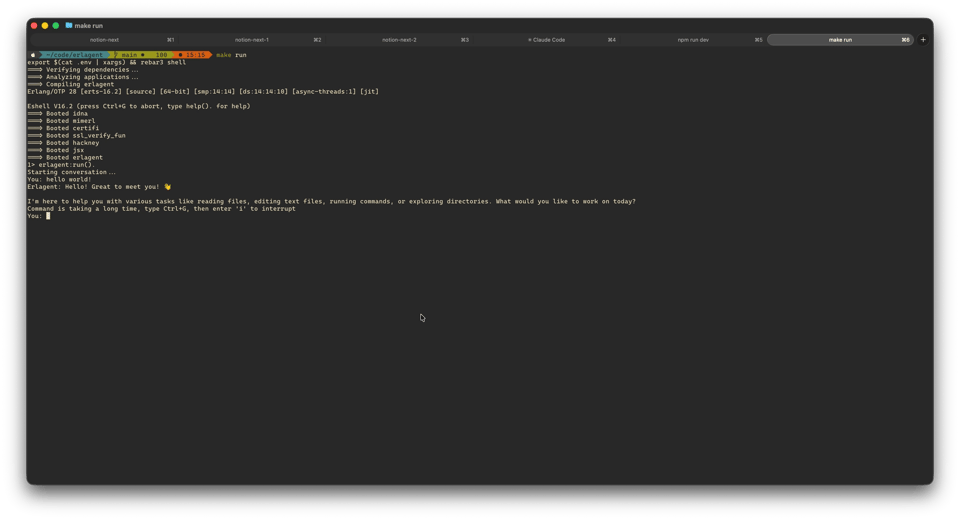
- Less consuming, more making: inspired by this post, I wrote a somewhat functional coding agent in Erlang. It’s only 250 lines long! Source here.
That’s all for this week. See you next Monday!
Michael
You just read issue #3 of Busy Living. You can also browse the full archives of this newsletter.


