
27 Tips For Future Bumpslash Designers
27 Tips on how to design Bumpslash combat for your game
New Blog!
Melos Han-Tani here! Welcome to the new home of my blog! I’ve been meaning to move off of Substack for a while... and finally found time to do it. If you're a past subscriber, two things you may need to check:
If you only want my game announcements, this setting wasn't preserved from Substack - however you can adjust your Buttondown subscription (somehow... I'm sorry if this requires making another account)
If you were a paid subscriber on Substack, I've moved you over here, but you may want to double check everything looks OK with your Stripe payments.
Anyways, I have a bunch of ideas I want to blog about... from (the now too-late) year-end lists, research thoughts, thinking about games and the way some people's worldviews are intertwined with their taste in games. Or, some rebuttals to some player response to Angeline Era's exploration (hehe) as well as explanations of some of the designs of AE's exploration levels. But I'll just start with something a bit more straightforward for now.
(Not subscribed yet? Subscribe for free!)
27 Tips For Future Bumpslash Designers
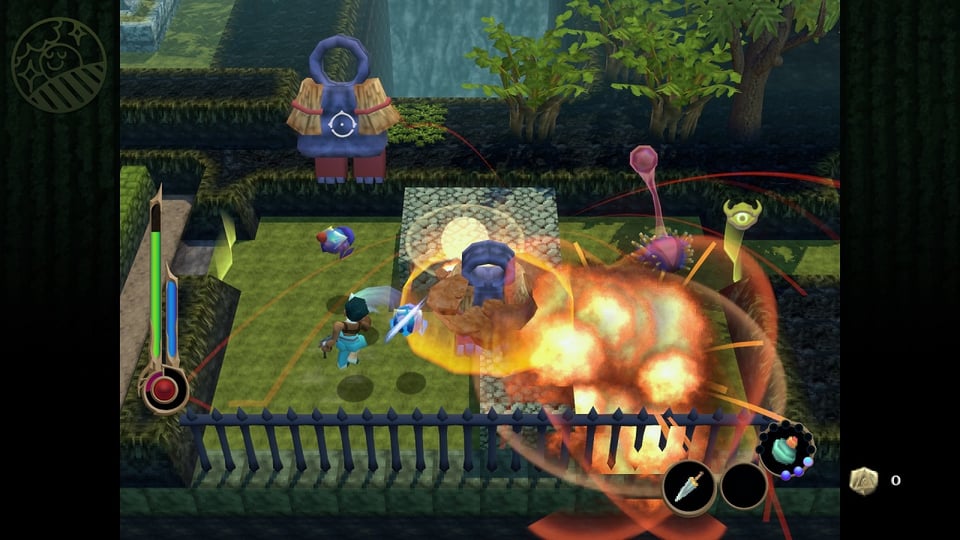
Bumpslash is the combat system of Marina and I's latest game Angeline Era.
Note that a Bumpslash Game is different from making an Era-like. A Bumpslash game might be an Era-like: an Era-like would be an action-adventure game with unique nonlinear overworlds, Bumpslash combat, imagination-guided storytelling and hilariously divisive level and story setpieces.
But a Bumpslash game could also be something else, I think. Bumpslash visual novel? Mystery? Maybe! Who knows!
So I wrote up 27 or so suggestions if you would like to try your hand at making Bumpslash combat systems. Please note these are based on what worked for Angeline Era, and I consider most of these to theoretically be flexible, however, I think future designers will find the most success with Bumpslash if you first think about why it works in Angeline Era (before then making tweaks to your own game's take on it). I'd be happy to see different takes on these principles... but I've got to play it to believe it!
Also, please note that AE doesn't even do all of these consistently or perfectly. If you worry too much about being perfect... it will make the work slow. No one's perfect! Don't worry about it! Experiment and have fun! The only important thing in designing action games is to be eccentric!
Risk Zones. At an average difficulty, Bumpslash should always try to feel like you are constantly moving around and making adjustments. The combat arenas should intuitively have zones of low and high risk, and require you to go in-between them. Harder rooms often pressure you to stay in risky zones (whether that be tighter rooms or more aggressive enemies).
Speed. I actually think a faster or slower feeling Bumpslash game could work, but just note it would likely differ in a bunch of ways. Just keep in mind that slower movement would probably be better with smaller combat rooms, and faster would be better with bigger combat rooms. And note that bigger combat rooms means you could run into higher production costs with bigger levels...
Positioning Matters! Avoid giving players basic moves that grant them safety no matter where they are (dodge roll, parry). Bumpslash should always focus on movement. To get out of the way of an attack, you have to move or jump. Limited-use items (like AE's Blood Trick/Iron Body) can be OK, but be just be wary that the act including them, while it will widen possible playstyles, will also lead to something that whittles down the balance of the combat.
Jump! Without jumping, positioning becomes a bit more tied around walking around enemies in circles, which can be needed because often your angle of attack matters in Bumpslash. Jumping lets you easily get around the enemy, it also adds an interesting dimension of verticality to combat, and it's also a way of dodging that doesn't rely on i-frames, and doesn't necessarily make you safer depending on the enemies you're fighting. FWIW, I think Bumpslash could work without Jump or Double Jump, but if you remove Jump in a 3D game it might work against you depending on the wider scope of the game (e.g. an 3D adventure game, jumping can be nice)
i-frames: This is particularly a matter of designer taste, but in AE I give the player a few i-frames after any attack, mostly to prevent being hurt during the brief moment of being hitstopped and some other situations where the player doesn't quite have full control yet. Note that you can have enemy attacks that override these i-frames if it's something like the Fishes' lasers. I didn't give too many i-frames though because I wanted sloppy positioning to be punished badly.
TRY GUN. The gun is necessary in Angeline era because battle arenas tend to be 10x10 to 12x12 in size and you move at about 5-6 tiles per second, meaning crossing the room could take 2-3 seconds! So naturally there will be some large gaps in-between enemies and the player. The gun helps the combat system by letting you keep up aggression from more spots on the battlefield. Of course, you should have an ammo system or something to balance the fact guns allow for damage from a zone of low risk. Angeline Era went with an 8-ammo, 3-per-refill approach to prevent overusing the gun. Angeline Era also refills ammo when going between rooms, which makes no sense but allows you to quickly get back to shooting in the next room. I will add that theoretically if the player moved much fast the gun could be less important, but consider how faster movement often creates less of an grounded relation between environment and player (which may not be good for adventures like AE).
MAKE GUN SIMPLE. Don't let players aim the gun. As soon as you introduce aiming the flow of the combat system is completely annihilated by creating too much mental load in the gunplay. Things work better when combat prioritizes the position of your player, rather than aiming the gun reticle. The player's position IS the act of aiming the gun.
REDUCE MENTAL LOAD. Bumpslash combat works when it feels effortless and like swinging a tennis racket or baseball bat. Every action your player can take has some kind of mental load, especially when combined (e.g. considering to throw a grenade, shoot, or go in for a bumpslash). When these actions require more complicated buttons (e.g. if you could aim the gun), you increase the mental load. If there are too many choices, that increases the mental load. Keep things just minimal and intuitive enough that the combat becomes second nature. Limit more 'thinky' things like the Gun or Artifacts via ammo systems.
Simple enemy AI. Combat becomes heavy, overly-thinky and burdensome when an enemy has to be carefully watched for movements or tells. That style of enemy works better in other types of games. Bumpslash enemies should behave more like geometrical elements moving around the screen, this means simple, even dumb AIs. Complicated AIs means players require more attention to defeat them. Complicated AI will drag the pace of combat down as players wait around for safe openings, often requiring consistent means of dispatching them. Complicated AI tend to work better with more technical combat systems, but Bumpslash should be simple. An example of 'complicated AI' could be the Sword Brigand enemies in Angeline Era where you either wait to stun them or create one via the gun. They work OK sometimes but they are a bit of an oddball.
Let enemies synergize. Enemies on their own should often be pretty simple, and instead, the complexity of the combat should come from the overlapping and emergent effects of putting multiple enemy types that create interesting patterns together. Each enemy should have a different way of creating zones of low and high risk.
Moving enemies tend to be better at setting the flavor of a combat arena than shooting enemies. When enemies move, they interact with the geometry of the combat arena, and create interesting zones of risk, especially when factoring in having to approach the enemy to attack them. If an enemy sits still and shoots, there's less of this dynamic. AE has enemies of both types, to various degrees of success. There's no need to stick to just one, sometimes using both can be good!
Downplay enemies being invulnerable at certian times. It's OK to do this at times, but have the invulnerable/vulnerable state alternate quickly. Some AE enemies do this with various tradeoffs (e.g. the spinning robots with laser arms), but it's best for the combat if enemies are generally always vulnerable from some angle without too much waiting or set-up required from the player. Avoid Zelda-like enemies (where you have to use a puzzly item to get them vulnerable).
Downplay enemy bullet attacks. Bullets are going to be a useful tool, but there is a certain threshold at which the fun of the combat is dampened when it's entirely about dodging without much opportunity to attack back. I don't think you should avoid bullets, but try not to rely on it for every enemy type, use it more as a spice or flavor.
Shadows. Try to use circle shadows under everything relevant to combat. Depth perception is impossible in 3D lol. Avoid realistic shadows cast by directional lights.
Camera Angles: An ideal camera angle for bumpslash is around 45-55 degrees. Lower than this and it's hard to see depth, higher and it's hard to see height.
Camera Movement: The camera should move as little as possible while fighting. This means jumping shouldn't cause any camera movement most of the time until landing on higher/lower platforms, and even then sometimes you should have the camera in rooms just stay at a fixed height.
Be careful of RPG systems. You WILL need numbers for the combat system: damage, health. But try not to show the player these. And try not to have number or stats-heavy ideas applied to the game's combat system. This will ruin the combat because numbers push a game to be more about changing things in a menu rather than increasing your consistency and skill in combat, and everything should be feeding back to being aware of your player's movement and positioning. That said, some stats can be OK. Angeline Era uses level ups to create some sense of danger and pacing to the world's farther levels, but it's done with a bit of compromise: enemies still have a 'minimum hits to die' value, and overleveling never lets you 2-shot a Bugdog. If you use numbers in a Bumpslash game, attention should be paid to how overleveling affects early-game fights. Also, it's nice if the game is possible at Level 1 with minimal (if any) items, because it means the game hasn't let level/stat scaling break its fundamental combat.
Subweapons in moderation! In many modern action games, the base attack is fairly weak or worthless in favor of filling up a special meter to do some super attack (e.g. modern Ys, like Ys 8-10). Bumpslash is the opposite: you can very occasionally have access to additional skills, but the focus should always be about Bumpslashing. View Subweapons (like the Grenade) as something supplementary, and don't let them take the stage, because they will defocus the combat. Likewise, if you have alternate weapons (like the Rapier or Spear) they should still use that basic Bumpslash verb.
Emphasize physicality. Bumpslash is supposed to feel like athletics, in the sense of an athlete using tools in sports as an extension of their body, like baseball bats or tennis rackets. This is why Bumpslash should feel intuitive and non-thinky, placing focus upon your movement and position. You may need to strategize in Bumpslash games before jumping into action, but the act of doing the fighting puts you in 'the zone' of execution. The act of Bumpslashing in the game should have a weight to it, this is done in Angeline Era via the knockback system, where depending on your poise stat and your enemy's poise stat, you or the enemy are knocked back some amount. This stat is hidden from the player but changed based on their level, and it helps emphasize the player needing to be aware of their angle of attack. Hitstop is also useful, just having a few frames of the player being paused after an attack can be enough to emphasize that a hit has connected.
Physicality and Movement: It's important to have a very slight bit of momentum to turning around/moving, because of the aforementioned point. This helps the player feel embodied within the game's world, which works hand-in-hand with the above notes on physicality (especially because momentum is involved in being knocked back, so to have super snappy movement might feel contradictory). Still... it's best to err a bit more towards snappy than like, slidey lol. Just not too snappy!
Level design: AE's bumpslash works the best with linear levels where you lose health over time, where opportunities to heal should be rare or risky. As players take damage they are forced to pay more and more attention to the enemies and levels, which in my opinion is the satisfying and fun part about learning levels. You lose this once you introduce easier healing or dungeon-like-branching/exploration into levels. Not that your Bumpslash game shouldn't have any exploration or dungeons, but just know that the "most natural level design fit" for Bumpslash tends to be these more linear levels. Of course, AE features plenty of non-linear levels, where combat can be something of a tool for expression and narrative. You could also utilize small sequences of combat into non-linear levels, which Angeline Era does a few times (e.g. some levels in Throne's Pall, or the level where you're constantly being poisoned).
Level Flow. This one is subtle and not totally required, but it's usually better to put room entrances at the bottom of rooms, as you shoot upwards and players can utilize this. Likewise locating a few enemies near the entrance to a room makes it easy for players to make their first move.
Keep combat rooms small. You don't really want people to chase down enemies, and more space (without an increase in enemies) means there's much less tension with dodging or avoiding. Of course there can be exceptions with certain enemy layouts (as Angeline Era has) but generally you'll find better results with keeping the combat rooms small.
Use combat rooms. These are helpful as they force players to fight enemies. It's easy to just run past enemies with double jumps and AE's quick movement, so you need a way to stop players from doing this all the time.
Eye gates can help. Eye Gates create intentionality within combat rooms, and they allow for microstrategizing on repeated player attempts. The way Eye gates work is I can tell the gate to "mark" certain enemies, and then tell it how many kills it needs to open. So in a room of 4 enemies, I might mark two, but only require 1 kill (of those two) to open the gate. This creates a sense of intentionality with each room in the game, and it also pressures you as the designer to imbue intentionality to how you're laying down enemies.
Think about how many hits it takes to die. This is an important number for level balance. Basically once a player's HP goes high enough to give them more than 8-10 hits-before-dying in a level, it reduces the sense of risk for players. This is useful for placing a level within a big open world and deciding what types of enemies to use. I like to balance the levels and enemy damage around a "hits to die" of 8-10, that allows for enough rooms per level to make the level feel substantial and establish a sense of place. 8-10 also allows for higher difficulties to feel much more intense, and gives you room to create tougher levels.
Stay focused on Action! Generally Bumpslash works better when you don't design your systems with having lots of stats, skills, attributes. Instead, work these RPG-like elements in when the game really calls for it. Leveling up in AE helps with making the world have a bigger sense of intentionality and texture, creating regions of danger and safety. Alternate weapons and subweapons (Artifacts) can let people try out alternate playstyles instead of banging their head against the wall (although some people will still bang their head against the wall and yell at you about it... shrug!). Is a full-on Action RPG version of Angeline Era possible? Maybe, but my gut has some suspicions about it.
And that's it for now! I could go into some of these more in depth or with examples, but this should be helpful for the time being.

Add a comment: