
Play is learning and learning is experience and, according to Aristotle, experience is the meaning of life.
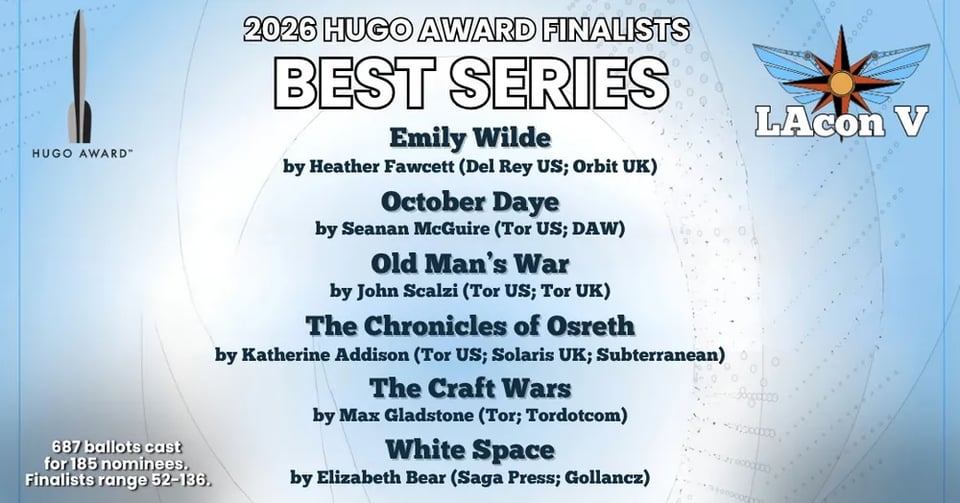
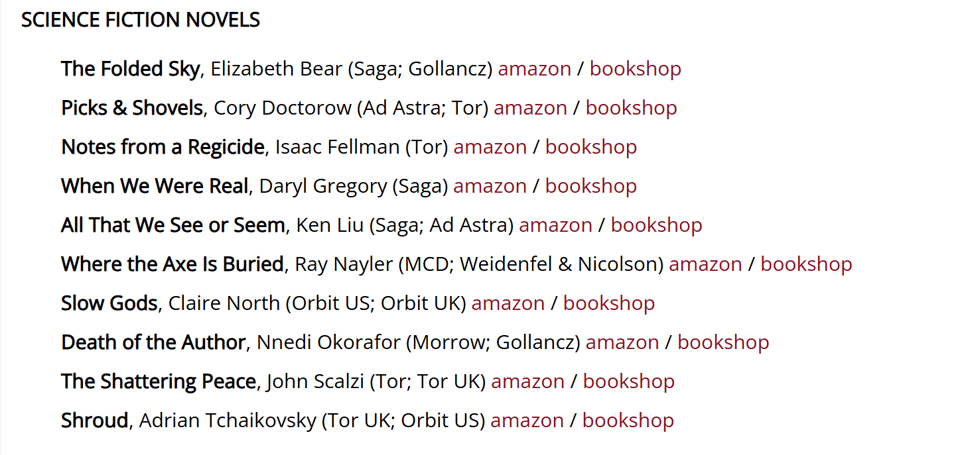
The big news first: The Folded Sky and “The Witch and the Wyrm” are both nominated for the Locus awards, and White Space is nominated for the Best Series Hugo Award!
The company I find myself in for all three of these honors is incredible, and I am especially thrilled to be listed alongside some of the best writers in the business, and some of my dearest friends.
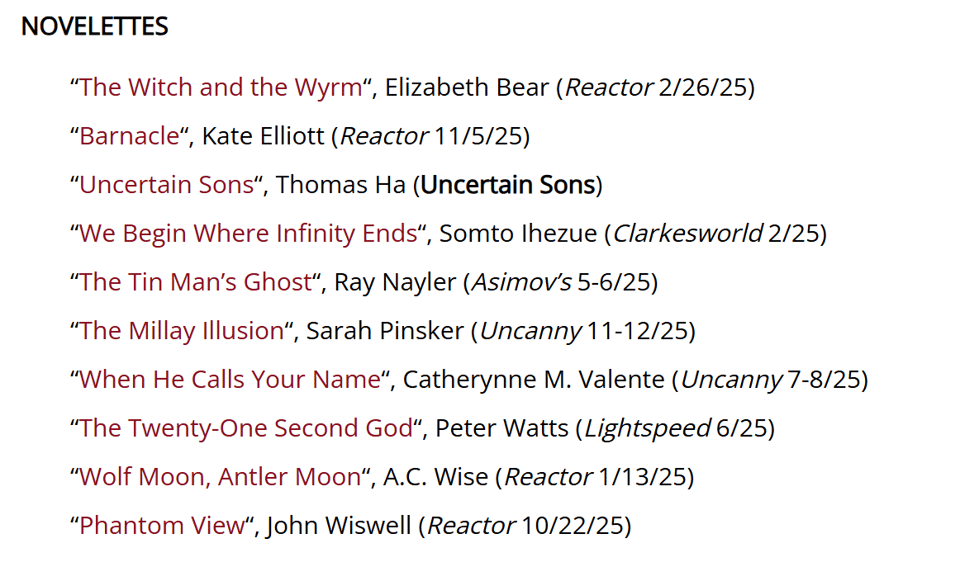
I’m also delighted to note that my dear spouse Scott Lynch is nominated for his very first Hugo Award, for Best Novelette, for the brilliantly satirical and increasingly way-to-soon political satire of “Kaiju, Agonistes.”
Thank you so much to everybody who nominated something they loved, and everybody who loved what I wrote enough to nominate.
If you are so moved, even if you are not attending Worldcon, you can vote for the 2026 Hugo Awards by purchasing a WSFS “Supporting” Membership ($50) that will also allow you to participate in site selection for 2028 and nominate for the 2027 Hugo Awards. (It also comes with access to the Hugo Awards Voter’s Packet, which is a massive bolus of ebooks, audiobooks, computer games, graphic novels, podcasts, zines, and I don’t even know what that is definitely worth more than $50 and is likely to eat all your free time for quite a while.)
This is my fourth Hugo nomination, which humbles and flatters me in ways I cannot even begin to describe. I have seen people offering advice to first-time nominees. Here is mine: Enjoy it. Rollll in it. And pick somebody else in your category to also root for, because nothing beats winning yourself but also, watching something you love win is pretty great also and I am still proud of losing a BSFA to Kelly Link in 2006, quite frankly.
Dude, I was on a ballot with KELLY LINK.
This morning on my run I was listening to a Planet Money Podcast supporter exclusive which I sadly cannot link because it is behind a paywall, as you probably already deduced from the phrase “supporter exclusive.” Anyway, it’s an interview with C. Thi Nguyen on his new book The Score, and I loved it. It’s an in-depth discussion of a lot of things I was saying (some of them here) last year and the year before about the problem of metric toxicity, and how if you play a game the structure of the game teaches you behaviors, because that’s how you score points and are rewarded. (Goodhart’s Law, more or less, but elaborated.)
And I thought, as I was jogging up a rather large hill enjoying the overcast and the cherry blossoms, listening to this podcast, “Of course, because play is learning.” And shortly after that, Nguyen quoted Aristotle on the meaning of life being what we spend it on, and reader, I had an epiphany.
And the epiphany was this, more or less: that people who stop playing for the sake of play, who are worried that playfulness makes them look silly, who focus entirely on winning by whatever metrics they have chosen (more money, more power, more PRs, more lovers on a string, more Hugo nominations, more yachts) are unintentionally robbing themselves of the opportunity for growth because they are not allowing for discovery, for exploration, for experience outside the bounds of what serves the metrics.
Toxic metrics lead to toxic people, is what I’m saying. Childish, self-involved, narcissistic people who can’t imagine anyone else with personal agency, or any value in helping someone else, or—just to pick something at random—the ability to close an important route of international trade.
It’s the catastrophe of taking yourself too seriously and not having time to mess around in boats, or whatever.
But it does give us a place to look for ways to start to fix that.
Stay brave,
Bear
