The Whiplash of Modern Work
It seems like every week, we feel a type of whiplash at work. I hear the following from my clients and colleagues:
One client mentioned they were told to be innovative and take risks, but later, a surprise performance improvement plan (PIP) focused on keeping to goals and not making mistakes
Their company announces AI will streamline everything, then mandates a full return-to-office for “collaboration”
And some companies, like Salesforce, may be regretting “redeploying roles” of thousands of staff with AI less than 6 months later (see this article and this YouTube)
As a former manager, I can speculate that this may not be just bad management, but it’s everyone (including management) experiencing the pull of different forces. It’s not just different kinds of changes we are all struggling with; we’re caught between multiple swings in our systems.
The Pendulum Pattern
Think of changes in the workplace like the pendulums in the picture below. Something pushes one pendulum which causes it to move to an extreme. For example, in the last few years, we saw:
2019: "Must be in office to be productive"
2020-2022: "Work from anywhere, results matter"
2024-2025: "Everyone back in office or you're not committed”
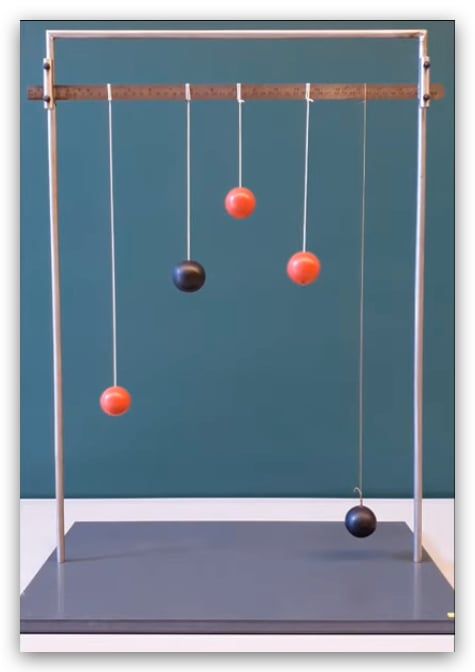
But there are multiple forces (or pendulums) in motion here, as shown in the video of this classic science experiment. Just like in that science experiment, I feel we have multiple cultural pendulums influencing what happens to us. And the pendulums also influence each other.
In other words, while the “control over your work” pendulum swings fully back to in the office from “fully remote,” we can all feel other pendulums swinging:
Generative AI challenges what it means to “work” (technology pendulum)
Economic uncertainty makes everyone risk-averse (stability pendulum)
Trust in leadership has collapsed in multiple ways (authority pendulum)
The whiplash comes from multiple pendulums swinging at different speeds and directions, and the energy of one can be transferred to another. Unlike the science experiment, these cultural pendulums are driven by human decisions. A few decisions build momentum for other decisions. But the pressure from these decision swings can feel just as chaotic.
You are constantly experiencing multiple swings in different directions, and it can take a tremendous amount of energy for any organization (or even an individual) to try to hold onto them all. Different regions and industries may experience different pendulum combinations: countries with strong labor protections see narrower authority swings, while rapidly-growing economies might prioritize different pendulums entirely. But the multi-system stresses are felt by all. This is why successful adaptation feels draining right now.
So what can you do?
Surviving the Swings
To save your energy and your sanity, pick the pendulum affecting your daily work most directly. Let the others swing. Let’s call this The One Pendulum Rule, and you can apply it in three steps:
Name Your Primary Pendulum: What’s the biggest source of whiplash in your workday?
Authority: Changing rules about autonomy/control
Technology: AI/automation reshaping your role
Stability: Economic uncertainty affecting job security
Find Your Range: Where can you operate safely, regardless of the swings of this cultural pendulum? For instance, if it’s the Technology pendulum, develop skills that work with the technology, not against it. For today, that doesn’t mean being an AI expert. You just have to learn to apply the new technology so you can understand how it might impact other parts of your work, and you can converse with others objectively about those impacts (instead of speaking out of fear). It also means understanding how the technology works at even a high level and understand it’s limitations. In generative AI, hallucinations and unexpected behavior still show up.
If you focus on the swing of Authority, build relationships with both your direct supervisor AND skip-level managers. Document your wins for micromanagers, but also develop independent judgment that shows well under autonomy and working out loud. The goal isn't to pick a side, but to demonstrate value under both management styles.
If your focus is on Stability, focus not just on today’s stable spot, but on where stability may be swinging in the future.
Build Your Next Lever: As I mentioned, these cultural pendulums affect each other, and yet, you can focus on one pendulum. But you also want to be prepared for the next shift across all the pendulums, which could be: building a new skill that transfers across industries, nurturing a relationship outside your current company, or shoring up a financial foundation (even a small one) to get you through the next transition.
So you don't need to track every pendulum. Some are weather you endure, not systems you navigate.
Swinging Forward
The exhaustion you're feeling isn't from working harder. It's from constantly recalibrating across multiple moving systems. By focusing on your primary pendulum, you stop trying to be everything to everyone and start building a better position for the long game.
Over the coming months, we'll explore the pendulum further. The goal is not to add complexity, but to help you recognize when you're caught in collision forces and when you can simply let some pendulums swing without you.
If you need help figuring out your primary pendulum or whether it’s time to nudge it or get out of the way, feel free to reach out.
Footnotes
In an interesting January 4th article called “The year we start building back”, Brian Elliott talks about the shifts at the executive level: CEOs in 2025 abandoning employee-centric approaches (remote work, DEI) and returned to "tough-talking CEO swagger" with rigid RTO mandates, rank-and-yank reviews, and AI-as-headcount-reduction strategies. Then in 2026, 66% of these same CEOs plan hiring freezes and "investing in capital over people.” In the same article, Brian Elliot points to evidence showing these tough-talk CEO strategies often backfire. The pendulums swing for everyone.
Note that I didn’t call one pendulum the AI pendulum. Technology tends to swing into new innovations, and another one is coming behind generative AI that could be just as disruptive: quantum computing.


Add a comment: