The Compass and the Map: Navigating Your Career Evolution
We navigate our careers with two essential tools: a compass and a map. The compass, calibrated by early mentors and industry norms, points us toward what we've been taught defines success. The map, constantly evolving throughout our professional journey, shows us the terrain we've explored and the opportunities ahead. Together, they guide us through the complex journey of building a meaningful career.
When we first enter the workforce, our maps are simple. Success means landing the job, impressing the boss, and getting the promotion. The boundaries are clear: work hard, deliver results, climb the ladder. Our compass points unwaveringly toward conventional markers of achievement—the prestigious title, the salary milestone, the corner office. We don't question whether these destinations are truly ours; we simply follow where everyone else seems to be heading.
But as we progress, something remarkable happens. Our professional maps expand beyond the traditional routes. We discover that the linear career path we once imagined—analyst to manager to director to VP—rarely unfolds as planned. Each reorganization teaches resilience, each failed project builds judgment, and each unexpected opportunity reveals capabilities we didn't know we had. We learn not from the promotions but from the rejections, not from the successes but from the recoveries.
This evolution of our career navigation system finds one possible explanation in developmental psychologist Robert Kegan's work. His adult development theory gives hints that our approach to work transforms as our minds develop, moving through distinct stages that fundamentally change how we make career decisions.
Most adults operate from what Kegan calls the "socialized mind." Here, we look outward for direction. Translating into our careers, we chase roles that impress our peers, pursue paths validated by our industry, and measure success by external scorecards. Our professional compass isn't calibrated to our own values—it's magnetized by company culture, industry standards, and societal expectations of what a "successful career" should look like.
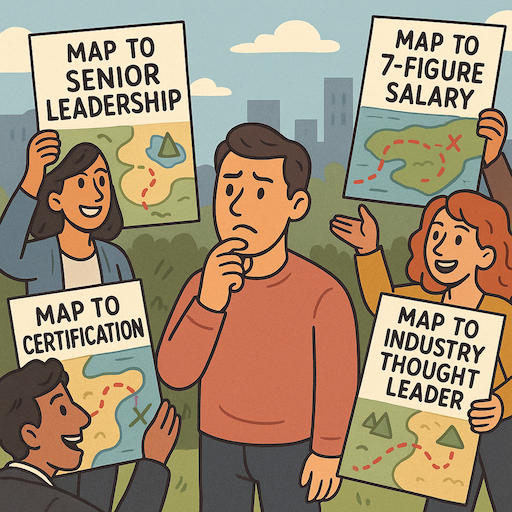
This external orientation serves a purpose. It helps us learn the rules, build credibility, and establish ourselves professionally. We understand how to play the game because we've internalized its rules. Yet for many, there comes a moment when following this borrowed career map leads us somewhere unexpected: the dream job that feels hollow, the promotion that brings anxiety instead of satisfaction, the industry accolades that feel strangely empty.
The transition to what Kegan calls the "self-authoring mind" in our careers rarely happens smoothly. It's often triggered by professional disruptions: being passed over for a role you thought you deserved, succeeding at something that brings no joy, watching a colleague choose an unconventional path that suddenly makes your traditional route feel constraining. Perhaps it's the moment you realize you're building someone else's vision while your own remains unexplored.
As Glennon Doyle captures perfectly: "This life is mine alone, so I have stopped asking people for directions to places they've never been." In career terms, this means stopping asking others how to succeed in your unique professional journey when they can only share the maps that worked for theirs.
The self-authoring professional doesn't reject mentorship or guidance, but filters advice through personally constructed criteria for meaningful work. The questions shift from "What role should I pursue?" to "What impact do I want to make?" From "What will look good on my resume?" to "What will help me grow into who I'm becoming?" From "What's the next logical step?" to "What's the next right step for me?"
This transition challenges us because it often means departing from well-trodden career paths. While the socialized mind seeks to fit seamlessly into existing organizational structures, the self-authoring mind seeks to build a career that fits its own architecture. The former provides ready-made career ladders and clear success metrics. The latter requires us to construct our own scaffolding, sometimes building bridges between fields that rarely connect, or creating roles that didn't previously exist.

Consider the senior manager who realizes that leading larger teams doesn't energize her as much as deep technical work—and chooses to move to an individual contributor role despite the "step backward" it appears to be. Or the successful consultant who leaves to teach, trading prestige for purpose. These professionals aren't lost; they're navigating by their own stars.
The self-authored career map reveals different landmarks: projects that stretched your capabilities rather than just your hours, roles where you could be authentic rather than just successful, organizations whose values aligned with yours rather than just those with the best benefits. These waypoints might not make sense to everyone observing your journey, but they create a coherent path when you understand the internal logic guiding them.
Our professional maps will never be complete. We'll discover that skills we thought were peripheral become central to our value, that industries we never considered offer unexpected alignment with our strengths. The career compass, too, requires recalibration as we refine our understanding of what meaningful work means to us—not to our parents, not to our peers, not to our past selves, but to who we are now and who we're becoming.
The journey from the socialized to the self-authoring professional mind isn't about becoming a rebel or abandoning organizational success. It's about taking ownership of your career narrative, recognizing that while others can share their routes to success, you must ultimately chart your own.
In the end, the most significant careers aren't built by reaching predetermined destinations but by becoming skilled navigators of our own professional development—confident in our ability to find meaningful work even when the path ahead is unconventional and the territory unexplored.
Stay Human My Friends,
Mark
Footnotes:
If you're ready to start drawing your own career map, consider beginning with a Personal Annual Review to clarify where you've been and where you're headed. Sometimes the best career moves come from understanding the patterns in our own professional story.
If you read the last newsletter, I wanted you to know there was a glitch in the “free” coaching session calendar. That’s fixed now and can be found in the Personal Annual Review description.


Add a comment: