Why swimming from Alcatraz is like a job search (it has nothing to do with sharks)
Good Job was on backorder, but we’re back baby!
(a long read, but a short speech adapted from my commencement address to the Mdes Interaction Design at CCA on Saturday, August 16, 2025)
Two weeks ago, I took a big leap. Quite literally. I boarded a ferry to Alcatraz, with about 400 other people and proceeded to jump off the boat in just my bathing suit in an effort to swim back to shore. People who don’t know me might say this sounds like a very bad idea. Out of control. Insane. But people who know me wouldn’t. blink twice. Seems reasonable. Doable for you. Consistent with your character. I’ve been a swimmer all my life, started doing open water swimming last year, and doing 45 min to an hour in the cold water swimming just over a mile didn’t seem unreasonable. I knew it wouldn’t be the physical challenge, but a psychological one. I just needed to get over it and swim.
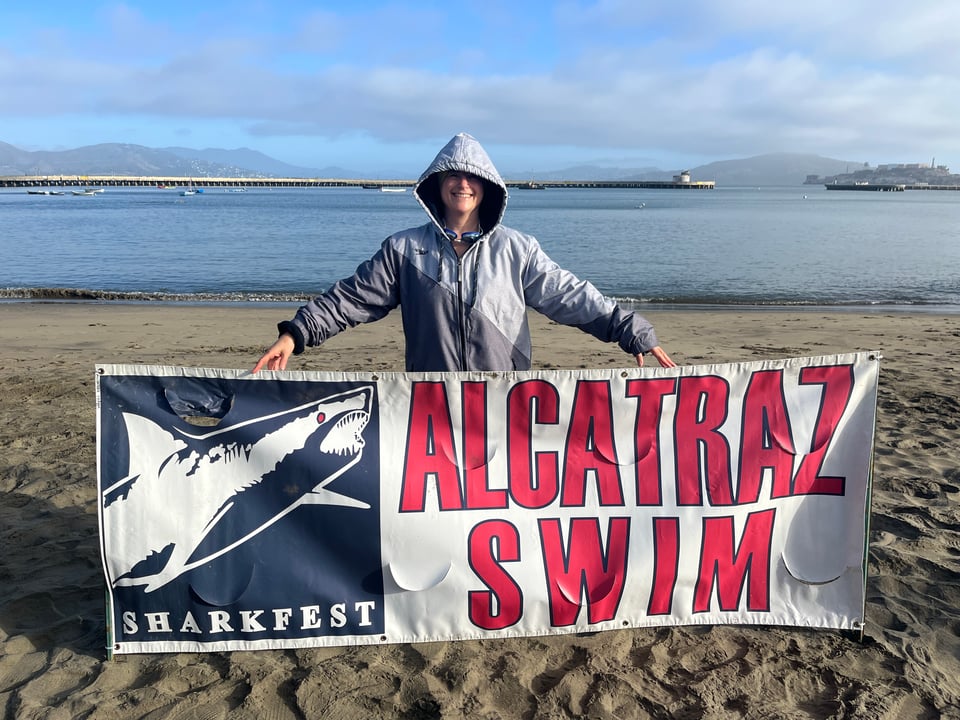
Both sides were right. It’s a crazy, unhinged thing to jump off a ferry into the bay. And it’s something I should have been able to do.
But I didn’t.
I failed. I jumped off the boat and started swimming, just like they told me to, but I wasn’t getting anywhere. I looked and found I was swimming away from the line of yellow swim-capped heads that indicated the starting line. The ferry horn blew indicating the start of the race, and I saw them all pulling away from me. I swam hard towards them and there was no one else around me. I thought they would tell me where to site on shore so I wouldn’t get pulled off. The flat water we’d cruised in on suddenly felt choppy. I swam, I took a breath, I got a mouthful of water. I tried, I kept swimming.
I made it about a third of the way before I started listening to the voice in my head that kept saying “nope,” and “I don’t wanna,” and “I have made a mistake.”
There were rescue kayakers out, and by the time I got to them, I’d made up my mind: this wasn’t my day. I was towed to what I named the SS Failboat, watching the rest of the swimmers make their way to shore in their matching yellow caps. When given the opportunity to jump in again, closer to the entry of Aquatic Park to give it one more shot. I did it. I got back on the proverbial horse. And almost immediately, the “nope,” “I don’t wanna” and “I have made a mistake” came back and I was getting myself towed again to the boat of shame and failing. Despite sharing the deck with about a dozen other swimmers who self-rescued, it was a quiet ride.
I met my friend Lisa for a swim in the bay the very next day. She brought her friend Pauline, a 74-year-old woman who has done the Alcatraz swim 209 times. When I told her about what happened, she looked me dead in the eye and said, “what happened out there wasn’t your fault. It was choppy as all get-out yesterday.That race is known for being disorganized, and they didn’t tell you where to site. Next time, you’ll go out with a small group and you’ll find someone at your pace. You’ll let them take the lead and follow them for a few strokes. Then you’ll be ready to take the lead. You can rest. You can always lie back, catch your breath, and get back to swimming when you’re ready. You’re a strong swimmer. You’ll do this.”
This is the advice I needed, this is the advice I’m giving you.
I’m telling you this because no matter how prepared and how confident and how willing you are to take risks, not everything is going to go your way. Some of this might be your fault, but most of it won’t be.
Design careers are non-linear. It’s unlikely you’re going to go from graduation to Big Impressive Design Job. And that’s fine. That’s great.
That’s probably a more interesting story. What you have to do is relieve yourself of the expectation that things are going to go exactly as you imagine. Some things are going to be in your control, but a whole lot isn’t.
What you can do now is be open, curious, and give yourself some grace. I have another story for you, don’t worry, it’ll all come together.
Very early in my advertising career, I got some very good advice. I’d just landed a big advertising job, my first as a copywriter. I was trying to emulate the other creatives I saw, who had a ton of confidence that borderlined on cockiness. They looked like they had it all figured out, so I acted like them. I was strong in presenting my work, defensive about my choices, arrogant. I was not a great collaborator. My creative director told me this: other people can make your work better. It was subtle, but the message was clear. Don’t be a jerk, be open to other ideas, it doesn’t have to be all you, all the time.
In the spirit of “other people can make your work better,” I turned to my friends, colleagues, and people I trusted to ask them what is the best piece of advice they’d ever received, or what they wish they had heard earlier in their career. Here’s some of what they had to say (which I agree with implicit and explicitly)
Make sure to build a life outside of work. Work can be a community, but it shouldn’t be your only community. Same with school people. Get out there and pursue your hobbies, your sports, your art. Meet the people out there who have nothing to do with tech, with design. That’s the stuff that’s going to sustain you your whole damn life.
Get comfortable talking to people. All kinds of people, and about everything. Hone your public speaking skills, your storytelling skills, your small talk skills. So many people you meet and need to collaborate with won’t understand what you do, or what you’re trying to convince them of. Learning how to engage and connect with people, no matter if it’s 1:1 or you on the main stage of a big conference- connecting with people is a core component of what we do. Talk to strangers. Do cold reach-outs to people you admire. No risk, all reward.
Plan a bit, but not too much, The best job of your life may not exist yet. I’m a planner. Always have been. Makes me anxious not to know what’s next. I graduated with a degree in Russian Literature and no idea where it would lead me. I did not like that feeling. But being open, following my interests and instincts, identifying what my skills are, like writing, brought me down an interesting path. Content Design was not a thing when I graduated. So, get to know what your skills and strengths are. Not everyone has them, and don’t take them for granted. Pursue them.
Do start saving money now. Any amount. Just so you get in the habit. Do it with your first check so you don’t notice it. There, there’s your pragmatic advice.
Ask the dumb questions. This week I was in a meeting, and it was a big one with a lot of people with big titles. I raised my hand to ask a question, but then lowered it because I didn’t want to seem like I didn’t know what I was talking about. Later, a colleague said to me that he was going to ask a question, but had second thoughts. Turned out, we had the exact same question. I bet there were other people in the room who did too. There really are no dumb questions.
Find your voice. Find your strength. Fine, yes. I will now talk about AI. Ugh. Here we go.
In soliciting all these pieces of advice from my community, I thought I would do an experiment and put the advice into the AI machine and ask it to summarize the points, but do it in the voice of Margo Stern, author of Good Job: Designing Interviews and Interviewing in Design. I was annoyed at how good the result was. It was efficient, it was quick, and except for a few telling word choices, it sounded like me.
But then I realized, the REASON why the AI machine could spit out some fake Margo content was because of the work I’ve done. The essays I’ve written, the talks I’ve designed, the entire book I published. All those things were borne out of my experience, my insight, my ideas. My voice is informed by where I come from, people I’ve met, struggles I’ve had. It’s because I’ve sat with a blinking cursor, had a million conversations, and did the work. I’ve spent the time, pain, and energy. If you jump right to AI to do your work, you never get to find what your own voice is, which is extra shitty. Deprives humanity of your own voice and perspective, and drives us more towards homogeneity.
AI rant over.
So what’s next?
What you can do is begin to draw on your resources now to support you moving forward. Find your Pauline. Get back in the water the next day. Sign up to jump off the boat again. You have done the hard thing. You have honed your design and presentation and interview skills. You are strong swimmers. The next thing you can do, the thing you can do that’s entirely in your control, is find how you’re going to be resilient in the face of setbacks. How you can find inspiration in the every day. How you can turn your hobbies into sources of strength. How your friends and family, the people who are here to support you today, when everything is going great to also be there for you when it’s a less sunny day. I promise you. You’ve got this.
Also, taking a big leap off a boat, feeling like you’re behind the starting line already, watching everyone pull away from you, doing the thing that they told you to do and still not getting it right might feel relatable, right? But I did the thing. You are doing the thing. I survived. I learned a lot. And I’m giving it a shot again.
My Alcatraz swim attempt #2 was just scheduled this week for October 13th. Wish me luck, and I’ll return the favor.