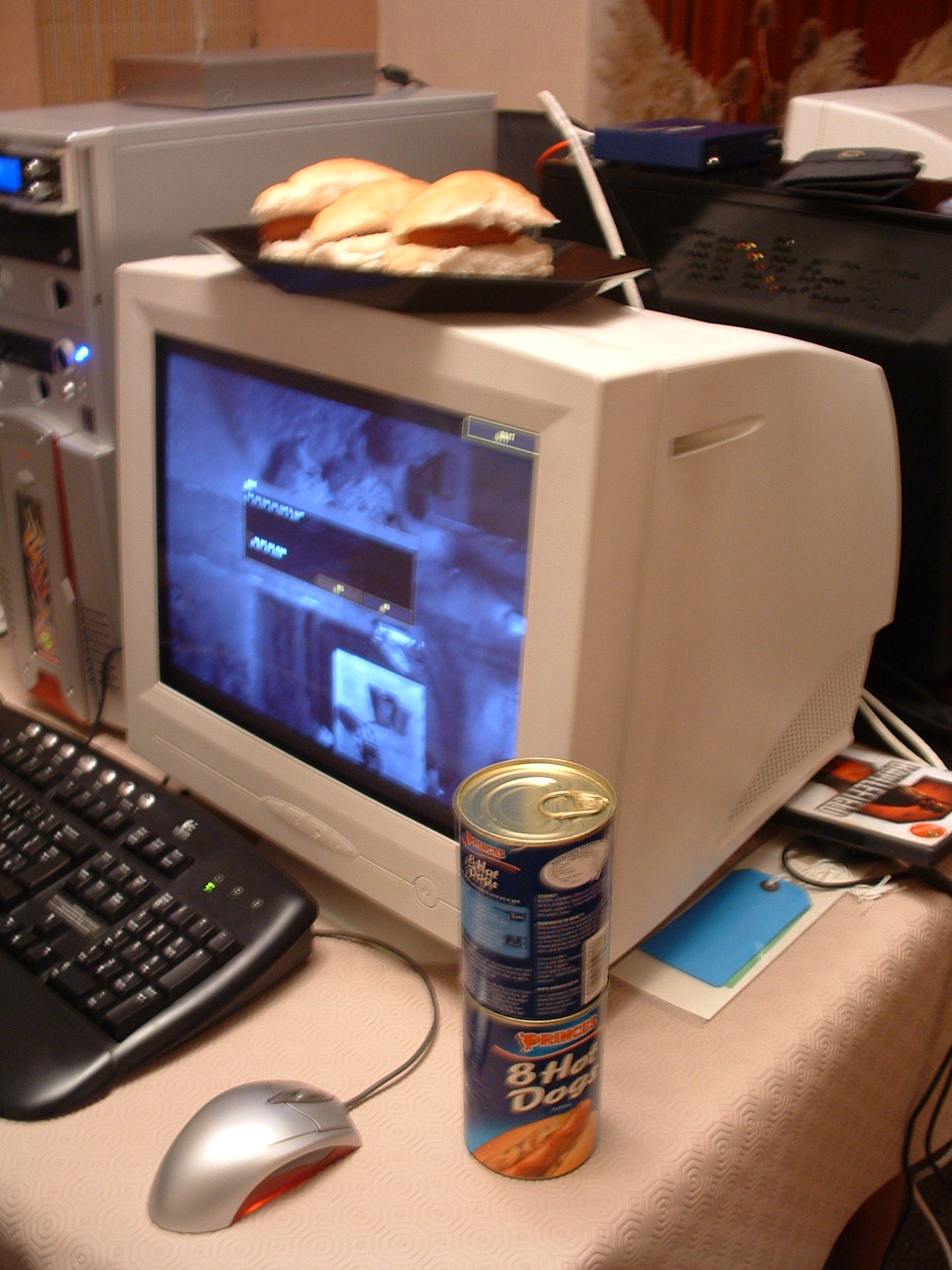
The room smells like microwaved hotdogs and sweat. Six computer tower units wobble precariously on someone’s mum’s dinner table, fans blasting hot air into the already-thick atmosphere. Cans of knockoff Red Bull litter the table and someone is crouched on their knees trying to find the other end of a patch cable. Welcome to a computer game meetup in the early 2000s.
Kids of today missed out on so many formative experiences from that era. Some they were lucky to dodge: dial-up internet, memes about President Bush, MiniDisc players and the music of Limp Bizkit. But in other areas, I pity the children of Gen Z, because they never got to experience things like CDRW mixtapes, the early internet before its enshittification, attending school before everyone had phones and cameras, and, of course, LAN parties.
POV: It’s 2005 and you’re about to eat like a king.
For the uninitiated (or youthful): a LAN party was one of the only feasible ways to play PC games with friends before online multiplayer for games consoles was as ubiquitous as it is today. You’d bring your computer (and enormous CRT monitor, and keyboard, and mouse) to someone’s house—probably a friends’s parents’, given this was a mostly-adolescent pursuit—and play games together.
I’ve spent a lot of time in limbo these past few weeks.
I remember learning at university about the concept of “liminality”, which (Wikipedia helpfully tells us) is about:
the quality of ambiguity or disorientation that occurs in the middle stage of a rite of passage, when participants no longer hold their pre-ritual status but have not yet begun the transition to the status they will hold when the rite is complete.
In other words: I’m interviewing for a new job while currently unemployed.
There was a period a decade or so ago where I’d listen to Ryan Adams’ Gold double album on a weekly basis. It’s the perfect blend of Americana, singer-songwriter and rock’n’roll and when I discovered his music I greedily digested it all, constantly returning to this album.
Then, in 2019, the New York Times broke a story about a repeated pattern of (alleged) sexual abuse by Adams against a number of women, often following a pattern of him promising them various music/industry-related support in exchange for their favours (and silence). I had to stop listening to Gold.
I loved the Ender’s Game series of sci-fi books, before later discovering that author Orson Scott Card was a card-carrying (sorry) homophobe and apparently missed all the messages of acceptance, tolerance and peace that his own books contained. I won’t even bother listing J.K. Rowling here.
It’s June 2017 and I’m on a work trip to Belfast – it’s my first time in Northern Ireland and I’m feeling a little lost.
The city was beautiful but bruised, and the impromptu history tour we got from a sharp-eyed colleague gave me an insight into the fractured politics and complex divisions that years of news stories about the Good Friday Agreement, or childhood questions to my dad about his Red Hand of Ulster tattoo never quite expressed.
I felt ignorant, implicated, and overwhelmed. Away from the peace walls, the murals and the taxi-cab tours, I needed a drink. I wandered from the hotel and found a likely-looking pub.
Belfast, where Catholic and Protestant areas are divided by “peace walls”, and streets are gated with curfews
The Traitors is on TV again. If you’re a fan of the show and/or already understand the premise, then feel free to skip the next paragraph while I sum it up for everyone else:
A few dozen random people go and live in a remote Scottish castle for a few weeks and embark on mildly trivial “challenges” to add money to a prize pot. 3 of the 22 contestants are secretly “Traitors”: eg. they’re evil, and must choose a victim to “murder” each day. They, and the the rest of the players, must face a daily “round table” where they have to accuse one another of being traitors, eventually voting someone out (“banishing” them). The “faithful” players left at the end of the game can split the prize money, but if any traitors are left unbanished, they take the cash instead.
Let’s be honest, I’m watching the show for Claudia Winkleman’s ridiculous outfits as much as anything else
The third season has just started on BBC1 and it’s already receiving rave reviews. If you’ve ever played boardgames like Werewolf, Mafia or Avalon then you’ll already be familiar the basic mechanics of this kind of game… in which case, this TV show may not be for you.