The Journalists Striking Over AI
Newsroom workers at ProPublica walked for 24 hours after management refused to rule out AI-related layoffs
By: Decca Muldowney
Workers at the renowned non-profit investigative newsroom ProPublica became the first journalists to take strike action over AI provisions last Wednesday as they walked off the job for 24 hours. The historic strike marked a new chapter both for newsroom unions and others in the labor movement concerned about the impact of “AI” on their jobs. You can support ProPublica’s strike fund at this GoFundMe.
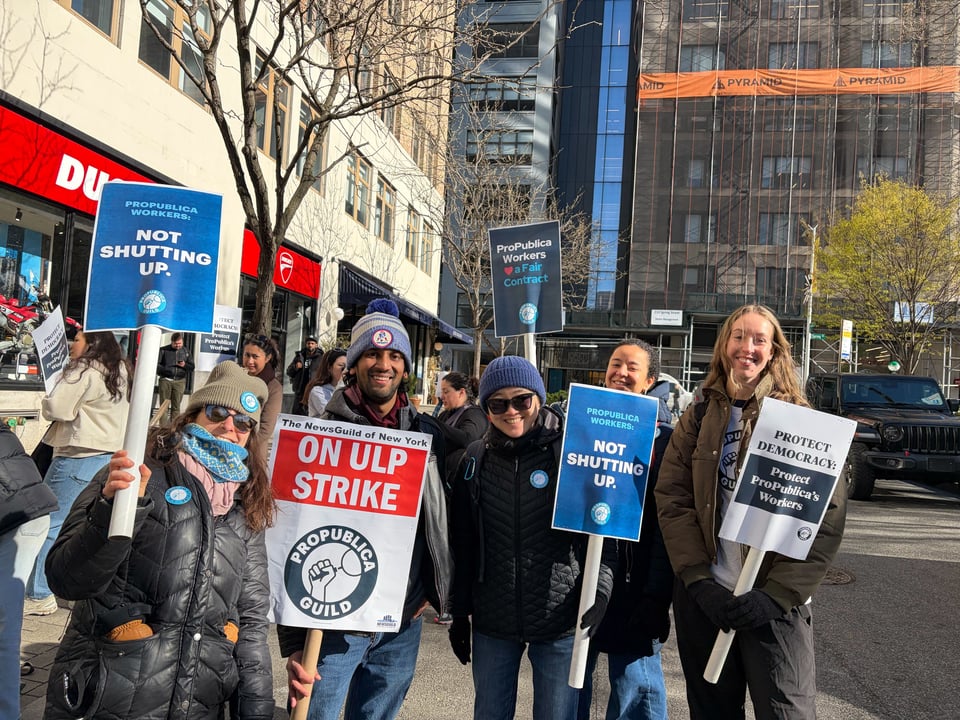
Ninety-two percent of the newsroom’s 150 unionized workers voted to strike, partly over ProPublica management’s refusal to rule out AI-related layoffs, according to the union. The company has also rejected other AI protections, according to Mark Olalde, an environmental reporter and member of the ProPublica Guild’s bargaining committee. Olalde told Nieman Reports that the ProPublica bosses had ruled out language that would protect workers from being disciplined if they don’t want to use AI tools and offers from the union to bargain over any AI-related issues as they arise.
The strike came after 28 months of bargaining, the union said, and other unresolved issues including job security protections and denied wage increases.
“Our members are standing together to demand that management agree to very basic, very standard union protections,” said Jeff Ernsthausen, a senior data reporter and secretary of the ProPublica Guild. “We care deeply about our work, so we call on management to understand the gravity of this walkout and to come to the table ready to take our concerns seriously.”
A day before they walked out, the union said they’d filed an Unfair Labor Practice with the National Labor Relations Board, accusing ProPublica’s management of implementing a unilateral AI policy at the company without negotiating.
“This fight over the use of AI in the ProPublica newsroom demonstrates that it’s the workers who are the heart of this journalistic enterprise, and who will fight to preserve it,” Susan DeCarava, the president of the NewsGuild of New York, told Nieman Reports.
ProPublica’s management responded by doubling-down on “AI”.
“It’s too soon to know exactly how AI will affect our work. Rather than make promises we can’t responsibly keep, we are exploring how these technologies can create more space for investigative reporting and thinking deeply and creatively, not less,” Alexis Stephens, ProPublica’s director of communications told the Verge.
This kind of garbled thinking is what we’re seeing from bosses across countless industries right now. How can text extruding machines create “more space” for the extremely human endeavour of investigative journalism?
We’ve discussed all this and other journalism-related “AI” hype on several episodes of Mystery AI Hype Theater 3000, including:
Episode 29: How LLMs Are Breaking the News. In which award-winning AI journalist Karen Hao joins us to talk about why LLMs can't possibly replace the work of reporters -- and why the hype is damaging to already-struggling and necessary publications. [Podcast, Transcript, Livestream]
Episode 39: Newsrooms Pivot to Bullshit. 404 Media journalist Samantha Cole joins us to talk journalism, LLMs, and why synthetic text is the antithesis of good reporting. [Podcast, Transcript, Livestream]
Episode 65: Crunching the Numbers. So-called AI tools are increasingly infiltrating newsrooms, particularly when it comes to data analysis. I chatted with Alex and Emiy about the need for journalists to distinguish between "AI" and reliable, verifiable research methods. [Podcast, Transcript, Livestream]
Save the Date!
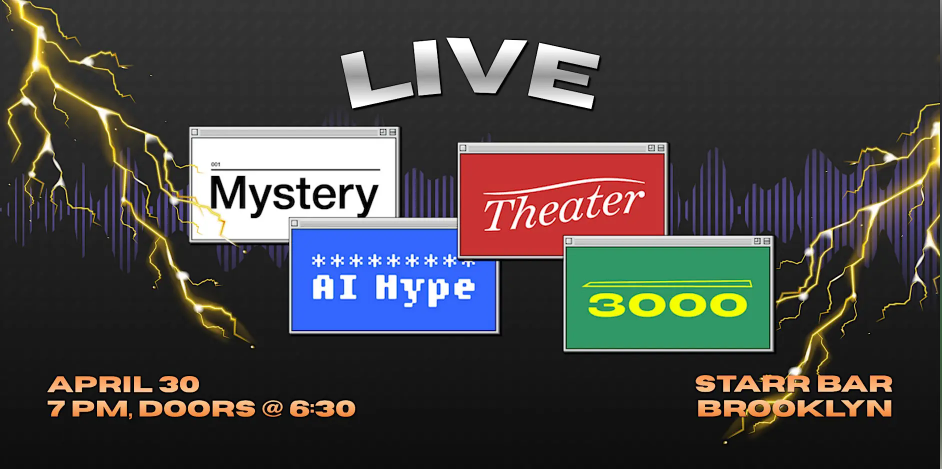
In exciting news, Mystery AI Hype Theater 3000 is holding its very first live taping! Join us on April 30 at Starr Bar in Brooklyn, New York. Get your tickets at Eventbrite.