A tale of two "AI" documentaries
By: Decca Muldowney and Emily M. Bender
Emily was interviewed for two documentaries which premiered at Sundance this year: The AI Doc: How I Became an Apocaloptimist (dir. Daniel Roher and Charlie Tyrell) and Ghost in the Machine (dir. Valerie Veatch). The films couldn’t be more different.
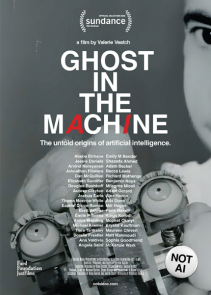
Ghost in the Machine is a rich, historically grounded and well-researched exploration of what is going on in the name of "AI". It presents a lot of information, but also gives you time to sit with it, and ultimately leaves viewers better informed. By contrast, The AI Doc is a vehicle for hype of the doomer-booster variety, presented through a very naïve lens disguised by high production values.
Let’s start with what’s wrong with The AI Doc. It was introduced at the screening Emily attended by the Sundance programming representative as having "a strong sense of informational integrity," but it's hard to imagine a characterization more off the mark. Emily agreed to be interviewed for this documentary because she thought the director was working on making sense of the discourse around "AI" in order to better inform his audience. This is not what happened.
The frame of the film is that the director, Daniel Roher, is expecting his first child and is feeling very anxious because he has picked up the idea that "AI" might lead to terrible things. He attempts to address this anxiety by interviewing "experts", most of whom seem to have been culled from the 2023 TIME 100AI list.
The interviews are arranged into roughly four groups: First, Roher talks to the doomers and gets convinced that we're headed for misery if not extinction. Then, after prompting from his wife, who says she needs him to find hope, he talks to the boosters. Roher then presents himself as talking to a new group of people to try to understand how to navigate those two extremes. Confusingly, many of the interview clips in this part are from interviews already seen earlier, so the narrative arc of the film is belied by the actual footage. His apparent take away from the third batch of interviews is that all of the power sits with the AI company CEOs, so he talks to them. Variety notes that the PR teams at OpenAI, Anthropic and DeepMind were impressed, which in turn speaks volumes about the lack of credibility of this film.
In setting things up this way, he does his audience a big disservice. Instead of engaging in journalism (fact checking, what?) he just lets himself get buffeted by the imaginations of some of the most unhinged people in this space, and platforms their nonsense. One person claims, unchallenged, that "AI" (ahem, we think you mean image and video synthesis systems) can generate images and video "from scratch". That's bullshit: these systems can only generate images and video because they were built out of tremendous collections of (largely stolen) images and video. Another speaker claims that just like language models capture patterns in language (providing the example of "periods go at the end of the sentence"), "AI" can "uncover the patterns of the entire universe and everything in it". Throughout there is conflation of all of the tech sold as “AI”, but even beyond that, with the imaginary tech the doomers and boosters believe will come about if we can just scrape together enough compute and training data.
The contrast with Ghost in the Machine is stark. Interestingly there are some parallels in the genesis of the two films. Veatch, the director of Ghost, describes being invited to test out Sora (which we wrote about here) with a group of other artists, being horrified by the racist and sexist output, and then horrified again at the lack of interest on the part of OpenAI. Meanwhile, Roher (in his film) tells Altman that his project started when he was playing with an image generator ("probably yours") and was both terrified and impressed. Altman sagely deems that the usual reaction.
From these parallel starting points, the projects went off in very different directions. Where Roher’s film is very self-referential (worries about his own kid), Veatch started reading and researching about these systems and their impacts in the world, following footnotes and citations, and ended up interviewing three dozen experts across a wide variety of fields. Her research also led her into archival material, reaching into the history not only of the machine learning systems sold as "AI" today, but also statistics (ML is applied statistics) and its roots in 19th and 20th century eugenics.
At the panel after the premiere of Ghost the moderator pointed out that "no one" is talking about the side of things Veatch pulls together in her film. But part of the genius of her film is that she in fact connected with a group of people from diverse fields who are and have been talking about it, and wove together an informed and engrossing essay.
Predictably, Ghost is drawing not just positive reviews but also some from people who would really prefer not to have the "AI" narrative challenged. It's informative (and entertaining) to see their criticisms. One review is headlined "‘Ghost in the Machine’ is Already Behind the Times", which is particularly hilarious because the documentary does an amazing job of tracing the historical roots of today's "AI" ideology. Not just back to the 1956 Dartmouth workshop (and excellent historical footage of McCarthy and Shannon) but also to the connections between the founding of statistics and eugenics. Historical contextualization does not expire just because tech has moved on to their next marketing strategy.
Veatch’s film is of this moment because it situates the narrative being pushed by the AI bros in both its historical and present context—the latter being coverage of environmental damage and the exploitative labor practices behind "AI". The people who complain that it is "out of date" because it doesn't speak to this week's buzzwords or this week's specific hype are frantically trying to stay within the narrative that the tech companies want to restrict us to.
The AI Doc takes no critical distance, serving only to platform the nonsense inside a narrative arc meant to tug at heartstrings and fan a sense of urgency. Ghost in the Machine on the other hand, is the film that meets this moment.
Here are some podcast episodes that we think are relevant to the wider discussion raised by these two films:
- Episode 4: Is AI Art Actually 'Art'? We talk with philosophy professor Johnathan Flowers, art administration professor Jennifer Lena and research scientist Negar Rostamzedeh about algorithmically-generated image art. We discuss the hype, the ethics, and even the definitions of art when a computer is involved. [Livestream, Podcast, Transcript]
- Episode 19: The Murky Climate and Environmental Impact of Large Language Models. Emma Strubell and Sasha Luccioni join us to discuss the carbon, water and energy consumption of “AI”, and why even the direst estimates don’t tell the whole story.[Livestream, Podcast, Transcript]
- Episode 20: Let's Do the Time Warp! (to the "Founding" of "Artificial Intelligence"). In which we time travel back to a conference of men who gathered at Dartmouth College in the summer of 1956 to examine problems relating to computation and "thinking machines," an event commonly mythologized as the founding of the field of artificial intelligence. [Livestream, Podcast, Transcript]
- Episode 46: AGI Funny Business (Model). We’re joined by author Brian Merchant who offers a history of the current AI hype wave and how it sure looks like Sam Altman, Elon Musk et al don’t have much of a coherent business plan. [Livestream, Podcast, Transcript]