In Media Res
I just turned forty years old. It feels like the set-up for a joke. Let's talk about it.

All these accidents that happen
Follow the dot, coincidence
Makes sense only with you
You don't have to speak, I feel
Emotional landscapes
They puzzle me
The riddle gets solved
And you push me up to
This state of emergency
How beautiful to be
State of emergency
Is where I want to be
— Björk, Jóga
I just turned forty years old.
It feels like the set-up for a joke. Forty years since my uneventful birth in 1986, when God saw fit to put me on this planet. Born in Austin, Texas, I was the first child of Air Force veterans who got pregnant quickly and much to their surprise right after ending their respective four-year tours. I inherited both their bad eyes and teeth, the way other babies inherit freckles or smiles. The story goes I came out screaming, kept screaming when the nurses took me away, and didn't stop until the nurses brought me back because I kept the whole maternity ward up.
I was the only daughter on my father's side that had been born in several generations. This made me something of a novelty to my paternal grandparents. At least, for a few weeks. I had my father's hair, eyes, and complexion in a way that made me thoroughly theirs. It was amusing in that way that small, cute animals are until they have to eat or shit. I didn't really know them after the first few years of my life, but what I remember from those short, sporadic visits didn't make me miss their presence.
1986 was the year David Lynch's Blue Velvet came out. That's What Friends Are For by Dionne and Friends was the top song of 1986, per Billboard's Year-End Hot 100 list. The Chernobyl nuclear disaster happened just a month before I was born. All of this, too, sounds like the set-up for a joke.
But I can't think of anything.
My favorite comic book character for a long time was Doctor Manhattan from Alan Moore and David Gibbons’ Watchmen. I know it's rather gauche in most circles of the internet to talk about Watchmen with any amount of fondness these days. I would never let social graces or popular consensus keep me from running my mouth, and that applies doubly to comics.
When I was twenty-three, I got really into Watchmen. Posters on my wall, t-shirts in my closet, seeing the 2009 Zack Snyder movie three times in the theaters kind of into it. Writing fanfiction on LiveJournal kind of into it. I adored Nite Owl. I was at once repulsed and captivated by Rorschach. I thought Silk Spectre was fascinating and sad. I thought the Comedian was an absolutely wretched character study. Ozymandias both annoyed and scared the shit out of me in equal measure.
But Doctor Manhattan -- the watchmaker's son Jon Osterman, given life by Billy Cruddup's warm monotone -- hit me in a way that I couldn't articulate.
The avatar of a deterministic world view so detached from humanity that he is actively antagonistic to everything I believe, I remain profoundly moved by Doctor Manhattan. His is the story of a man who sees the full scope of reality so clearly that everyone within it becomes a smear on the lens of his instrument. Manhattan retreats into the nihilistic certainty of a clockwork universe, with all its events perfectly mapped out through the laws of cause and effect. It's a cold and bitter certainty, experiencing the future and past and present all together, seeing the chains that bind them, pulling everyone toward the same terminal place.
Why care about anyone? Why care about anything? Why worry about the consequences of your words and actions when you already know how these little people with their little lives will respond to you? After all, what would you do if you died a fragile man and were reborn as a god?
Just date teenagers and run around buck naked, I guess.
The story of Doctor Manhattan is also one of a man being shaken from this comforting static by the stupid things people do. Imperialism and Thatcherism and nuclear geopolitics, yes, but also a decidedly human element. Soft feelings. Jagged truths. The wet black horrors and the bright warm spots. By getting entangled in the lives of the people he's detached himself from -- a lover, old comrades, New York City itself -- he allows himself to be surprised again. To see where the chains of cause and effect can give. Where that breakage leads to new possibilities.
And I get that. It just isn't quite what I respond to about Doctor Manhattan.
Ten years ago, I turned thirty. Twenty years ago, I turned twenty. Thirty years ago, I turned ten. That's such a strange thought. By the age of ten, I couldn't foresee a future where I would still be alive. At fifteen, I resigned myself to never leaving home.
I was homeschooled. An enduring depression followed me since I was old enough to make memories of my own. I had no social skills, no coping skills. I was also an undiagnosed autistic child with emotionally stunted narcissists for parents, left to my own devices because I was just “too difficult” to parent. All I ever did was read, write, mind my studies, and take care of the dogs. Needing anything more than food and shelter was too much for them, I guess.
The way I saw things going, my twenties and thirties would be spent keeping the house for my family. Cooking, cleaning, tending to the animals. My forties and fifties would be spent taking care of my now sixty- and seventy-year-old parents. Eventually they would die, and then I would have to find something else to live for. I didn't have dreams. Those were for other people.
When I turned thirty, I found myself sitting on a bench at my college campus, enjoying the May sun on my face after a final exam. I finished up my bachelor's degree later than some. My twenties were dotted by sporadic enrollment at my local community college. I pursued an associate's degree whenever I had money to spare from waiting tables but it didn't amount to much. At twenty-six, I had a major depressive spell, ended up on the kitchen floor, then got up and applied to my state college. I got in immediately. Four years later, I was the only college graduate in my family.
I remember sitting on that bench, the warmth of the sun dripping between the trees above me, feeling quite melancholy. I was thirty and had a degree. Pretty soon, I'd have an office job with insurance and everything. At that moment, it all felt so impossible. Being there. Being alive. I wasn't proud, per se, because I wasn't able to feel those kinds of feelings. It was more like a strange new appendage, this thing I had done for which I would now have to be responsible, a limb that needed someplace to rest.
The degree didn't do much for my untreated panic disorder, or the long dark night of my teens and twenties. That night stretched on for another seven years before I got into a PTSD treatment program. I could imagine a sunrise then, but not until I allowed the night to pass over me.
I'm not the ambitious type, really. I never set my sights on a career or some industry position. If I could pay my way in the world just sweeping floors or cleaning tables, I would do it in a heartbeat. The marketing agency job I have now happened by pure luck and a series of weird events. Before that, I worked at a dysfunctional law office for about five minutes. Before that, I spent a year at a conservative Christian home goods and decor company, sharing an office with a terminally online furry. (That last part isn't relevant, but it is true and it's funny to say.)
In 2018, I moved cross-country to live with my long-term, long-distance girlfriend, Melissa. Then I wandered into a job interview, cheerfully explained how my traumatic experiences in the dentist's chair as a teenager made me empathetic to the concerns of prospective dental patients, and started working in the dental marketing industry a few days later.
I have the same enthusiasm for writing website copy as I do for waiting tables. The job is just a job. Some days it's great because I like my coworkers and we goof around. Sometimes the customers are very pleasant and we can have some nice conversations. It ultimately means nothing to me. Once I finish up and close the laptop for the day? It's all gone, wiped from my mind as if none of it ever happened.
Obviously, the thing I care about instead of creating shareholder value is art. Making art. Engaging with art. Talking about art. Art just doesn't pay my bills. It pays a few here and there, but not enough to live off of. Maybe it could if I worked harder at it and pushed to monetize it. But I already work eight hours a day for somebody else. Making the art I love a job with all the crap that comes with it doesn't sound very satisfying.
I say all of that because the marketing job I've been at since I was thirty-two just dropped me down to part-time hours at forty. Trimming labor costs, optimizing work flows, positioning themselves as strongly as possible for a sale, blah blah blah. ChatGPT ass corporate talking points. If I hadn't weaseled my way into having considerable phantom stock in the company by being there longer than is medically advisable, I would bail out. As it stands, I'm hoping for the company to sell off quickly so I can cash out my stocks and run far, far away.
That's the rub, you know? I went to college to get out of part-time work and find a path forward that didn't involve living with my family. Now I'm right back here, feeling like a hostess at P.F. Chang's, my last restaurant job before finishing college.
That's not what forty is supposed to be, I hear my American lizard brain hiss as it slithers around at the base of my skull. I'm supposed to be secure. I'm supposed to have a plan. Buying property. Buying a new car. Saving for retirement.
The lizard brain slithers around and tells me I'm little more than a child. I don't feel like a child, because I'm not a child. The child that I was didn't think I was capable of being the adult that I am. I pay my way, I take care of people, and I stand on business. I try to help people in my community -- online and off -- when and where I can.
The world I was “promised,” as a subject of the imperial core enjoying an ill-begotten lifestyle, existed only in advertising campaigns and TV shows. It exists for a select few, of which I was never counted among. The American lizard brain says I'm falling behind? I remind myself the race itself is a lie. I'm not here to create shareholder value, or buy things to make others feel better about the economy.
I'm no longer my father's daughter, that novelty baby born too loud. I'm no longer the ornery daughter to sell off and make more babies for the family to claim as their own then toss aside. Shareholder value be damned.
Having an untreated panic disorder, with a sprinkle of undiagnosed autism for flavor, means you experience time differently. At least, that's the way it worked for me. Time doesn't occur on a linear path. It's omnidirectional, a limitless expanse that blooms like a flower, each petal a new possibility. A new terrible promise.
You're driving your car down the road in Fort Worth, Texas, in 2015. Past the shopping plaza near the mall, the petstore, the grocery shop, the gas station. You think about jerking your steering wheel into the ditch and rolling your car. You think about the reality that will occur if you made that choice. What would happen? Would you get hurt? How badly would your car be damaged?
At the same time you're imagining the new reality you've created, it's 1992. You're six-years-old and you live in a shabby little apartment in Hurst, Texas. Your dad locked you out of his 1968 Volkswagen Beetle while you're out at the store. It's nighttime and the parking lot is dark but for the glow from a lonely light post. He sits in the driver's seat and laughs at you through the window as you uselessly pull the handle to get in. You kick at the little step under the car door with your little tennis shoe, the jutting metal rim, and ask to be let inside.
When your mother, standing behind you, eventually unlocks the car with her key and opens the rear door, your father reaches between the front seats to grab you by the arm. He yanks you inside roughly and you scream. The hand on your arm is like a vice, fingers digging into your skin. Dragged close to his face, he snarls:
“Don't you ever kick my car again.”
You cry all the way home. Whimper, mostly, because your father's already told you to be quiet. Your mother looks annoyed. Your father fumes in the front seat. He'll huff out an apology for losing his temper when you get home, but you should still know better. You should still respect his property. Whenever he screams or throws things at you, he doesn't do it because he's a bad guy. You're just making him upset.
At the same time that you're twenty-nine and six, and you're in the back of your dad's Beetle and rolling your car in a ditch, it's 1986. You're not alive yet, but you remember the story your mother told you. About how she was pregnant with you, about to pop, when she was at an intersection in Austin. The light turned from green to red. Before she was able to push down on the gas pedal, an eighteen-wheeler with blown breaks came screaming through the intersection. The horn blared, the driver panicked. People nosing into the intersection swerved out of the truck's path.
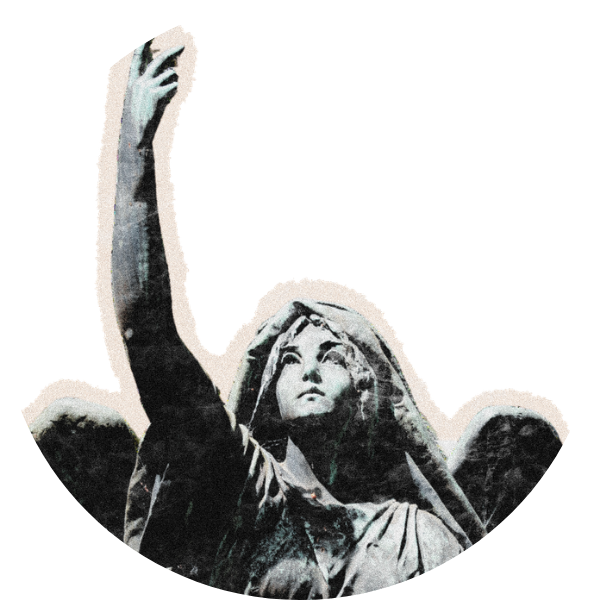
Your mother said an angel was watching over you that day. The angel saved her life and yours. You always wondered how an angel could look over you but let everything else happen. What could the angel be saving you for when your parents barely speak to you?
It's still 2015. You're still on the road, still in one piece, passing the Chinese buffet. Maybe it was the angel who kept you from putting your car in that ditch. Maybe you were too busy thinking about other things to do it.
That's why I always liked Doctor Manhattan so much. I've never seen a character experience time the way I do. For me, it's a kaleidoscope of past and present and possible futures. They happen all at once, fragments of time, reflected and refracted off of one another. I, too, always took comfort in a deterministic world view, knowing that I wouldn't make it to thirty.
Then thirty came and went. Thirty-five next, and now forty. Like Doctor Manhattan, the future could still surprise me.
I just turned forty years old. It still feels like there should be a punchline. There isn't one.
I'm not Doctor Manhattan. I don't see the future so clearly as to retreat into clinical certainty. But I do see a future. Time has more or less settled into its designated labeled boxes, past and present separated as much as they can be. Treatment, medication, and coping strategies have allowed for that.
I don't feel forty. I'm told I don't look forty, either. Thirty? Maybe thirty-one? But not forty. I feel better than I ever have. I feel younger. I feel better prepared. I'm happy. I'm in love. I am loved.
I don't know what forty is supposed to look like, because it didn't seem like a thing that I could have. But I guess it looks like this.
-
I love this. I'm turning 40 in a few months and much of this I feel I could have written about myself. Something about our generation, maybe, that so many of us are stuck in the same kind of time loop. I feel like I lost a decade somehow. But ah well. Happy birthday. I hope we keep finding ways and reasons forward.
-
Thank you so much. I've been trying to get a grip on myself and you spelled it out so clear, the weird, simultaneous, parallel visions. And the weird contradiction of feeling happier and safer even though I feel so much uncertainty.
This will stay with me forever. Thank you. Hope you had a happy birthday.
-
Incredibly grateful for this post. Thank you for being here.
Add a comment: