Frictionless Mobile Media
On Social Media Bans
Banning social media for children under 16 means cutting them off from active political and social justice discourse. Is that what this is all about?
It seems unwise to narrow critical focus onto clowns like Jonathan Haidt when the policy currently being role modelled by Australia is happening in the context of right wing attempts to remove sex-ed from schools (being rammed through legislation in New Zealand, subject of ‘leave our kids alone’ protests in Canada, a constant in America, land of the book banning, and, well, we don’t even need to get started on the UK).
Being cut off from politics and the reality of relationships, gender and sexuality will only ever be partial—there’s no air-tight or water-tight seal on anything—but the assertion of control is the point.
Children and teens deserve better than this.
The Social History of the Cardboard Box
One of the best long form pieces of the year is this essay in Places Journal by Shannon Mattern exploring the ubiquitous cardboard box as an object bridging the geography of networked global trade and modernist communication design.
![Tina Zimmermann, Amazon Tsunami, installation at the European Cultural Center Venice, April-November 2022, Palazzo Mora, Venice, Italy. [Courtesy of the artist]](https://assets.buttondown.email/images/46f59b8d-9de9-48cf-8f98-24370c6d8be5.png?w=960&fit=max)
Cardboard boxes hold a world of meaning — a geography of consumption, disposal, and reuse — that spans from Amazon to the Container Corporation of America.
Ideas of seamless design are frequently associated with digital interfaces connected to the internet, but packaging design is no less implicated in the ebullient culture of maximising flow and frictionless experiences that characterises the way we think about products and services today.
The idea that the internet is incorporeal is surprisingly mainstream. In New Zealand for instance, the phrase “weightless digital exports“ has become a shibboleth within public policy and tech lobbying circles, framed in contrast to agricultural exports. Many of us are simply not accustomed to thinking about the material foundations of digital technology as real, although this is perhaps shifting thanks to recent revelations about electricity and water usage in hyperscale data centers.
It’s fascinating that all of these problems and challenges are encapsulated in the history of the cardboard box, which is now inseparably integrated with internet-enabled commerce.
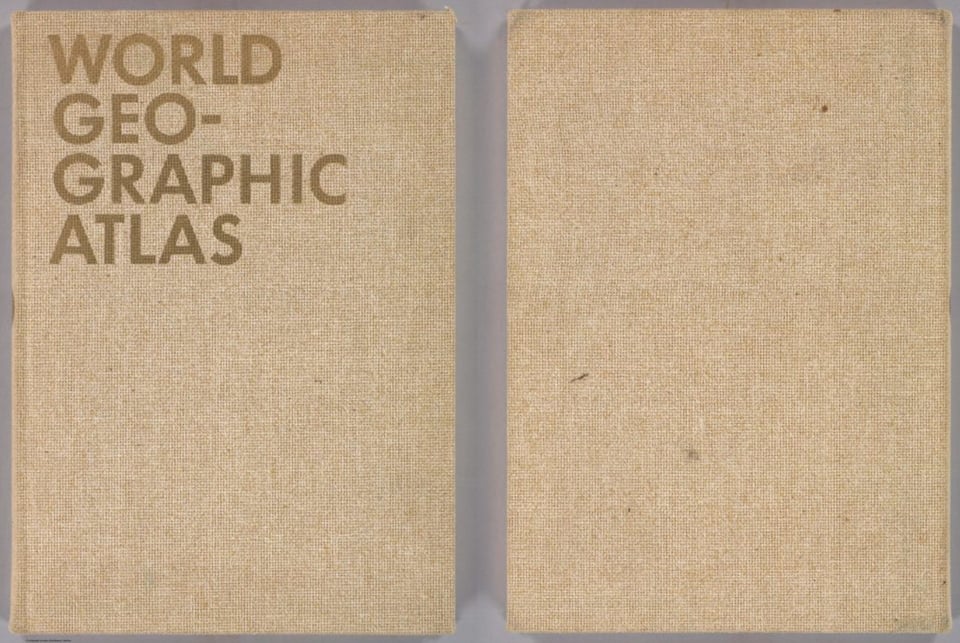
Wrapped up in all this is the story of The Container Corporation of America and Herbert Bayer’s World Geo-Graphic Atlas.
The Backrooms of Design Education
Back in the Y2K era, I was a philosophy undergrad student, immersed in Wellington’s design culture and music scenes. One week, on a graphic design and infoviz history bender, I requested an interloan of the World Geo-Graphic Atlas from archives in Australia (there was not a single copy of it on record in NZ).
It arrived a few weeks later at the VUW library (in a wide flat cardboard box, of course). I was surprised when they let me take the whole thing home rather than insisting it be kept in a reading room there. One of the strangest and most exciting books I have ever had on my desk.
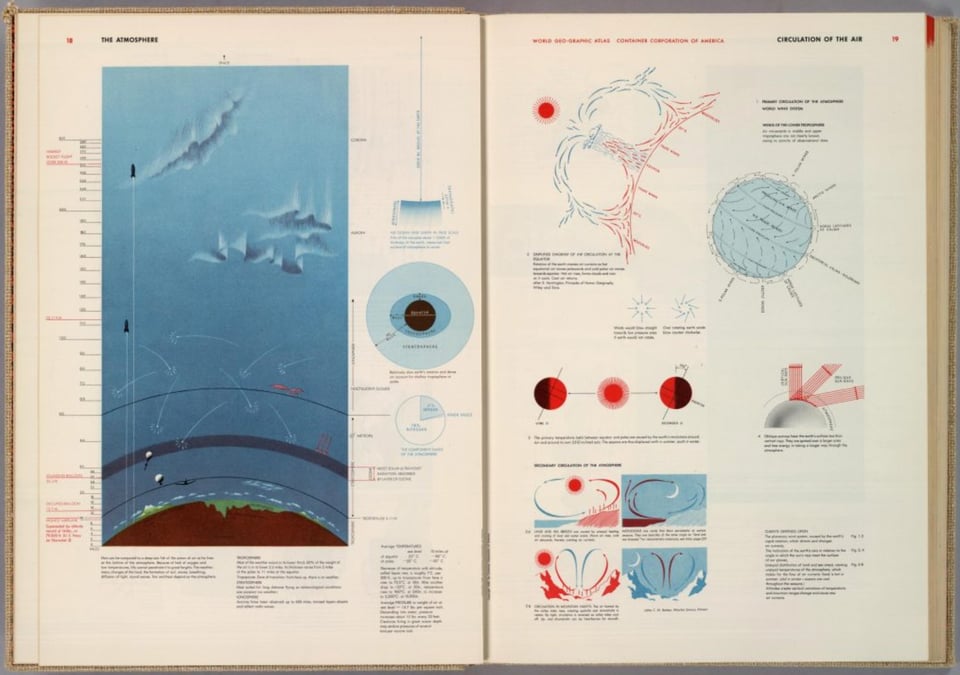
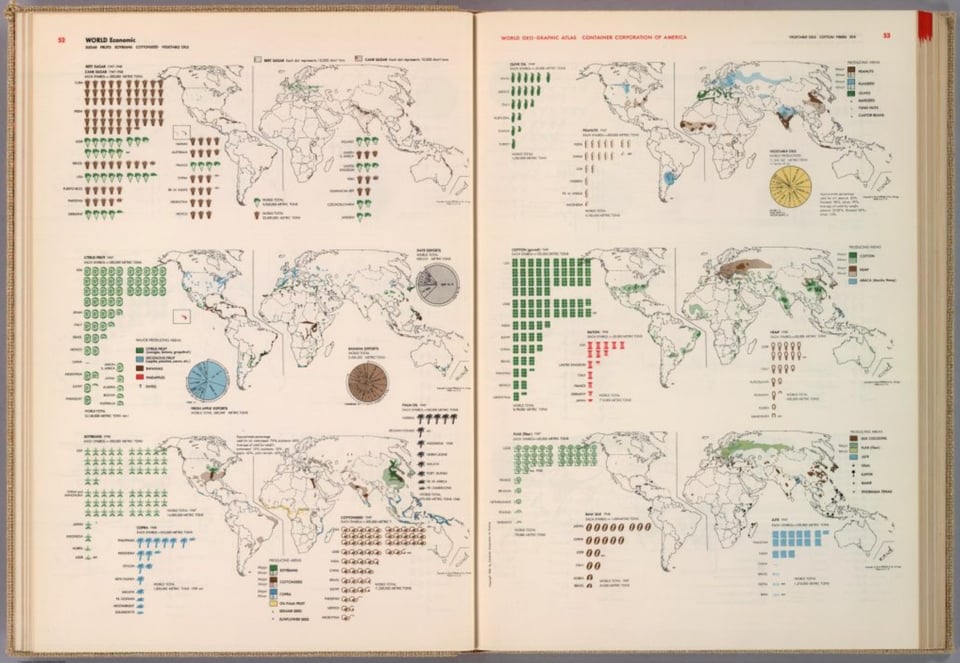
My initial interest was in complex visual, symbolic and typographic structure and the extraordinary synthesis of information. What I did not expect was how underlying all that was the hidden story of 1953: the geographic and economic narrative of industrial expansion and its environmental impacts.
The Atlas reflects an emerging recognition of humans existing at a planetary scale that would later come into prominence with the rise of the environmental movement in the 1970s. It meticulously documents the social and environmental context of a moment in deep geological time where humans were teetering on the brink of war, grappling with massive scale growth/decay cycles, laying bare the enclosure of the global south by the global north. All this in a corporate marketing object.
This turned out to be one of the books that changed my relationship to design in subtle but deep ways. I can see elements of this influence all over the place in my career, most prominently the work I did on the original UI and interactivity for the Te Ara Encyclopedia of New Zealand.
My thinking on the Atlas as a book and its place in the history of design has also evolved. With only 30K copies printed, it is both notable and un-notable. Many references spotlight Bayer with a ‘great man of history’ perspective, decontextualizing the corporate and American context of the atlas with its fraught expression of humanist commerce and nascent environmentalist awareness.
The Atlas is a prophetic early glimpse at the globally-connected future society and the rise of digital infographics and data in business, but its final legacy is of an impossibly analog object that was quickly buried under the sediments of 20th century life.