
⎋ the internet is a place, spilling out onto other places
and we need to make it better...or, and: please get rid of your Ring cameras

“The human spirit has not caught up to the speed at which things change in cities.”
—Suketu Mehta, Maximum City: Bombay Lost and Found, 2005
“The old people? They die. Now it’s young people with the social media. After corona, pew! The internet!”
—diner waitress, West Village, 2025
i wrote this note to you in secret. on the plane home from San José Mineta International Airport, i sat between a dad in a Google sweatshirt and a young man watching a movie inside his glasses.
to my right, the Google dad read on a Kindle-like device named BOOX, paging through a book about tunnel excavation, which can only mean one thing: The Boring Company. to my left, the movie-glasses lad swirled and jerked his wrists in circles. i wondered if he’d switched to video games, controlling a ghost i couldn't see.
i flapped my scuffed-up secondhand privacy screen onto my laptop. its black plastic, the wrong size, failed to cover the top 2” of this draft. i hoped my neighbors would remain too absorbed in their techbro pursuits to peek over.
the next day, i returned to my job, working entirely from home in a profession that’s supposed to serve people living in a particular place. to serve in this way requires you to be among those people in that place, but i am in my house, by myself.
this dissonance—this feeling so singular while i should be feeling mycelial—is disorienting. i feel like the screen is my place, which is both a privilege and a liability, and i think it’s increasingly others’ place as well.
my preoccupation with the political superstructures of the internet has bloomed so fully that i have detached myself from some of the people- and place-bounded work i used to do, both within and outside of my job. i’ve instead burrowed into the computer to read about the computer.
i’m not being radicalized by the internet, but i am being radicalized about the internet—and how it shapes our “real” life.
❃ ❃ ❃ ❃ ❃
as a planner, i think about place. i also think about people. tech and place are now inextricably interconnected. the internet is a place, and it impacts the other places we live, and the people in them.
in 2019, Queens residents and then-rep-elect AOC successfully quashed Amazon’s attempted incursion into Long Island City. it had planned to erect a new headquarters there, funded by tax breaks, and gentrify the neighborhood into oblivion. the next year, Google tried to claim a Toronto waterfront as a playground for its digital dystopia. it, too, flopped due to the will of people living there.
but it’s not just these obvious stunts. the products, services, and mindsets of technocapitalism rupture—or sometimes, reinforce—our connection to place, and to each other. how does tech mediate our relationships to the places we live? and to the people living here with us?
❃ ❃ ❃ ❃ ❃
the answers to these questions present themselves in sinister ways. digital impact becomes visceral. Ring, the doorstep-camera company owned by Amazon, is quietly weaving a web of surveillance and selling it to the carceral state.
in 2020, the company promised they wouldn’t share their footage with police. as the political tides reversed, Ring surfed them. they’re now “partnering” with “police surveillance darling” Flock, an AI-camera company that builds license plate-based surveillance networks for law enforcement.
now, local police can access both Ring’s doorstep footage and Flock’s license plate data. they hand it over to ICE, which then uses AI to scan it all for people’s faces, cars, and identifying information. in case we had forgotten, TechCrunch notes that “AI-powered technology used by law enforcement has been proven to exacerbate racial biases.”
ICE uses other technocapitalist-hellscape tools to do its evil work. Palantir’s new tool ELITE—Enhanced Leads Identification & Targeting for Enforcement—lets ICE look up people to deport on a map like you would look up a restaurant for happy hour.
if you want to learn about ELITE in podcast form, here you go. if you want to watch a TikTok about it, sure—you can listen to a journalist tell us about how its map functionality works ("it’s kind of like Google Maps," per an ICE deportation officer), how they use it for “special operations” like the attacks on Somali people (most of whom are U.S. citizens) in Minnesota, and how its facial recognition helped them pull a woman out of her van and attack 30 other people in our very own Woodburn, Oregon. to all defenders: here is a user guide for ELITE published by 404 Media.
Palantir founder Alex Karp, whose Muppet-like affect and graying mop belie his Luciferic core, has found his mate in our fluorescent Cheez-Whiz despot. Palantir is now deeply intertwined in the federal government’s operations, leveraging a billion of our taxpayer dollars toward a master list of personally identifiable information for every person living in the U.S.
Palantir is entangled with other services we use, too. some of those services are easy to opt out of, like Partiful, which makes party invitations with glossy, corporate Gen-Z aesthetics.
Partiful retains the ability to disclose personal information—where we gather, when, with whom, and why—to governments and private companies. this makes some people nervous, given Partiful’s provenance.
Partiful’s CEO, a mealy-mouthed Palantir alumnus, claimed that she “didn’t agree with Palantir providing data-analysis technology to organizations that violate human rights” but chose to continue working there for half a decade. an organizer in New York wrote a comprehensive rundown of the links between Palantir, Partiful, Peter Thiel, and infamous tech investor Marc Andreessen, who canonizes fascists into sainthood.
The Cut worked with a data-privacy watchdog to understand Partiful’s privacy policy, which they described as “so broad you can drive a bus through it.” even when we use the internet to meet in physical space, we are surveilled.

other services are harder—but not impossible—to disentangle from. Google, which is stocking its app store with immigrant-targeting facial-recognition apps and delisting apps that protect immigrants, has seeped into more facets of our lives.
still, people are organizing against this collusion. MediaJustice is hosting an event on February 4 to push back against the Ring/Flock/police/ICE cabal. students and professors are pressuring universities to drop their contracts with Palantir. Lesbians Who Tech (…!) dropped them as a conference sponsor.
in the meantime, unless you have material concerns for your safety (too many of my friends have received death threats), please consider divesting your porch from the massive surveillance net that Ring and its peers are building.
if we don’t care about being surveilled ourselves, protected as we may be by the vagaries of race, class, and geography, i hope we can reconsider our participation in services that surveil our neighbors at higher risk.
❃ ❃ ❃ ❃ ❃
we’ve all lumbered into in the chassis of another of another tech company that has disfigured our relationship to physical space.
in the mid-2010s, Uber snatched up capital at zero- and low-interest to subsidize its first rides. they bled a massive amount of money on each ride, undercutting taxis and snatching all their customers (and many transit riders).
losing money on every ride sounds like a bad investment, right? like no matter how many rides you snag, you’ll never get out of the hole—you’ll actually fall deeper into it…right? losses on individual transactions cannot be made up by sheer scale.
rather, Uber urged its investors not to worry about the normal logic of business, because once they drove out the taxi companies, they’d claim a monopoly. then, they could charge whatever they want to their now-captive customers and lower their driver payouts to the floor. Uber’s pitch to its funders exemplified what Cory Doctorow described in The Internet Con: How to Seize the Means of Computation as “tech exceptionalism”: the ideology that the normal rules of business don’t apply to tech.
monopoly was literally the plan, the promise. Lyft would later copy the business model—with a softer face but the same philosophy—to create a duopoly. tech exceptionalism positions tech leaders as unprecedented geniuses, but in reality, their only genius is to enclose markets.
the bill has since come due, as rides that once cost $5 have soared to $50 (even before surge pricing and personalized surveillance pricing). Airbnbs cost as much as the hotels they tried to run out of town; food delivery costs as much as the meal itself. platform companies have raised their prices closer to something approaching true cost, but still not enough to pay the human workers behind them fairly.
most of these companies remain unprofitable, yet they are still some of the most “valuable” companies in the world.
❃ ❃ ❃ ❃ ❃
rather than building sound business models, Doctorow explains how tech companies have dismantled and evaded anti-trust law in order to steal market dominance.
in this they follow the path worn by other major industries in the last 40 years. in the U.S., three to five companies dominate our food system, consumer goods, air travel, elevators, and so on.
most major industries consolidated as soon as our governments stopped regulating monopolies and oligopolies. the internet grew up alongside a cresting wave of neoliberalism that peeled back our anti-trust laws. tech companies have also taken action to speed that process along.
tech exceptionalism manifests again in the myth that legislators are uniquely clueless about tech—bumbling grandpas incompetent to regulate it. in fact (for better and for worse), legislators are clueless about virtually everything, yet government still (sort of) functions.
almost no legislators are experts in water purification, airplane safety, or curriculum design, but the pipes still bring clean water (to most of us), the planes still fly (with notable missteps), and kids still learn (to varying degrees).
tech companies want us and our legislators to believe they can never understand the mystical tools the industry builds. but our legislators’ technological ineptitude, positioned as exceptional, is a political choice pressured upon them by oligopoly power.
when it comes to the people who actually need to know how tech works in order to regulate it, the industry has facilitated regulatory capture, or the ol’ revolving door effect. when only two companies dominate the landscape of an entire market, the only people knowledgeable enough to regulate them as, say, heads of executive-branch agencies, come from one of these two companies.
as tech elites in all sectors gain sway over our elected officials, our political conditions press ever closer to technooligarchy.
we now have “five major publishers, four major studios, three major labels, two companies that dominate apps, and a single company that dominates ebooks and audiobooks.” no partridges, no pear trees. the majority of the internet consists of “five giant websites, each filled with screenshots of the other four,” as a software engineer in New Zealand put it.
❃ ❃ ❃ ❃ ❃
the word “economy” comes from the Greek (*cue Gus Portokalos voice*) oikonomia (ee-kon-o-MEE-ah), or the management of a home and its resources. solidarity economy practitioners define economy as “the processes that provide for life.”
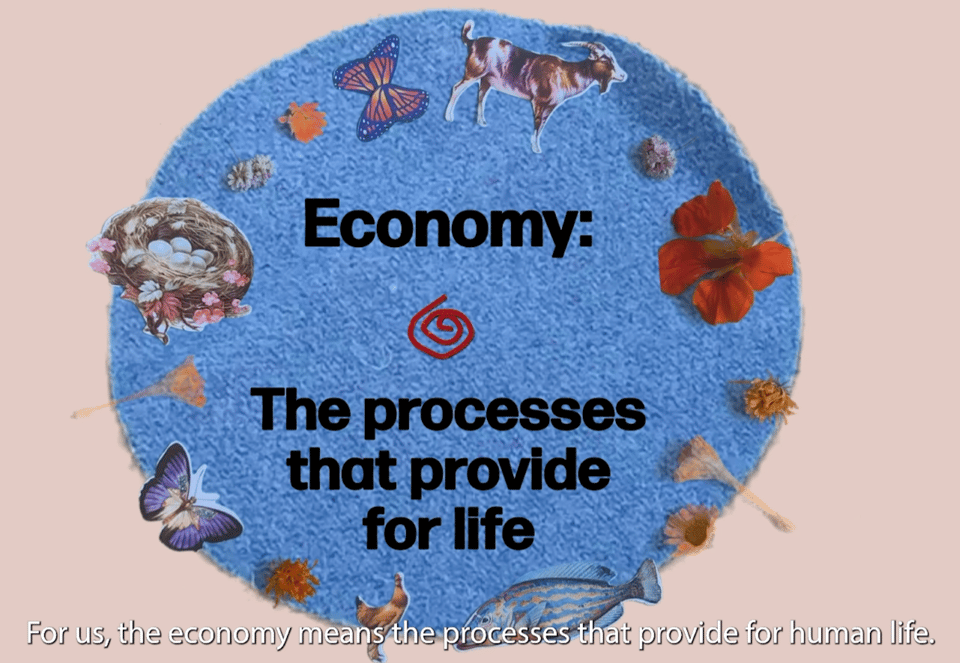
our economy is increasingly mediated by the internet. the provisioning of toilet paper, rides to the airport, and social connection is done on platforms. in All Consuming: Why We Eat the Way We Eat Now, Ruby Tandoh deems the the internet “the primary food infrastructure of modern age,” with GrubHub and Resy displacing grocery stores and farmers markets as the ways we find something to eat.
Doctorow describes a platform as a business operating a two-sided market that connects its business customers (e.g., ad buyers) with end users (i.e., us)—in effect, a middleman.
middlemen, or intermediaries, aren’t inherently bad. Persephone Farm needed someone to operate the farmers market so Portlanders could get their celtuce stalks and purple sprouting broccoli, for example.
the relationship becomes toxic when the intermediaries “grow so powerful that they act as gatekeepers" who "usurp the relationship between the two sides of their markets.” Facebook intermediates between your great aunt in Pennsylvania and teenagers in Russia raking in ad dollars with fake headlines about Hillary Clinton eating children. when platform companies control communication between us, they can control us.
platforms lock us into their “walled gardens,” so we can’t export our information and use another service. once they’ve drawn us in, they can undergo the process of "enshittification"—that fecal phrase that made Doctorow famous.
he outlines the process in his book with a giant poop emoji on the cover:
“First, platforms are good to their users.” think: the chronological, non-addictive, Instagram feed with your friends, no ads, and no video.
“Then, they abuse their users to make things better for their business customers.” they exploit the everyday people using the platforms by flooding us with “content” we didn’t ask for, which ranges from obnoxious to existentially threatening.
“Next, they abuse those business customers to claw back all the value for themselves.” they screw over the companies advertising on their platforms by price-fixing ad costs and using algorithmic sorcery to suppress visibility.
“Finally, they have become a giant pile of shit.” they make their services worse because no one has anywhere else to go.
so everything is poop now.
the internet was originally designed to avoid this fate, but the technooligarchy found a way. Kelsey McKinney describes how the internet was “supposed to be a place of opportunity, not just for profit but for surprise and connection and delight.” it was never meant to be “six boring men with too much money creating spaces that no one likes but everyone is forced to use because those men have driven every other form of online existence into the ground.”
❃ ❃ ❃ ❃ ❃
i spent a weekend with six people who operated bike-share systems for Lyft, five of whom were traumatized out of the company. their stories made the regulator in me quake.
the guy running scooter-share in a Midwest city forgot to charge his hundreds-strong fleet of toys before dumping them out on the street. men took their new hires to the bar on their first day and over-shared their sex lives. NXIVM membership, generally. random mid-level staff make decisions for entire cities with a two-sentence email or a one-line Slack message. corporate ladder-climbers abuse and discriminate against their staff with no recourse.
the ideologies of these companies is to squeeze as much out of the city and our people while providing as little as possible. rather than actual tech exceptionalism—excellent business practices, solving problems never solved before—companies have created market dominance through manipulation and outright lies.
Uber launched without cities’ permission, including where cities like Portland and entire countries (continents!) like Australia had proactively banned them.
to fool the public officials secret-shopping to identify Uber cars, the company created an entirely different app and pushed it to people they predicted—through what types of data surveillance, we don’t know—could be regulators. this fake app showed no cars or rides available in their city.
the point was to make Uber so popular that it would become irrefutable. so many people would demand Uber's illegal services that cities would have to legalize it. this scandal, or, rather, standard business practice, was known as grayballing.
companies operating at this scale—the scale of monopoly, oligopoly, or oligarchy—harm us because we continue pay them, because we have no choice, because they’ve squashed all other options.
❃ ❃ ❃ ❃ ❃
when i worked in Portland’s transportation department, i got the numbers on how Uber and Lyft vampire-sucked the riders off our buses and trains, sending us into the real so-called “doom loop”—fewer riders on buses means the buses come less often, and on and on.
the city became harder to navigate, especially for those with the least to spend.
if the internet is a place, it’s also becoming harder to navigate.
it's getting harder to use the internet "the old-fashioned way"—using search engines to find links to actual webpages, which are now hidden deep below Google’s AI Overview and other proprietary sludge that takes up half the page. this feature has reduced clicks to real websites by over 34 percent. like a roadblock in an eternally delayed street paving project, the AI Overview keeps you from getting to where you want to go: accurate information presented in context by people and institutions you can trust.
every “article” you do find in the morass is formatted the same: a bloated table of contents, each section filled with numbers that further fan out into bullet points of generalized fluff you already knew—low-impact activities are better for ankle pain; restarting your computer is a good first step. these articles are overbuilt 11-lane freeways. seventy-five bullet points could have been three.
AI slop is what happens when you take the map, put it through the paper shredder, and try to find your way to the park. it’s permeating all searches, and it’s grown so pervasive that it’s breaking the models that power it.
it has gunked up the internet so much that when you need to figure out where Charli XCX’s new movie is playing, find a recipe for spanakorizo, or understand the deal with Typeform, the only thing left to do is ask Chat...and it was Altman et al.’s plan all along.

but we shouldn’t buy it. we have to remember the cycle of enshittification.
ChatGPT has entered its adolescence. it imminently needs to monetize, cease bleeding cash, and reach profitability. like Uber, Lyft, Airbnb, and all that came before, it will soon charge us more for worse service.
ChatGPT sits in the second step of the enshittification process: abusing their users to make things better for their business customers. they’re about to “prioritize” advertisers in results. at the same time, they’re asking people to fork over their medical records.
this can only go great, especially in countries with fractured access to health care and media literacy that’s tanking further into the crater every day. (please don’t share your medical information with ChatGPT.)
❃ ❃ ❃ ❃ ❃
in addition to ruining the internet's basic functionality, the companies controlling it reach for something deeper: they transform our mindsets and enlist us into a technocapitalist value system. as algorithms supersede our most basic through processes, companies indoctrinate us into treasuring frictionlessness and speed at any cost—including agency about our time and attention.
as we’ve moved from clicking through our friends' Facebook Walls to the perfectly tailored, infinite scroll of Reels and TikTok, we’re now flooded with stimuli that we never actually asked to see.
Berkeley researchers posit that algorithmic systems that predict your needs before you’ve even felt them represents a “transformation in the structure of the web” that “enacts a technocapitalist worldview of efficiency, optimization, and seamlessness.”
they liken what we get to “digital junk food,” which (diet-culture connotations aside) consists of “high-engagement, low-context media that fragments attention and limits depth. Curation becomes invisible and decision-making outsourced.”
as we smooth all cognitive friction, we receive a gavage-feed of ceaseless distraction. it fractures our attention and directs it away from what matters. when we lose the ability to focus, we lose the ability to think critically and constructively, to hold the long view we need in order to envision a different future. we give up our very ability to make decisions.
❃ ❃ ❃ ❃ ❃
in the future, i will share some tiny embers of hope, and some ways i’m attempting to disentangle from the internet without altogether disengaging.
i also want to push further into how the technooligarch-controlled internet mediates our relationship to place and to each other. for example…
how are AI chatbots, parasocial podcaster relationships, or time spent observing strangers on TikTok changing people’s needs for social interaction in the "real world"?
how are those changes influencing the types of spaces—bars, cafes, basketball courts—that can afford to remain operational?
what are the ways our tech reinforces our connection to where we live?
in the meantime, what do you see? how do you notice tech changing our relationships with place and, thereby, our relationships with each other (or vice versa)?
<3
Add a comment: