
⍈ now is not the time for a five-year plan
or is it? Kim Petras, Jo Ann Hardesty, concrete, geopolitics, futures, grief…i’m in a weird mood
i am not a canvasser. in my history of political and civic action—not the deepest, but not the shallowest—one thing i did not do was enter the intimate space of a stranger’s doorstep and engage them in difficult conversations. i am not as bold in conflict as the East Coaster in me would suggest, so i prefer to operate behind the scenes.
in 2022, that changes. my friend, then the Governor’s right-hand-(wo)man, graciously goads me into a canvassing session to re-elect Portland City Councilor Jo Ann Hardesty. a straggling handful of volunteers huddles in a loose semicircle outside Fulcrum Fitness, bearing the mist as the campaign manager runs us through a too-brief training. he pairs us off: you and her, him and him, you two. he points at me. then, he points at Jo Ann.
for my first canvass, i walk alongside Jo Ann Hardesty herself.
Jo Ann served in the State House of Representatives in the 90s, then became the first Black woman to serve on Portland City Council in its 168-year history. she carried the left flank of City Council on her back—she was the left flank, always asking my superiors at the City hard questions from the dais: what do you mean affordable? for whom? in 2020, she bore the brunt of responsibility for those frenetic attempts to resolve the problem of the police, something she’d been working toward for decades, and then she bore the backlash to that responsibility.
when the bungalow dwellers off Hawthorne open their doors to us, she does the talking. i curl up flyers and stick them into doorknobs, tap tiny buttons on the MiniVAN canvassing app.
between houses, Jo Ann tells me about growing up in Baltimore, and i tell her i’m from Richmond. in her face i see a recognition i get from Black people here once they learn i’m from Virginia, a place with other Black people: an exhale, a lowering of the shoulders, at least one actual, “oh, you get it,” how odd it is here. she tells me about her time in the Navy, asea in Philippine waters, and she lets me in on a secret: firefighter culture, it turns out, reeks even worse than cop culture.
toward the end of our assigned stretch of 38th Avenue, she spends a luxurious 20 minutes talking with a white man on the steps of his billowing porch. the guy asleep on the sidewalk across the street is lowering his property value by the minute, you see, and enough is enough. Jo Ann turns her ear toward him in genuine empathy, slips him her business card, will find that man—which one, both—some help.
i summarize for Jo Ann my six years in the bureaucracy, how i once presented a report to her at City Council, about the godforsaken scooters. at the end of our time together, she senses the budding dread of my own languishing inside the gummed-up gears of the machine. she tells me i better have a five-year plan. i don’t.
i look down at my phone and realized i’ve messed up the canvassing app—my one job, failed. none of the 30 houses we visited would get logged in the system.
three Portland Police officers, including the president of the police union, plant a false story in the Oregonian that Jo Ann engaged in a hit and run. she loses the race.
⍈ ⍈ ⍈ ⍈ ⍈
three years later, i apply to graduate school. a year and change after that, i begin. now, nearly five years from Jo Ann, i still have no five-year plan in sight—not even the provisional one where i spend five years getting a PhD. even this is un-guaranteed: in the Canadian system, you must do the Master’s and then apply for the PhD. my Master’s cohort has 13 students. there are three PhD slots.
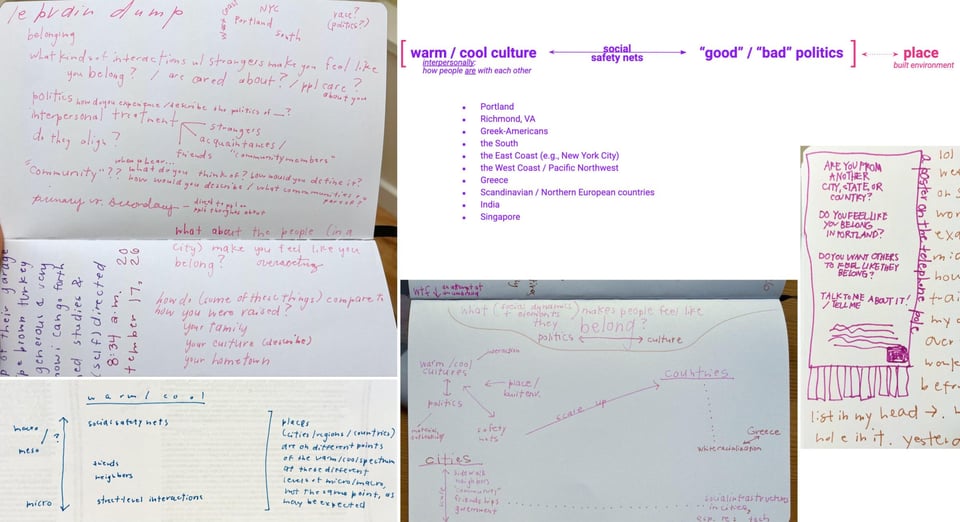
still, to even try to get there, i must map out a research trajectory for the next one, two, four years. professor after professor tells me my questions are too big, too networked, my scope too ambitious. they are; it is. i am everywhere. every few days, i draw wild diagrams that spill across the constricting folds of my journal’s 5”x8” pages. i yearn for a wall-sized whiteboard, but the landlord says no nails in the drywall. i can map out an entire career’s arc of questions to pursue, but i cannot map out a Master’s thesis—the length of a handful of love notes.
⍇ ⍇ ⍇ ⍇ ⍇
on Monday, in my eternal searching (of internet, of soul), i come across an essay by a professor i’ve just met. through Instagram Stories, she watches her aunt chronicle the destruction of her own neighborhood in Iran. a pharmacy, gone; a bank, gone, at the intertwined hands of Israel and the US. hunks of concrete ground her videos, which, like all imagery flooding out of the region for untold months, serve as testament and beacon: i am still here, amid the gone.
on Tuesday, my godmother sends me an invitation for my great aunt’s 90th birthday party. she knows it won’t make it by Canada Post in time, so she texts a grainy photo of Thea Mo, a pigtailed child and a great-grandmother, lying flat on specked granite countertop.
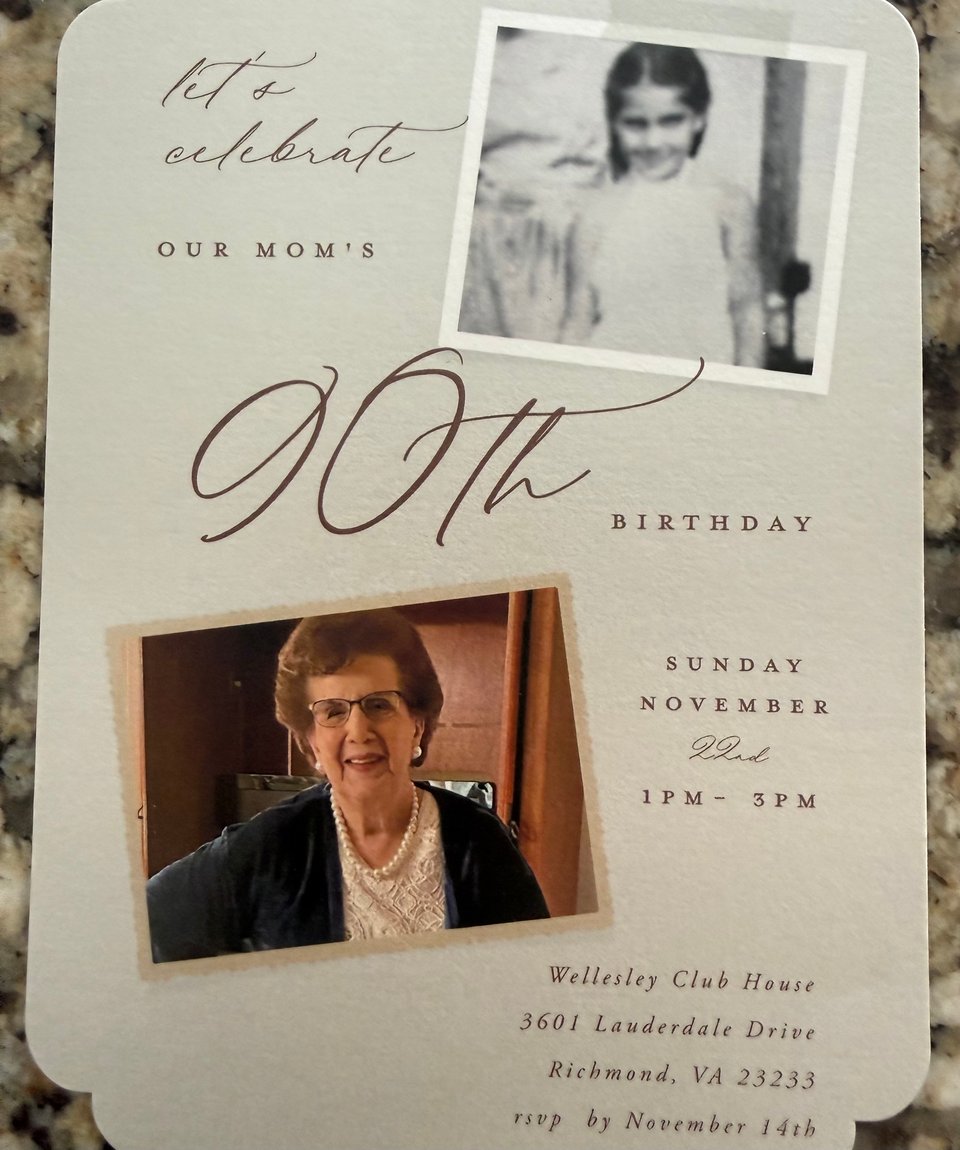
Thea “Mo” is my grandmother’s sister. Thea Mo always signs my Christmas cards in Greek: Θεία Σμαρώ. Mo is short for Smaro, her Greek name with an S like a lazy Z and a rolled R. she learned, when she still had those pigtails, that people couldn’t get it through their lips.
i won’t make it to Thea Mo’s birthday party at the Wellesley Club House, a few miles from her home that she and my great uncle bought 50 years ago, some decades after the courts rendered unenforceable the racial covenants that prohibited Greek people in the deeds. unlike the rest listed in those covenants—Black people, Chinese people, and others with skin tinted unlike our own—Greeks gained free reign of the housing market and never looked back.
Thea Mo bought her house five minutes from my grandparents, with the same ticky-tacky, copy-paste layout: a sunken bar with Greek columns, a three-foot framed photo of the relevant child in front of the Parthenon, a wall of gold-specked mirror, plush cream carpet, lamps made of green glass as tall as my five-year-old body.
⍈ ⍈ ⍈ ⍈ ⍈
on her latest album, Kim Petras trades in her usual raunch for a heartfelt vulnerability—rather, she toggles between the two. (i live for the high-low.) from “Polo” (”Titties poppin' out my bra, like wow…Slap that logo on my ass, uh-uh”) she transitions deftly into “Brutalist,” where she draws an architectural metaphor for the psychiatric treatment she received as a trans child. with shimmery effects and a vocal tone that hearkens to MUNA’s self-titled album, she sings:
“There was a building there and it was brutalist
And it was beautiful, it was my favorite
But it's not there no more, because they tore it down
They really ruined it
My dad's an architect, he used to show me it
When he would drive me to the psychiatry
Again and again
Didn't come back a man
I guess I ruined it”
she tells us, “They cut my hair at the psychiatry,” and of the building—and her gender presentation—she continues, “They took a knife to it / They took a bomb to it / They bulldozered it / They didn’t give a shit.” by the end of the song, the building is gone, fallen to dust.
four thousand miles away, my dad took me to another Brutalist building, where he worked in his accounting firm. a hulk of Reynold’s Wrap metal the length of the Washington Monument enfolds its rounded three-story exterior. the designer himself, one-hit architectural wonder Haig Jamgochian, hammered the metal by hand.
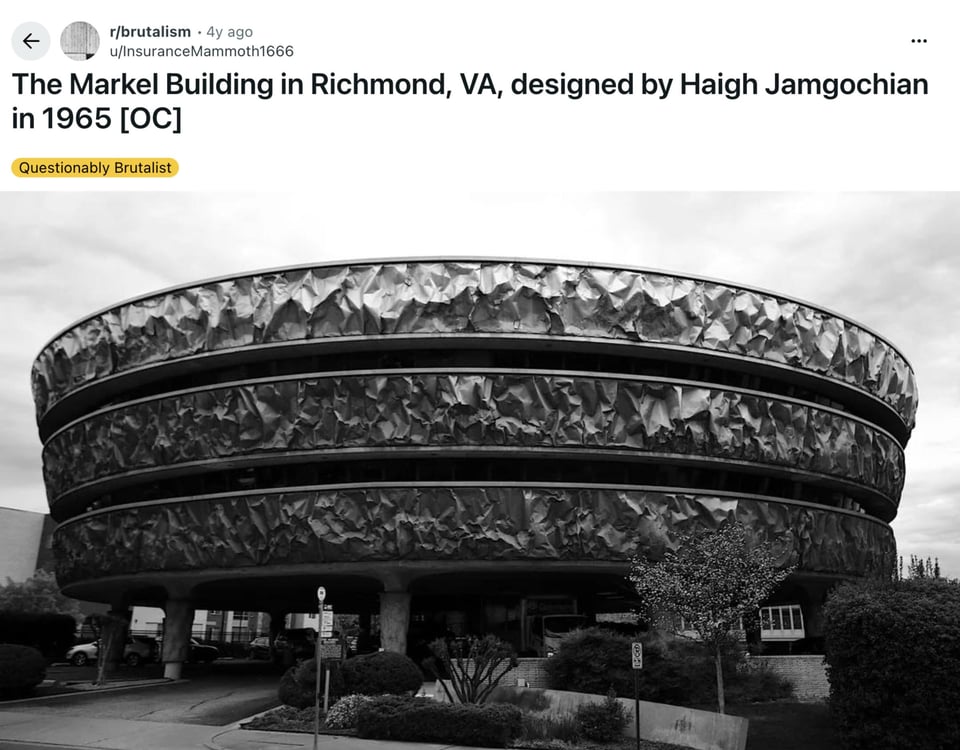
my eight-year-old feet pitter-pattered in circles along the corridors of the building. from his curvilinear suite in Jamgochian’s masterpiece, my dad did the books for most of the Greek-owned restaurants, tailors, and shops in the city.
Jamgochian’s parents survived the Armenian genocide. during World War I, Turkey organized death marches of Armenians into the Syrian desert in order to claim Anatolia for itself and its people. concurrently, they conducted a Greek genocide with marches, burning sieges, massacres. combined, they saw an upper-bound estimate of 2.7 million deaths. parts of my family history are unknown to me, but half of my great-grandparents are from the place and time where this occurred.
Hitler took inspiration from the Greek and Armenian genocides. decades later, Israel has funhouse-mirrored its way from oppressed to oppressor. a web of geopolitics links Israel’s long genocide in Palestine to my professor’s aunt recording her own neighborhood’s bombing in Iran. in it, Greece is complicit. they weave the web.
Greece sends aid and weaponry to Israel, and Greece blocks the safe passage of people fleeing the conditions they help create. guarding itself against a boogeymanned “Muslim” from the south and the east—drawing upon a warped imaginary of its own past—Greece sends refugees into the sea, teargasses the forest where they cross. Turkey—once perpetrator—now picks up the very human pieces of Greece’s inhumanity, rescuing children from the fragile rafts the Greek Coast Guard sinks. people unsubscribe when i say this. it is true.
Brutalism comes from the French brut, or raw, like exposed concrete. every building tumbled to rubble is concrete. every building tumbled to rubble is Brutalist.
⍇ ⍇ ⍇ ⍇ ⍇
on Thursday, we are sent to Great Dane Coffee on the UBC campus to engage in sociological “non-participant observation.” we watch, from a distance, interactions across differences of race, ethnicity, ability. we take fastidious notes, learning to be scientists of the social world.
students descended of everywhere mill about this “majority-minority” city. they are here, be here near or far for them, “investing in their futures.” they trade stories of visiting their uncles in Thailand, flying to Mexico for a wedding. some saunter by with over-ear headphones or anime plushies dangling from their backpacks. a young student wearing hijab carries a pristine tote that reads PALESTINE in big block letters. she waits in line under the canopy. her chin tips up as her friend elicits a breezy laugh.
i think of the aunt of this young student, or the aunts in the land written in red on her bag, or the aunt of my professor. these aunts and those of untold others may never turn 90, may never get to throw a party at the neighborhood clubhouse, to invite all the other aunties and celebrate over dolmades, tzatziki, baklava, all these foods we share under different names.
on Sunday, Ta-Nehisi Coates joins us up here, way on the edge of the earth, to give a talk at UBC. he tells us: you think genocide is over there, but it’s not. you’re over there. Zionists cite the US genocide of Indigenous peoples as a model. when Hitler wanted to know what to do, he sent Nazis to the Jim Crow South. the blueprint has gone global. you—we—are responsible for the whole of it.
in these conditions, a five-year plan may feel like a farce. but still, the students create them anyway, under that tired advice: a five-year plan will set you up for a ten-year plan, a 25-year plan, a future.
then again, hopecore is trending among the Gen Zs on TikTok. WhimZ. 2026 did bring us Bad Bunny at the Superbowl, Zohran, Abdul El-Sayed, the latest “blue wave.” i wish to deny them none of it. who is right? for whom?
⍈ ⍈ ⍈ ⍈ ⍈
yesterday, it is my mother’s birthday. i call her.
you’ve arrived at the subscriber wall. everything is free! some matters simply must remain in your inbox ;) to see below this line, subscribe—or log in!