
✾ 27 minutes inside the cherry blossoms
subpar photos and a little squish, just real quick!
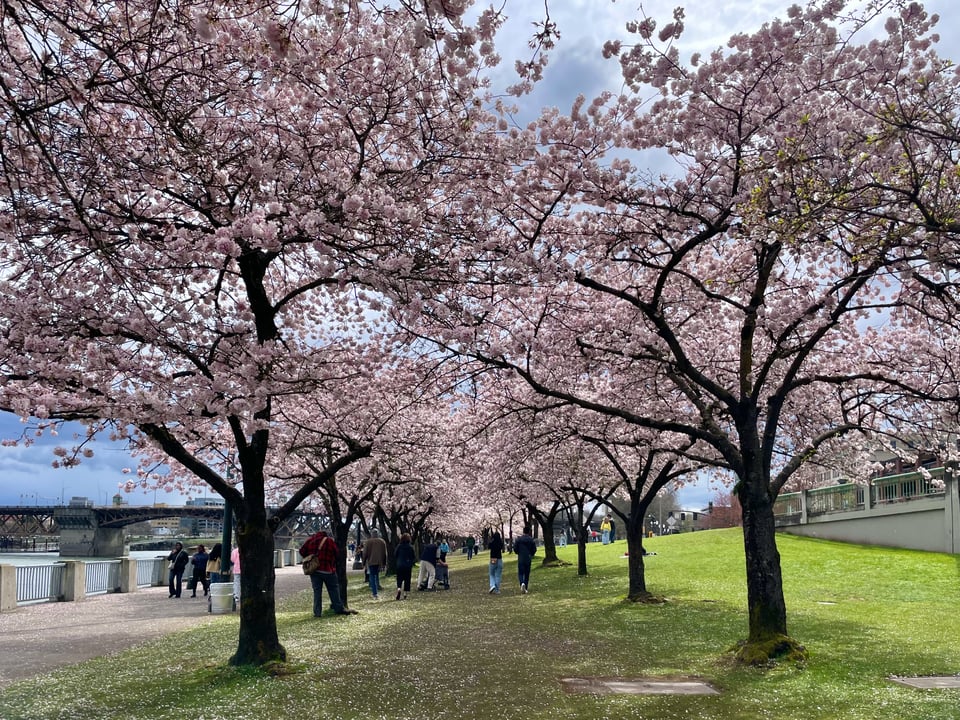
there is no visiting the cherry blossoms without visiting the people visiting the cherry blossoms. in fact, it’s half, or more than half!, the fun.
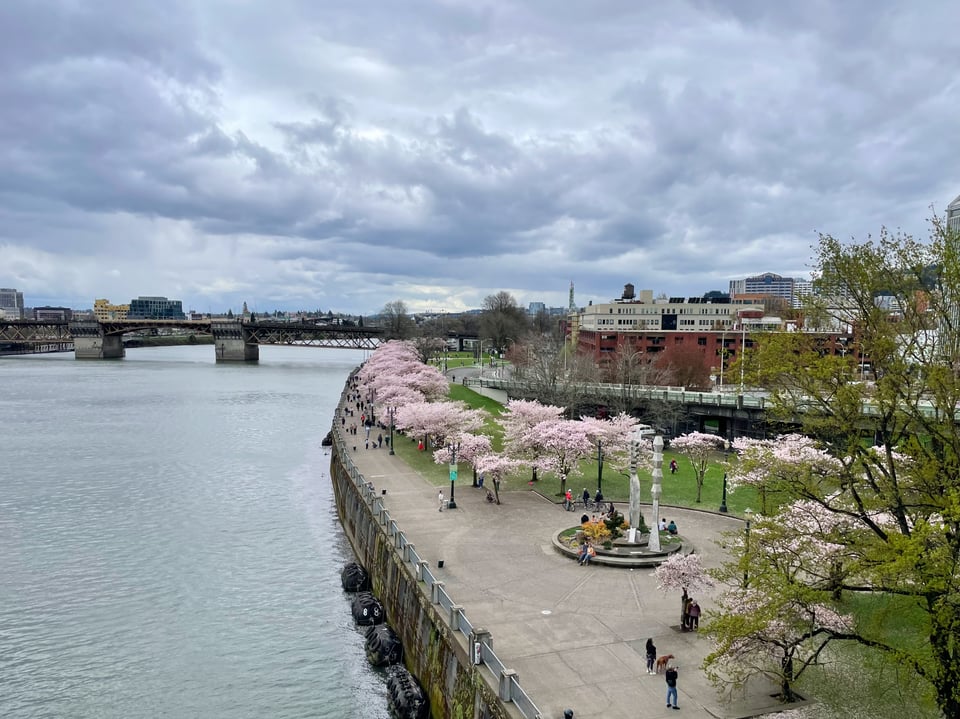
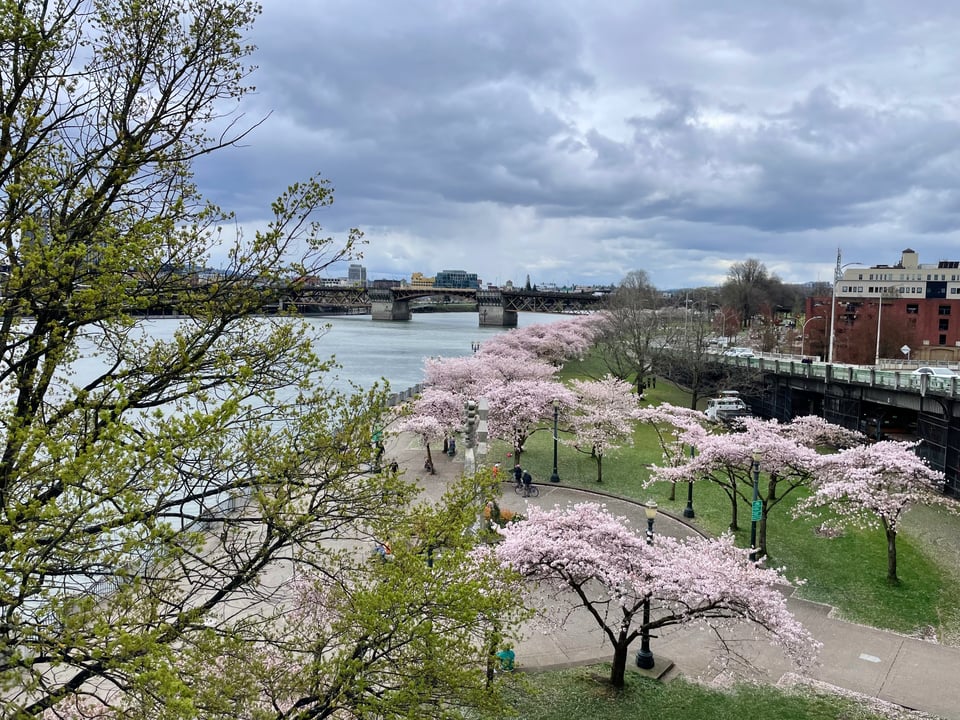
i walked in a T down Everett and between two rows of trees, my raincoat an accidental highlighter-yellow photobomb in a hundred backgrounds. daughters in their ugly-duckling phase dutifully photographed their momfluencers. a couple beaded bracelets on the lawn in full-face bear masks made of leather. a wanderer blew bubbles with a stick and a five-gallon bucket, like the Pigeon Man i found in Central Park when i was 10. i saw people taking pictures of people taking pictures, and then i became a person taking pictures of people taking pictures of people taking pictures. this linear span of “nature” is the closest to a city we ever get.
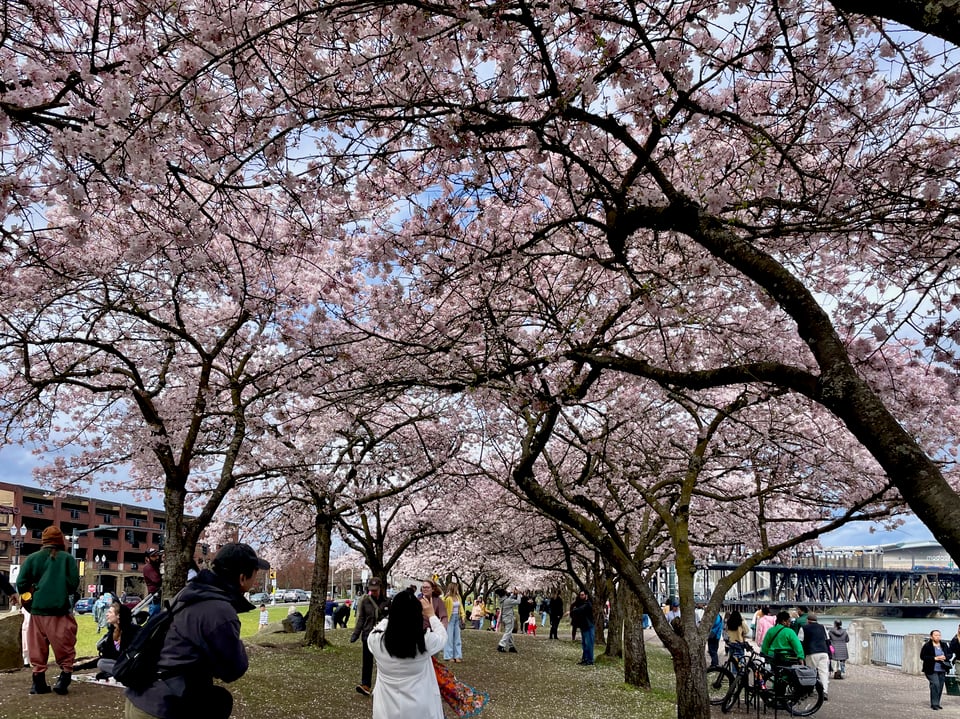
the cherry blossoms skirt the Japanese American Historical Plaza, located in the once-heart of Portland’s Japantown. in poems, sculpture, and the Bill of Rights engraved on rock and bronze, the plaza reminds us of the harms our governments enacted upon Japanese and Japanese-American people living here. during World War II, the U.S. government and local officials incarcerated almost 4,000 innocent people at the Expo Center, just a few miles north on the Yellow Line, alongside over 100,000 others up and down the West Coast. both immigrants and citizens were taken for simply being, a history that echoes again today.
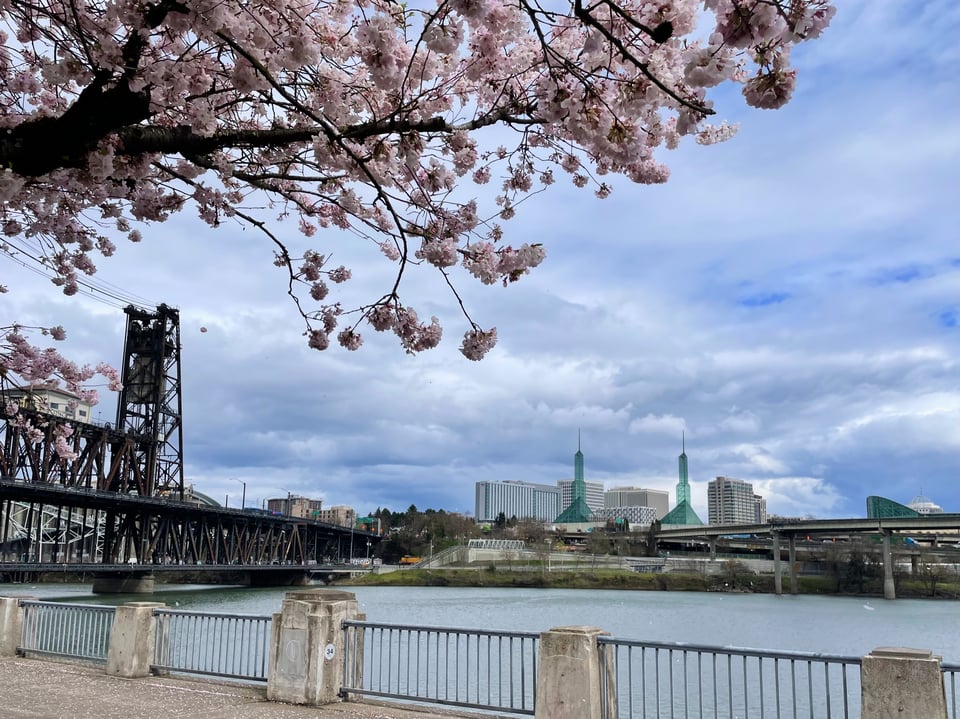
half a century ago, the City and the State ripped out the Harbor Drive Freeway to birth Tom McCall Waterfront Park. twelve years later, landscape architect Robert Murase designed the Japanese American Historical Plaza plaza in collaboration with Portland icon Bill Naito, for whom the bordering Naito Parkway (and now, the lime-green cycletrack Better Naito) are named. then, Japanese grain-trading businessmen donated the cherry blossoms.
this bold overhaul—gutting a freeway to make people-space instead—prefigured the bike infrastructure that put Portland on the map (well, certain maps) in the 2010s. but it would not be repeated on the other side of the river, where I-5 cut through Albina and faces expansion today.
over yonder, a cavernous grain elevator looms above the steel bridge, empty. the 1803 Fund, helmed by Rukaiyah Adams and capitalized in part by Phil Knight, has just purchased it. (lest we give the Shoe Dog too much credit, we remember that his $400 million donation amounted to 0.86% of his net wealth at the time.)
the Fund has folded the grain elevator into its plans to rebuild Lower Albina into a cultural and business hub for Black Portland, with stellar architecture and public spaces designed with Albina Vision Trust. around the grain elevator, this team will open the river to all of us, a generous gift.
in perhaps one of my favorite quotables of all time, Ms. Adams said of the plans, “While everybody else is crying into their beer about doom [loops], it takes generations of Black folks with ancestral knowledge to know how to pivot to the future and begin anew.”
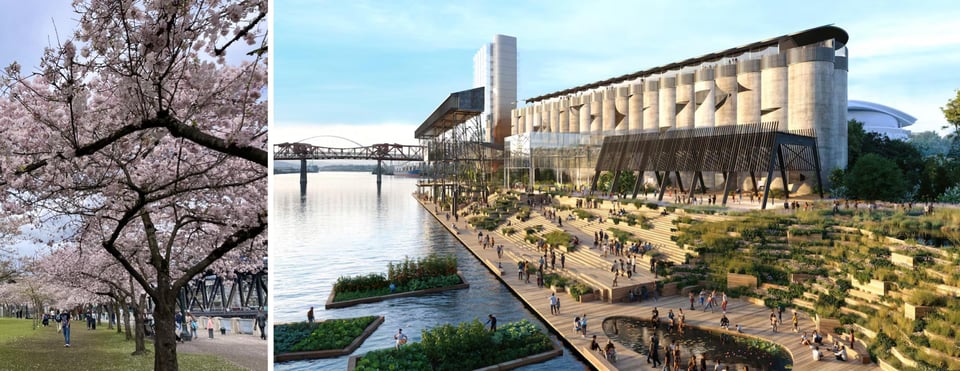
~45°31'38.5"N 122°40'08.5"W
the trees, born in 1990 like my sister, bloom their 36th year here. i see people from 6 to 96 prepping themselves for photos: perfectly coiffed toddler-WASPs beneath their mother brushing strawberry blond hair, a young boy in a Kelly green DELAWARE sweatshirt, tourists from the suburbs. on a small, square blanket, a Feeld date proceeds, discussion at intensely close range. i recognize two people but can’t place them: one, i think, a City worker on break who’d strayed further north than normal. lip gloss, kids on mountain bikes that cost more than a car, aging couples making funny faces, designer German Shepherds in bow ties.
people argue in varied accents about the direction of sunlight or the best place to stand. “sun on face!” “there is no sun!” he’s not wrong. in Portland’s spring, the skies can’t hold a smile for more than a few hours. puffs of blue-gray and slate abound. my iPhone 12 Mini and i are not great photographers.
yesterday, i was supposed to come to the trees with my friend, the writer Lola Milholland, a devotee and onetime resident of Japan. she’d invited me to a “hanami hangout,” a time to picnic and participate in “the Japanese tradition of sitting beneath the fleeting beauty of the blooming sakura with friends, family, and neighbors equipped with food, drink, and time to spare.”
i messed up my calendar and couldn’t go. in any case, it rained. Lola went.
later, we met up at the mall instead—the Lloyd Center, that hulk of light and space blooming with art galleries, nonprofit programs, a pinball museum, the ice rink where Tonya Harding trained. some think the Lloyd Center is wilting. we took one last pass before it gets ripped down this year.
Lola told me about the picnic, and how the whole point of hanami is that you’re supposed to go when the moment is ripe, when the season turns and the trees bloom and the sky opens up, not at 12-on-the-dot on a prespecified Tuesday no-matter-what (i.e., in dripping rain). the spirit of it had to be squished into an Americanized time-culture, but committed attendees communed beneath the drizzle.
i’ve been thinking a lot about warm and cool cultures. i’ve observed an inverse relationship between interpersonal warmth and the set of “good” politics that results in a social safety net. people are cared for by each other, or by the state, but not both at the same time: the U.S. South versus the Pacific Northwest; multi-generational households in Greece or India versus state-run Scandinavian eldercare and Finnish baby boxes. “progressives” voting “correctly” but cutting out their own family and friends versus Trumpers opening up their houses to houseless people. (if politics is something you do, not something you have, then…?)
i know i’ve constructed a false binary, but i want to know the directionalities: how do the cultures of the interpersonal and the politics of a people relate, and how do the places we live—the built environment—influence them?
as we mall-walked past Chicken Connection, an English-language school, and the vintage shop in the old Hollister bungalow, Lola posited that Japan complicates this binary. as she wrote after her last visit, the people are cool, and they are cared for by the state, either directly through services or indirectly through policies that keep housing and food attainable for most people. however, many people are also deeply apolitical, seemingly shrugging off one of the farthest-right prime ministers in recent history who’s just assumed power. some cities and countries in Latin America break this binary, too—they have warm cultures plus good social services. social housing in Uruguay and Bogotá’s TransMilenio bus rapid transit come to mind, but i don’t know enough.
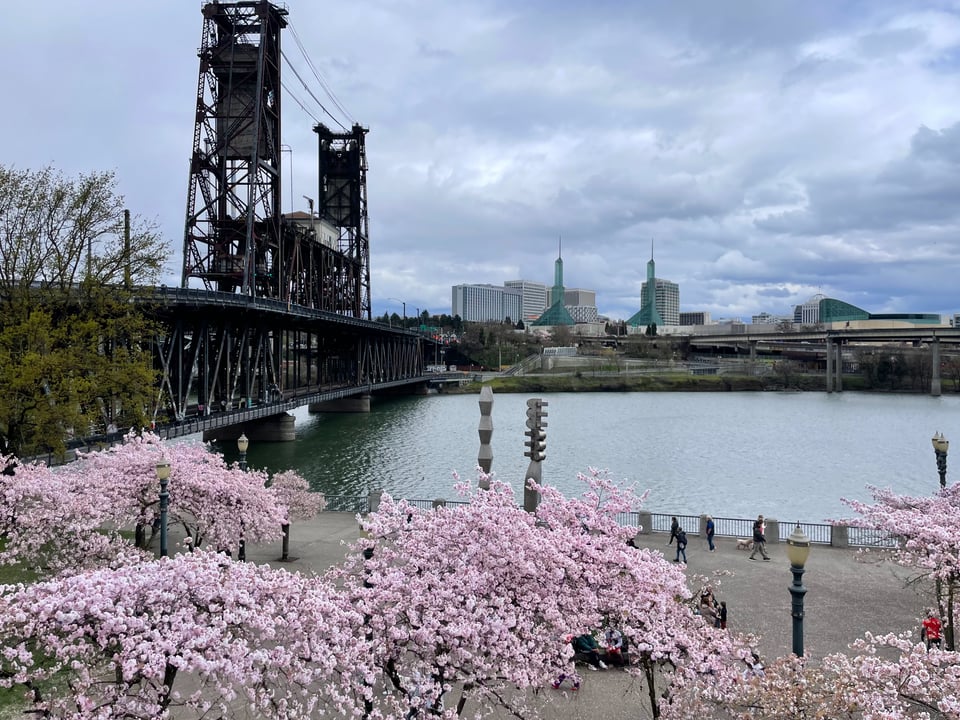
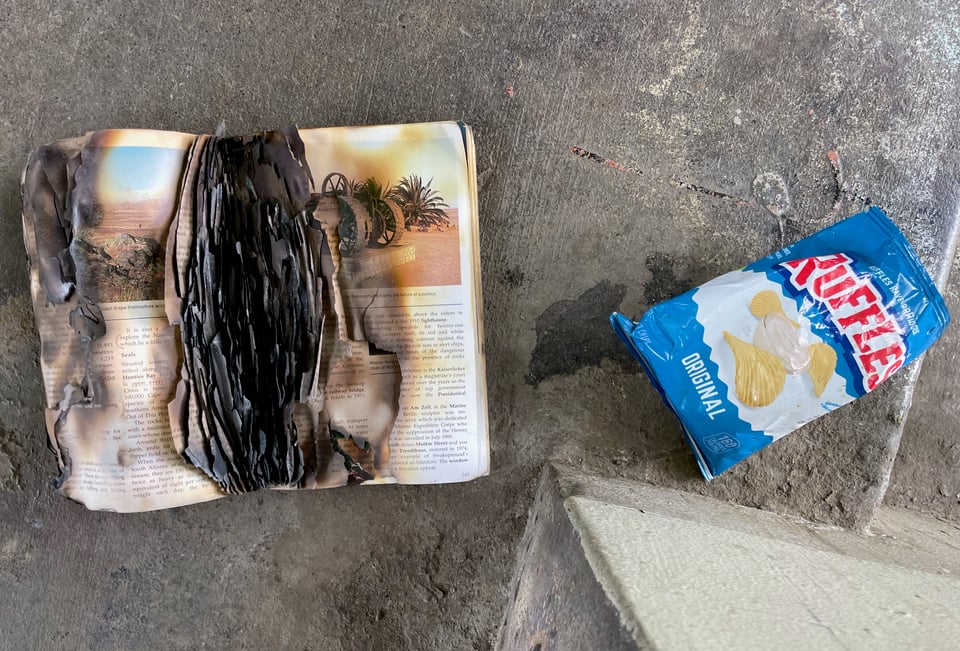
a friend is in Japan now. i think about sending her a picture of the blossoms from the elevation of the Steel Bridge, but i get distracted by artifacts in the stairwell: a burnt-up book describing the fur seals and architectures of Swakopmund, Namibia, penciled with underlines; an emptied bag of Ruffles.
above the river i think about how i used to cross it four times a day, two on foot and two on bike. all those years, i soaked up the river’s ions, knowing nothing of them until my witchy coop neighbor described them to me, wide-eyed.
i remember the two cherry blossoms at the north end, stumpier and fairer than the rest. they live on a slightly different timeline, blooming and fading almost imperceptibly sooner. maybe it’s their microclimate; maybe they buffet their neighbors from the metallic mist of the Steel Bridge and container barges to the north.
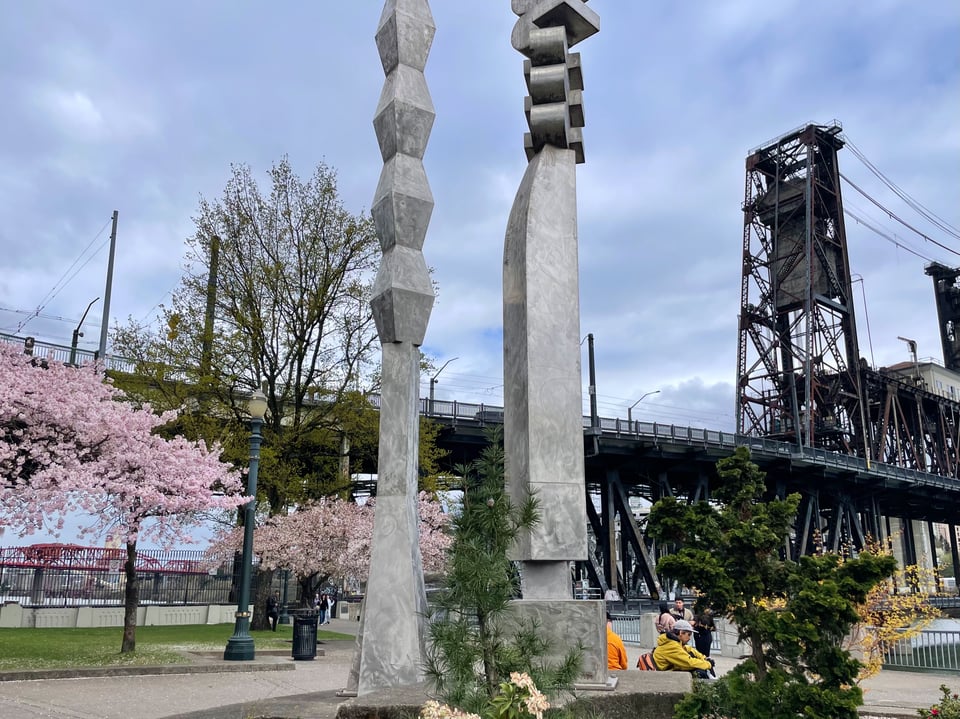
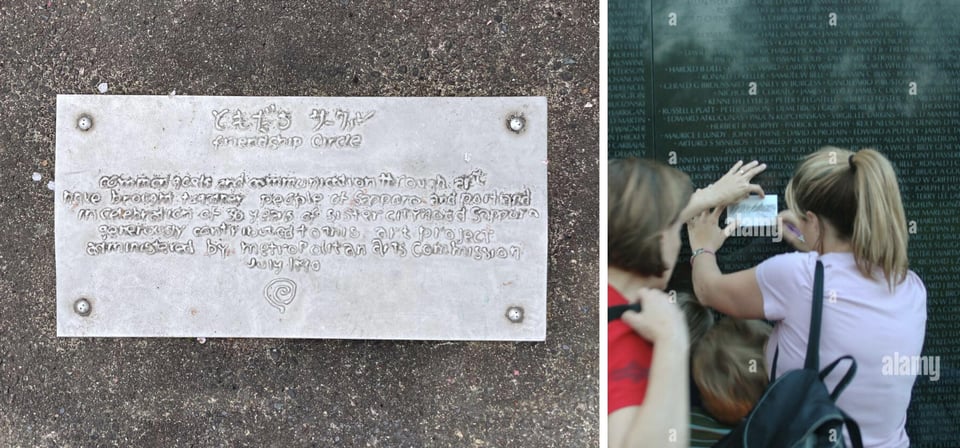
always ever running, i’ve never in ten years visited this speck of the park at a pace slow enough to really see the sculptures of Friendship Circle, that little roundabout of pedestrian scale. i touch my thumb to the plaque’s puffy, raised letters, which explain the sculptures as a collaboration between sister cities Portland and Sapporo. i think about 10th-grade art class when we learned about Maya Lin’s Vietnam Memorial, an anti-monument where people bring a piece of paper and a pencil to trace over their loved one’s name. these monuments are inversions of each other: extruded and etched, standing and sunken, friendship and war. writing of the Vietnam Memorial, Lisa Yin Zhang says, “I’m beginning to think that the true mark of assimilation in America is forgetting.”
Lola told me she lives in the present. i asked her how. i live in the future, except for now: i look backward as i prepare to leave the city that gave me my first decade of adulthood. this season of blossom-blooming is another moment in a year of lasts.
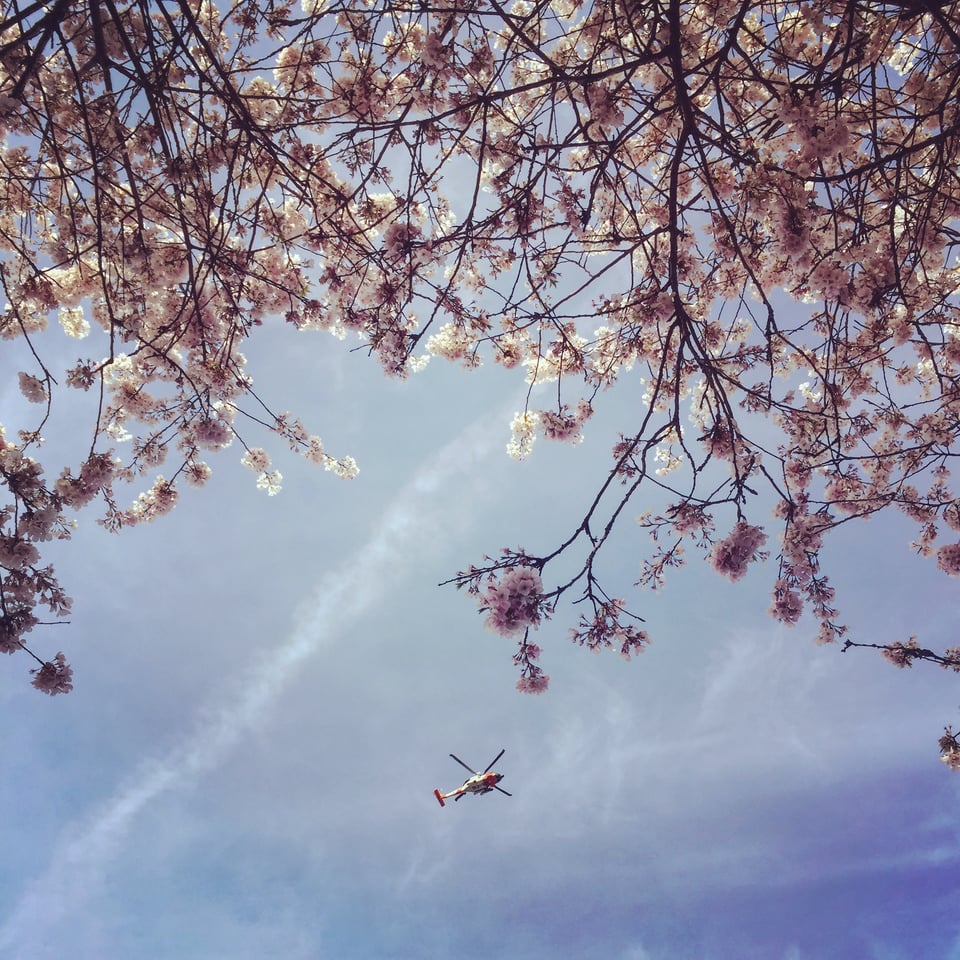
under the petals i see an infant, fresh out of the womb, wearing a hat woven into a flower. an elderly gay man pushes his partner in a wheelchair. they remind me of my friends—one presently caring for the other, who broke his foot in this very park—half a century into the future.
the blossoms and their plaza remind us of the past, and of the future. our histories replay on a loop, slightly altered, an unfolding fractal of branches. what does it mean to be reminded of the future?
<3
for the dedicated readers who made it here (and the beloved skimmers and scrollers), we are still seeking responses to the love notes potpourri poll!!i want to more about how you feel about warm and cool cultures, place, aesthetics, etc. etc.!
Add a comment: