The Monday Haul | Edition 2
The Monday Haul
Monday, October 26, 2026 · Long Haul Ledger · Edition 2
 The P-82, one of the biggest oil platforms in the world, set sail from Singapore for Brazil on October 18.
Oil prices stayed high this week, but the bigger story is how much got built and signed anyway. Gulf oil is flowing out at pre-war levels again, Qatar locked in American gas for nearly three decades, and companies put billions behind new pipelines, steel and factories. Eight things that moved the economy, in plain words, each with its source and date. Not investment advice. Not real-time.
This week at a glance
- 🛢️ Gulf oil exports back to pre-war levels, Brent near $114
- 🚢 Qatar buys American LNG through 2054
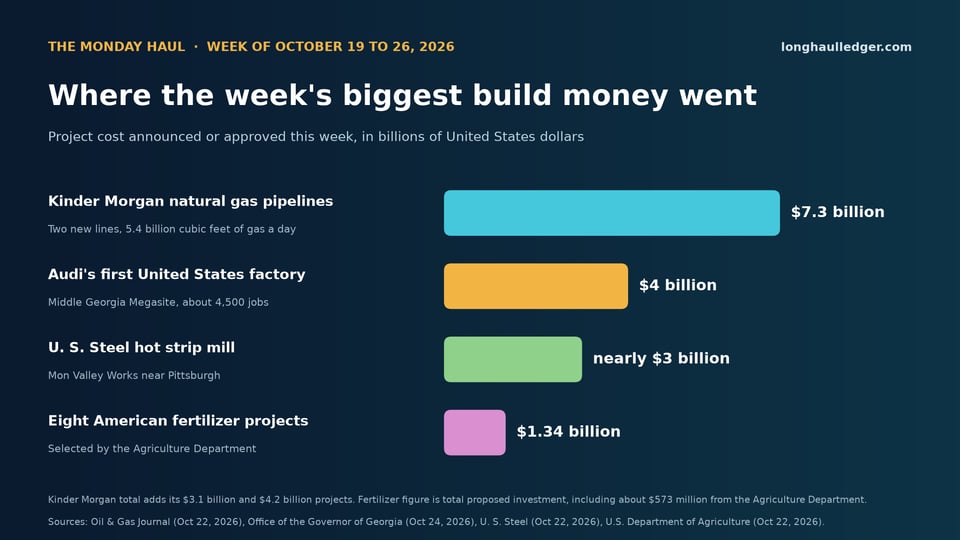
- 🔧 Kinder Morgan commits $7.3 billion to two gas pipelines
- ⚡ Virginia county approves a 3,000 megawatt gas plant
- 🇧🇷 Brazil's giant P-82 platform sets sail
- 🚗 Audi picks Georgia for its first US factory
- 🏗️ U. S. Steel funds a nearly $3 billion new mill
- 🌾 Eight American fertilizer plants get federal backing
Energy
1. Gulf oil is leaving the region at pre-war levels again, even as attacks keep prices near five-month highs. The US military said on October 26 that over 1.5 billion barrels have been exported from the Gulf since June with its help, and data firm Kpler counted at least 16.5 million barrels a day leaving the region in September, equal to the pre-war average excluding Iran. Prices still jumped after a deadly drone strike on Saudi Aramco's Shaybah field and reports of seven damaged tankers near Hormuz, with Brent crude touching $114 a barrel on October 23 for the first time since May. Why it matters: Brent settled at $72.48 the day before the war began in February, so the oil is moving again but the price of risk has not left the barrel. Sources: Al Jazeera (Oct 26) · Rigzone (Oct 23) · Bloomberg, via Rigzone (Oct 22)
2. Qatar, one of the world's biggest gas exporters, signed its first deal to buy American liquefied natural gas. QatarEnergy will buy 4 million tonnes a year from Cheniere through 2054, split evenly between Sabine Pass in Louisiana and Corpus Christi in Texas, with deliveries starting in the early 2030s. One million tonnes of it depends on Cheniere deciding to build a new unit at Sabine Pass. Why it matters: A 28-year contract from a rival seller is a long vote of confidence in Gulf Coast gas, and it helps pay for new export capacity on top of the roughly 56 million tonnes a year Cheniere already runs. A gas giant buying gas is like a baker buying bread: it usually means big orders to fill. Sources: Bloomberg, via TT News (Oct 22) · Offshore Energy (Oct 23)
3. Kinder Morgan committed to two big natural gas pipelines aimed at new power plants and data centers. The $3.1 billion Southeast Connector will run about 470 miles and carry up to 2.6 billion cubic feet a day, and the $4.2 billion Permian Link will run 434 miles to serve new power plants for a large cloud computing company. Both are backed by long-term shipping contracts and are due to start service in the second half of 2030, pending permits. Why it matters: Kinder Morgan's chief executive said requests to connect large new power users across the Southeast now top 200 gigawatts, which could mean about 8 billion cubic feet a day of gas demand if it were all built and all served by gas. Source: Oil & Gas Journal (Oct 22)
4. A Virginia county approved Dominion Energy's 3,000 megawatt gas power plant. Cumberland County supervisors voted 3 to 1 on October 20 for the Cumberland Energy Center, which would make about 3,000 megawatts of round-the-clock power on roughly 150 acres west of Richmond. It still needs a state air permit and approval from Virginia's utility regulator, and Dominion is aiming to start construction in 2029. Why it matters: That is more than three times the size of Dominion's 944 megawatt Chesterfield plant now being built, and Dominion expects it may need up to six new gas plants over the next two decades to keep up with demand. Source: POWER magazine (Oct 21)
5. Brazil's P-82, one of the largest oil platforms ever built, set sail for the Búzios field. The platform left Singapore on October 18 and can produce 225,000 barrels of oil a day and handle 12 million cubic meters of gas a day. It is 345.3 meters long, weighs more than 100,000 tonnes, and is the second giant Petrobras platform to head for Búzios in less than a month. Why it matters: Petrobras expects Búzios, Brazil's biggest field, to have 11 platforms running by the end of 2027, adding supply from outside the Gulf while Hormuz stays risky. It is longer than three American football fields, and it is taking the scenic route. Source: Agência Petrobras (Oct 19)
Across the economy
6. Manufacturing: Audi will build its first US factory in Georgia, a $4 billion plant with about 4,500 jobs. Audi picked the Middle Georgia Megasite in Peach County for a plant that will build SUVs for North American buyers. Grading starts in 2027, construction in 2028, and full production of 200,000 vehicles a year is expected in 2031. Why it matters: Audi now makes vehicles at 21 sites in twelve countries, and this is its first in the United States, one of the world's biggest markets for luxury cars. Source: Office of the Governor of Georgia (Oct 24)
7. Manufacturing: U. S. Steel approved a nearly $3 billion new hot strip mill at Mon Valley Works near Pittsburgh. The new mill at the Edgar Thomson Plant will raise yearly capacity from about 2.2 million tons to about 3.5 million tons of steel coils for cars, appliances and pipelines. Construction starts once permits are in hand, with first production expected in late 2029. Why it matters: A study for the company estimates the project will support 5,100 to 6,300 jobs across Pennsylvania over three years, on top of the 13,687 jobs U. S. Steel already supports there. Source: U. S. Steel (Oct 22)
8. Raw materials: The US picked eight fertilizer plants for federal backing, worth more than $1.34 billion in total. The Agriculture Department chose projects in more than a dozen states, with about $573 million in proposed federal funding, including a $265 million potash plant near Carlsbad, New Mexico, and modular ammonia units across seven Midwest and Southern states. Together they are expected to add about 1.08 million tons of yearly fertilizer production. Why it matters: The department estimates the projects could raise US potash output by nearly 40% and nitrogen output by 3.7%, while lowering potash prices by 5.3% and nitrogen prices by 4.4%. Source: US Department of Agriculture (Oct 22)
Extra Haul
- Egypt: Africa's largest solar plant, 1.2 gigawatts with 600 megawatt hours of batteries, won a $265 million loan led by the EBRD. EBRD (Oct 20)
- Mid-Atlantic: Google and Voltus expanded their virtual power plant deal tenfold, to 1 gigawatt of homes and businesses that can ease the grid at peak times. Power Technology (Oct 23)
- North Carolina: Corning will invest $585 million and add 414 jobs at its Wilmington optical fiber plant. WECT (Oct 21)
- Ghana: The government signed a $28 billion deal for a refinery and petroleum hub in Jomoro, though funding is not yet secured. Offshore Technology (Oct 22)
- Brazil: Luiz Inácio Lula da Silva won a fourth term with 51.79% of the vote, and his opponent has not conceded. Kyiv Independent (Oct 26)
In case you missed it
- Edition 1 of the Monday Haul, October 19: emergency oil releases, China's crude draw and Japan's $21 billion chip deal.
- All past hauls
- Why gas prices don't always follow oil prices
- Power bills and data centers
- The transformer shortage
That's the haul for this week. Thanks for reading. If something here caught your eye, you can dig into any place on the map, from the whole world down to major cities, at longhaulledger.com.
See you next Monday.
Management
Figures are as published by each source on the date shown and may be revised. Opening photo: Divulgação / Seatrium, via Agência Petrobras.
You're getting this because you signed up for the free Monday Haul.