Week 52 - Reminiscing the Reads
Hi All,
I struggle with sticking with a subject line format that is both consistent but allows me to be a bit witty. I'll stick to this since 2019 is nearing its end, hence week 52. "Reminiscing the Reads" is pretty much what I did as well since I compiled the archives of this newsletter this week, which I'll reserve for a post next week. The last of the year... Have a wonderful holiday everyone!
Take: Changing of the times, brought to you by technology

The 2010s Have Broken Our Sense Of Time
The rhythms of American life changed in the 2010s. How everything from TV to Trump to Instagram messed with your head just enough that time feels like it melted.
But the algorithm didn’t used to rule all. Most of the basic experiences on our phones didn’t even exist 10 years ago. In 2010, Instagram launched and the messaging app WhatsApp came to both Android and iOS; in 2011, Snapchat opened for business and Spotify came to the US; in 2013, the workplace chat system Slack launched. When Pew first began collecting data on the subject in 2011, 35% of US adults owned smartphones; in 2019, 81% do. Here at the decade’s end, there are 1 billion global Instagram users.
The early part of the decade was about building the systems. And though Twitter preceded this decade, the platform came to political and cultural prominence in the 2010s. Initially, information flowed in chronological order, unfiltered, strictly concise, and mostly from strangers, which distinguished the platform from the more insular and curated Facebook. During the 2012 election, Barack Obama’s presidential campaign formalized a kind of faux-intimate voice — personal messages, initialed by the candidate — that retained a corporate distance. But that kind of fakery couldn’t hold; as the decade progressed and platforms like Twitter shifted from novel experiences into assumed foundations for business, media, and culture, the nature of what we put into the platforms also changed.
Bonus Interactive Article looking at the decade

33 Ways to Remember the 2010s - The New York Times
A look back at what we watched, heard, read, liked and shared.
Take: Apps are the new underwriters
Payday Loans Are Available Via App - The Atlantic
Apps promising to “advance” a user’s wages say they aren’t payday lenders. So what are they?
The new payday lenders are much the same as the old payday lenders—except that the high-tech gloss also means that in addition to money, users are forking over an immense amount of data. In addition to monitoring users’ bank accounts and spending patterns, Earnin asks users to share their time sheets, which Earnin uses to record how many hours per week they’ve worked. Raines told me he enabled the app to track his location through his phone, so it can verify that he’s working consistently.
A recent L.A. Times article notes how more and more banks are mining transaction data to help retailers entice customers. Earnin, like Dave and Moneylion, works with the start-up Empyr to do something similar: The apps receive a publisher fee when their users redeem in-app offers furnished via Empyr. An Earnin user who has opted into the rewards program and is a frequent restaurant-goer might, for example, be offered a coupon at a local pizzeria, targeted precisely based on the transaction data shared with Earnin. Earnin receives a fee when users redeem offers, and Empyr uses that data to track the effectiveness of its ad partnerships with merchants.
The richness of transaction data, including lending data, is transforming the larger credit market; banks and lenders are ingesting ever more information from users as they attempt to determine creditworthiness, and not just traditional inputs like mortgage payments and business loans, but also the repayment history of small-dollar loans and even social-media data.
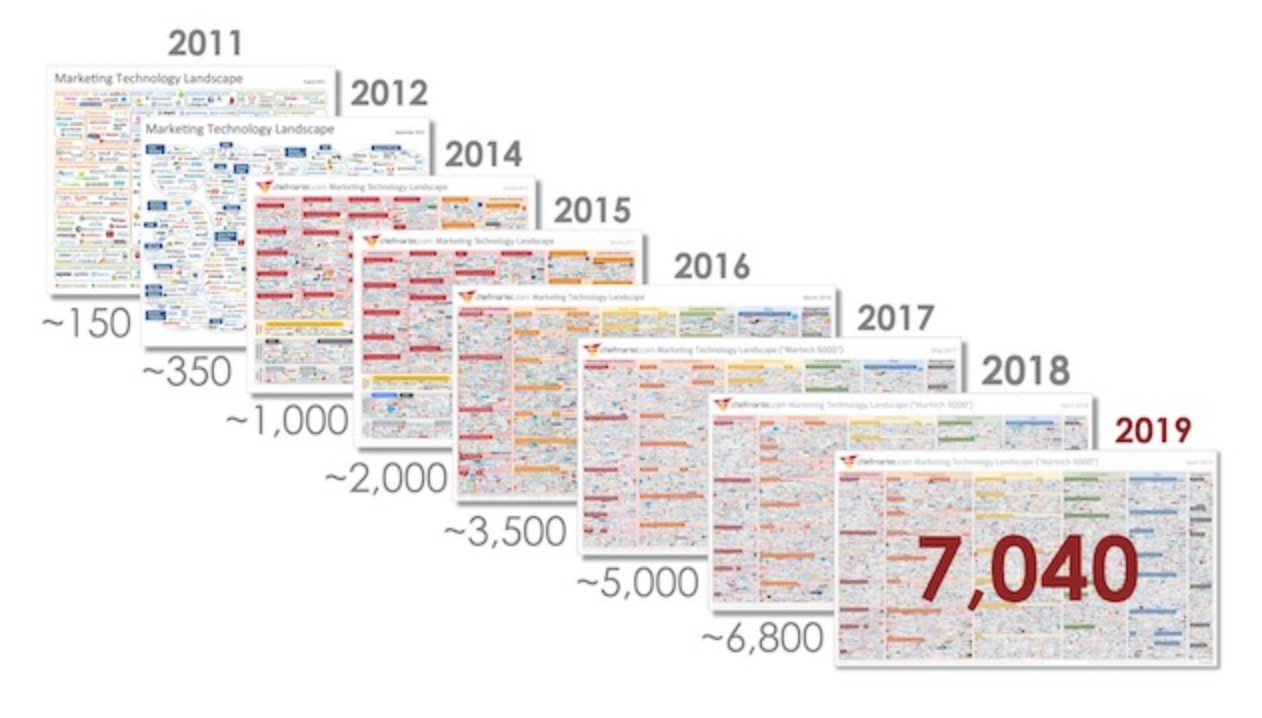
Take: Cambrian Explosion of Marketing Technology throughout the years