Week 15 - Antiquated Trade in a Modern Society
Witnessing the way humans, society, or even industries adapt to stay relevant or modernize has been amazing to read about this past week. And many things we rarely think about are often essential services to support a lot of modern life. The first article highlights an antiquated programming language COBOL, in desperate need of more programmers to help maintain core services in the financial world. Another article puts the spotlight on the USPS, a key provider of packages in America, also in desperate need of funding simply to continue to operate in the long run. And finally, the NY times took an intriguing look at an old industry merely evolving to standards in 2020 -- the sex industry.
Resilient & Rare
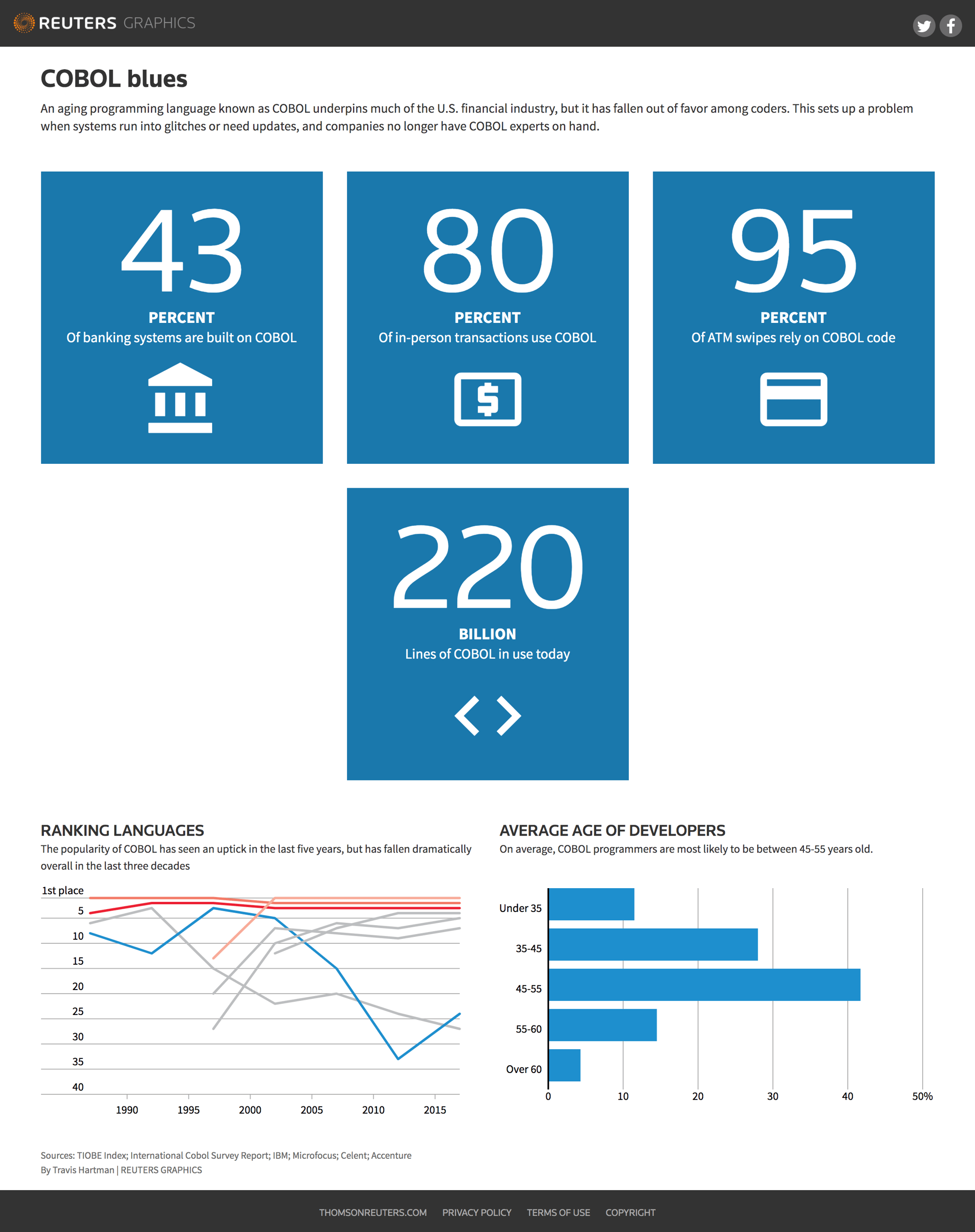
https://www.reuters.com/article/us-usa-banks-cobol/banks-scramble-to-fix-old-systems-as-it-cowboys-ride-into-sunset-idUSKBN17C0D8In the United States, the financial sector, major corporations and parts of the federal government still largely rely on it because it underpins powerful systems that were built in the 70s or 80s and never fully replaced.
And here lies the problem: if something goes wrong, few people know how to fix it.
The stakes are especially high for the financial industry, where an estimated $3 trillion in daily commerce flows through COBOL systems. The language underpins deposit accounts, check-clearing services, card networks, ATMs, mortgage servicing, loan ledgers and other services. The industry’s aggressive push into digital banking makes it even more important to solve the COBOL dilemma. Mobile apps and other new tools are written in modern languages that need to work seamlessly with old underlying systems.
Mail pipeline needs a lifeline

The US post office needs a coronavirus bailout | Vox
USPS is bleeding money because of Covid-19. But Republicans want privatization.
The Postal Service has been organized in several different ways across American history, but its modern paradigm, dating from the 1970s, dictates that the USPS is supposed to be a self-funded, independently operating public sector entity.
And at the core of that entity is a two-sided bargain. On the one hand, the Postal Service gets a monopoly on the provision of daily mail services. On the other hand, the Postal Service undertakes a series of public service obligations that a private company would not provide — most notably, daily mail delivery and flat postage rates regardless of where you live.
Back in 2006, a lame-duck Republican Congress turned up the pressure on privatization by forcing the Postal Service to prefund decades of pension and retiree health costs through investments in low-yield government bonds. That onerous obligation made USPS technically insolvent before the coronavirus hit. But rather than achieving its apparent intended result of spurring privatization, in practice it mostly served to give privatization opponents something to complain about rather than addressing the underlying decline in USPS’s business model. Along the way, however, USPS did find a promising new line of business as a contractor delivering Amazon packages.
Old Trade Goes Digital
https://www.nytimes.com/2020/04/10/style/justin-laboy-instagram-strip-clubs-live.htmlMr. LaBoy said he got the idea at 1 a.m. to try to recreate the club atmosphere on Instagram after he was bored and livestreaming one night to his more than 60,000 followers. “I was like, man, I need a demon to call up,” Mr. LaBoy said. “I said, ‘Where my demons at?’”
Women immediately requested to be guests on his livestream. His followers loved it. “I was like, hold up, we can’t be doing this for free,” Mr. LaBoy said. “Some girls were dancing, twerking, taking it all off.”
So he began pinning the dancer’s Cash App user names to the top of the feed, so that followers could send them money. Mr. LaBoy realized he had stumbled onto something. The “Respectfully Justin Show” was born.
In a separate NYT article on camming, this was surprising to discover happening during the COVID crisis:
Sex online, in general, seems through the roof. OnlyFans, a website where people subscribe to see the kind of pictures and videos that can’t be displayed on Instagram, reported a 75 percent increase in overall new sign-ups — 3.7 million new sign-ups this past month, with 60,000 of them being new creators.