
LLTT Newsletter - March 2026 - It Doesn't Matter
LLTT Newsletter - March 2026

It Doesn’t Matter
(Oh, but it does).
There is a chapter called ‘Teaching the Early Lessons’ by Diana Airey in the Handbook for Teeline Teachers the average student is unlikely to have ever seen.
But those who follow LLTT are hardly average…
The full context is worth savouring:
"It is a problem, in any case, to explain the free and easy system of Teeline. There are no rules as such, no boundaries, no confines. No outline is absolutely wrong. There are better, faster, clearer ways of writing a word, but only if it suits the writer. This message, however, can be counter-productive in the early stages. People are used to rules and regulations, and there is comfort or security in obeying them. We have been taught the difference between right and wrong since we were in high chairs and first threw porridge at the dog. A certain smug satisfaction comes from being right. And yet, in comes the Teeline teacher repeatedly saying 'It doesn't matter'. It does matter to them and reassurance is needed until the class understands why it does not matter."
"It does matter to them." This is the subject of this month’s newsletter.
Why It Matters
Think about what a new student brings to their very first Teeline lesson. They are almost certainly someone who has spent their entire educational life in a system of right and wrong answers. Spelling tests. Grammar rules. Correct and incorrect. The entire infrastructure of formal education is built on the premise there is a right way to do things — and the teacher's job is to transmit that way to the student.
Then Teeline arrives and says: there are no rules. Any outline is acceptable so long as you can read it back.
For some students, perhaps the more confident, free-spirited ones, this is a liberating message. For many others, however, particularly those who have relied on the security of correctness to navigate their education, it is quietly terrifying.
If there's no right answer, how do I know I'm doing it properly? How do I know I'm not building bad habits? How can I feel the satisfaction of getting something right?
The instructor who breezily repeats "it doesn't matter" might, with the very best of intentions, be pulling away the scaffold anxious learners need in order to feel safe enough to progress.
What Beginners Need
The chapter goes on to say:
"Which leads to the statement that my colleagues and I are agreed upon: that beginners need rules, with the freedom of the system being developed later. They need a good foundation on which to lay the basis for speed, and knowing the ‘rules’ is a sure way of achieving it."
Note this is not a contradiction of Teeline's philosophy, rather, it is a sophisticated staging of it.
The freedom in Teeline is real. The flexibility is, indeed, genuine. But it is best introduced gradually, once the student has a secure enough foundation to understand what they are being freed from.
A useful analogy: a student learning to drive is taught to put both hands on the wheel at ten-to-two, to check mirrors in a precise sequence, to use the clutch and gears in a particular order. Once they have passed their test and driven for five years, they naturally adapt their style — one hand on the wheel on the motorway, mirrors checked by feel and experience rather than a rigid drill. The rules were not lies; they were the scaffolding that made the learning process possible, even if the scaffold comes down later.
Teeline is exactly the same. Tell a beginner "there are no rules" and while you may be describing the end state accurately — you are describing it too early, and in doing so might deny them the security they need to build confidence and competence in those crucial early weeks.
The Implication for Your Own Learning
The takeaway for a student, and this is something we want you to consider, is this:
In your early stages, follow the recommended outlines closely. Not because deviation is "wrong" (it is not), but because having a reliable, consistent outline or grouping frees your conscious mind to focus on the flow of writing Teeline. The freedom comes later, organically, as your hand and mind develop their own rhythm.
The Handbook was essentially saying: don't skip the scaffolding phase by trying to get to the endpoint before you are ready for it.
The Deeper Lesson
Why is this worth discussing?
When you understand why a certain approach is used — including the reasoning behind it — you actually become a much better self-teacher.
If you are revising alone and find yourself thinking ‘I'm not sure if my outline for such-and-such is correct,’ the anxiety you feel is perfectly normal and should not be dismissed. That anxiety is your brain doing its job — seeking the security of knowing you are on solid ground. The right response isn’t to dismiss your concern because ‘it doesn't matter’ in Teeline. The better response is to consider you might simply require more guidance until it feels natural, and then give yourself permission to adapt it if a personal variation consistently works better for you. We discussed this in the December 2025 newsletter “Why Teeline Learners Might Need More Guidance.”
The sequence: learn the standard, master it, then adapt — is a tried and true sequence identified through years of classroom experience.
It is, in every sense, the right way round.
Reading Exercise — Spot the Theory
Have a look at this Teeline sentence below. Can you read it? This might be a bit challenging since we’re not providing context here.
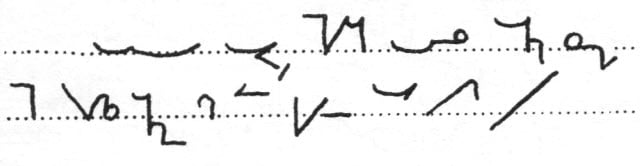
Before you check the answers below, see how many of these theory points you can spot at work in the sentence:
1. A word grouping gets us off to a flying start. The very first two words are joined together as a single outline. Which common grouping is it?
2. "The" gets added to a grouping. Look carefully and you'll see the word "the" has been absorbed into the outline that comes before it, creating a smooth, efficient grouping. Can you spot where?
3. A blend that wasn't used — but could have been. One word in this sentence could have been written using the WN blend, but the writer chose to write it differently. Can you identify the word? Remember, there ARE options in Teeline.
4. Kicking the 'ell out! One word in this sentence uses the principle of dropping the L in the "-LY" ending. Which word is it, and can you see how it's been constructed?
5. Mind the line! There's a word in this sentence where the letter P cuts through the writing line. When you see P dipping below, it's worth paying attention to how the rest of the outline sits. Can you find it?
Answers
"We were walking through the woods when suddenly the heavens opened and it poured with rain."
Theory points revealed:
"We were" — a very common word grouping. Groupings like these save precious time and should flow naturally from your pen.
"Through the" — "the" has been added to "through" to form a word grouping. But wait, how is that, you might ask? Remember: in groupings, TH can be reduced to H.
"When" — this could have been written using the WN blend, which is also used in words like "win" and "want". Both approaches are perfectly acceptable once you’re confident with this blend.
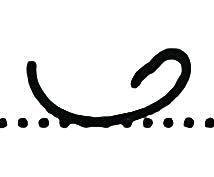
WN blend "Suddenly" — the L has been dropped before "-LY." We like to call this "kicking the 'ell out!"
"Poured" — remember that P ‘cuts’ through the writing line.
As always, if you have suggestions or topics you'd like to see covered in future newsletters, please contact us:
https://www.letsloveteelinetogether.com/contact-us
If you find this newsletter helpful, please help us spread the word and forward to a friend!
You know you can do better. You just can't quite see how.
That's the plateau talking — and nearly every shorthand learner hits it. The answer isn't just more practice. It's smarter practice, and having the tools to fix them.
Discover LLTT+

A Parting Thought
Be sure to visit us at the LLTT Website, YouTube, Facebook, Instagram, Quizlet and Soundcloud.
Looking for Teeline reading practice? LLTT’s Skill Building Through Reading 📗 is available for purchase online.
Five 5️⃣ carefully selected passages: Improve your sight 👁️ recognition of outlines and word groupings.
Dual Format: Each passage includes both printed Teeline and the longhand ✍️ transcription.
Proven Learning Approach: Reading printed 🖨️ shorthand is a method long-favoured by skilled practitioners.
Whether you're a student, journalist, or professional seeking to improve your note-taking, this book will be a valuable addition to your Teeline learning resources.
To order, please visit the book’s landing page.



Add a comment: